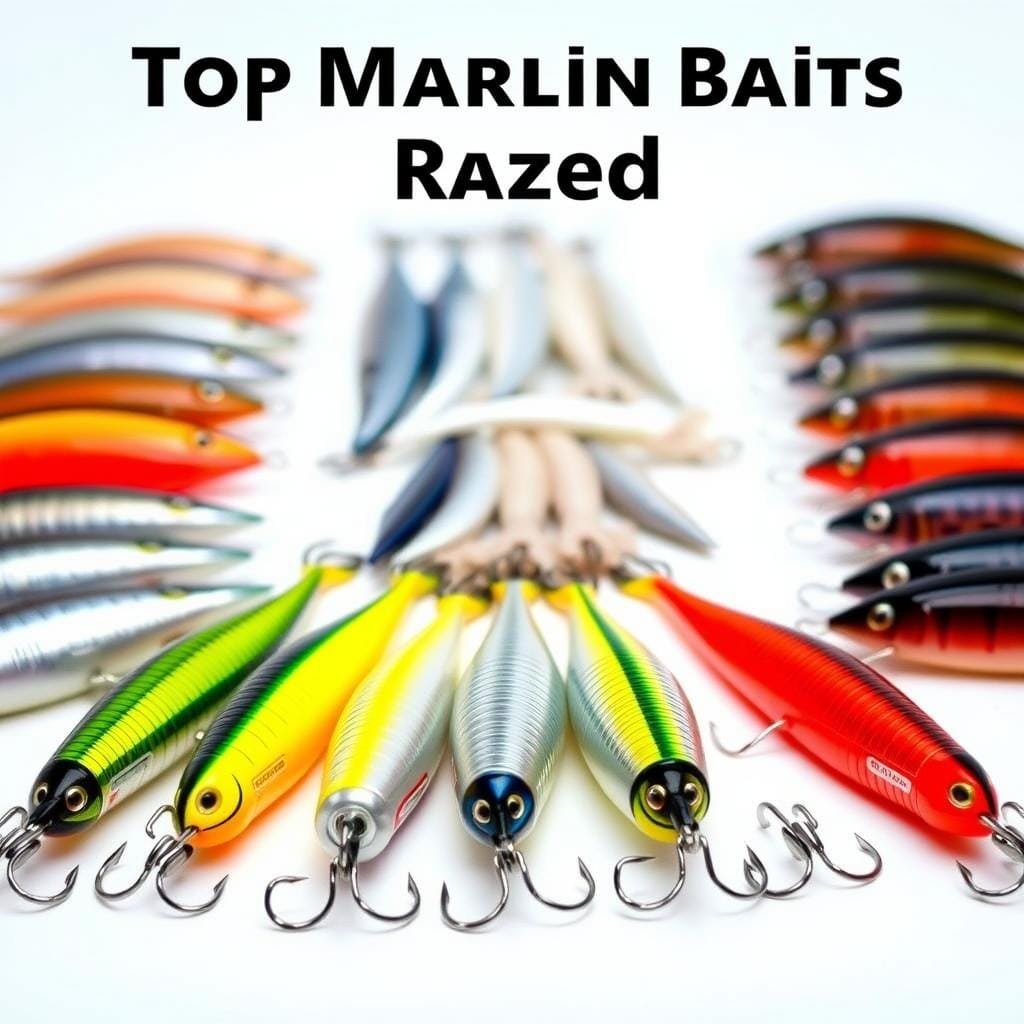
Chasing blue water bills needs more than luck. It starts with choosing the right marlin bait. Also, it requires the discipline to set up a full billfish spread.
Think AIDA: grab Attention, hold Interest, spark Desire, drive Action. This means matching size, shape, color, and position with sea state and speed. Brands also play a big role.
Fathom Offshore lures are made in North Carolina. They are built for tournament-grade marlin gear. Zacatak marlin lures add to proven spreads with patterns that shine in changing weather and light.
Looking for blue marlin lures that get bit early? Start with a short, punchy spread. It should have a confident teaser and a clean, straight runner aft. We’ll show you what to run, where to run it, and how to sync lure action.
By the end, you’ll know which marlin bait wins the rigger wars. You’ll also know which offshore trolling lures deserve a spot onboard.
Up next: what makes a marlin bite—and how behavior, forage, and position turn good ideas into hookups.
What Makes a Marlin Bite: Behavior, Species, and Forage
Marlin change how they hunt with the light, current, and depth of bait. A good spread works with their hunting patterns. They mainly eat tuna and squid, helping you plan your lures.
There are two types of blue marlin, one in the Pacific and one in the Atlantic. Knowing this helps you adjust your lure’s rhythm. Fathom Offshore gear is made for these fish, mimicking prey to get them to bite.
Blue, black, white, and striped marlin at a glance
Blue and black marlin are big and fast in the open sea. White and striped marlin are leaner and better at finding food in slicks. They quickly become interested in your lures if they match their food.
The weather and how the sun hits the sea affect their hunting. In calm light, small lures work best. But in rough seas, bigger lures can attract them. The right lure can catch even the biggest marlin.
Why marlin key in on small tunas and deepwater squid
Small tuna lures mimic the movements that make marlin chase. Deepwater squid lures imitate the slow rise and fall of squid, adding a burst of ink. These lures match the feeding patterns of marlin in different areas.
The Pepal Grande lure’s strong action is perfect for tracking these movements. Even big blues in Hawaii will chase small tuna lures when it’s clear. A darker lure might suggest squid deeper down.
How subspecies and local forage influence your spread
The Pacific and Atlantic blue marlin have different habits. In the Pacific, a louder teaser might work better. In the Atlantic, staggered lures can catch fish on the edges. Fathom Offshore offers packs that match local conditions.
Use a rigger with small tuna lures, a corner with squid lures, and a shotgun for wary fish. Keep changing your spread until you find what works. Marlin behavior changes, so your spread must too.
Hard vs. Soft Lures for Marlin
Both materials help catch fish but in different ways. Soft-head marlin lures and hard-head marlin lures work together. They help read bites and make the fishing better.
Brands like Moldcraft, Black Bart, Pakula, and Fathom show how it works. They help catch fish offshore.
blue marlin lure tactics show that rubber skirted options work well. Moldcraft soft heads are good for slow-trolled or bridled baits. Resin hard heads from lines like Pepal Grande, Mo’ Head, and Double O work well at speed and in rough water.
When soft-head teasers shine for more follow-through
Soft-head marlin lures keep fish interested longer. Many crews say fish grab these teasers and hang on. This gives time for a calm setup and a clean switch.
Use these teasers in the short rigger or bridge positions. They encourage fish to follow the lure even when they lose interest.
Advantages of hard heads for controlled teasing and retrieval
Hard-head marlin lures pop and track well. They stay visible in rough water. When a fish bites, the hard face slips out, letting the mate clear the teaser fast.
This control is key when seconds count. Durable resin faces work well at high speeds and in choppy water.
Mixing materials in your starting spread
Start with a mix: soft-head lures near the boat for longer looks, and hard-head lures on the corners or long riggers for clear tracking. Change placements based on feedback, current, and fish mood.
As bites come, swap in teasers that match the last fish. This makes the next switch faster and cleaner. Mixing materials gives you options when the bite changes.
| Feature | Soft-Head Use Case | Hard-Head Use Case | Why It Helps |
|---|---|---|---|
| Follow Duration | Extended on hookless teasers; fish chew and track | Shorter but decisive interest near the surface | Improves timing for pitch-bait setup |
| Retrieval Control | Can stay in a clamped mouth | Slips free quickly for clean clears | Speeds the switch when a fish lights up |
| Action at Speed | Softer pulse, forgiving in prop wash | Stable pop and track in chop | Reliable presentation across lanes |
| Spread Role | Short positions to encourage lure follow-through | Corners/riggers for structured lanes | Covers different behaviors in one pass |
| Tease-to-Pitch | Longer hold makes the switch less rushed | Fast pull-away prompts the eat on the bait | Raises conversion on tough fish |
Dialing in Lure Size and Weight
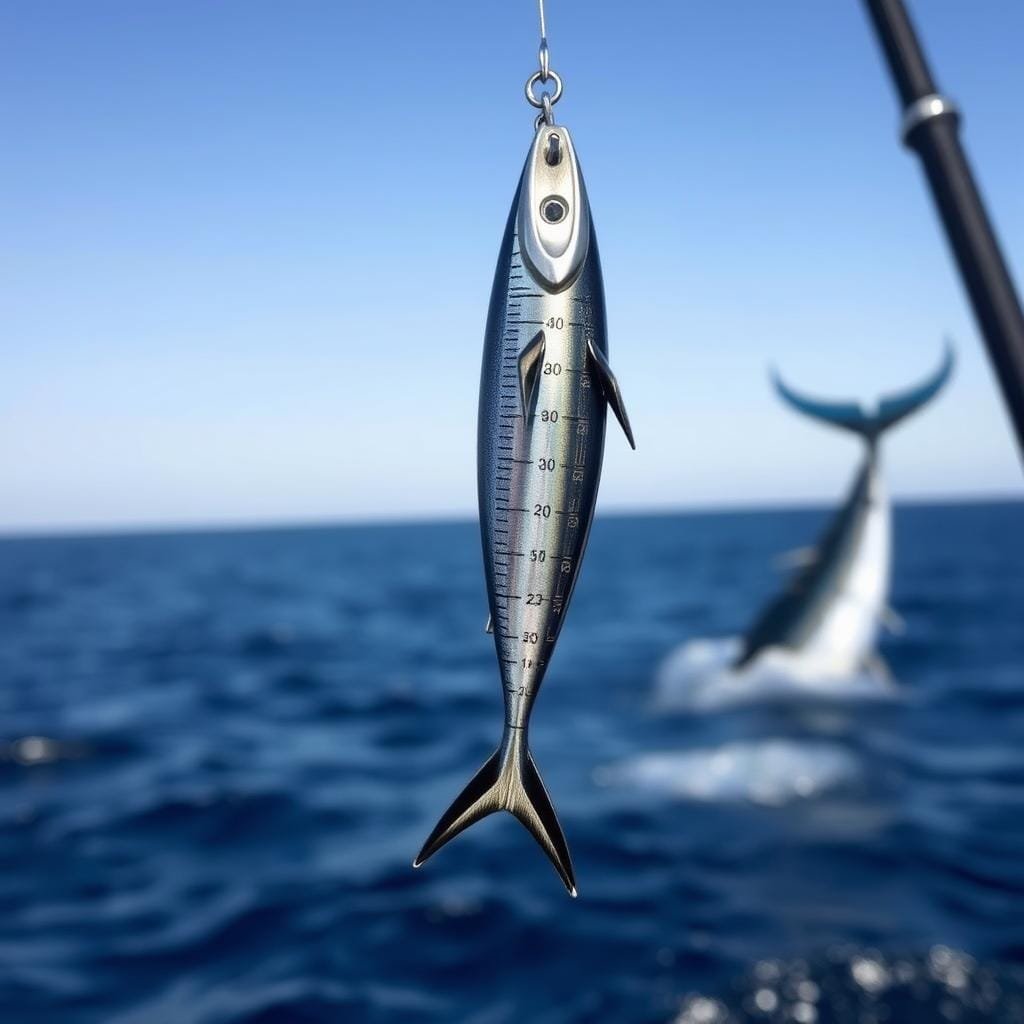
Finding the right marlin lure size is key. It depends on the spread’s job. Use different sizes to make each rod unique.
Weight and design affect how the lure moves. For more on this, check out this guide to offshore trolling lures.
11–15 inch standards for blue marlin teasers
Most teams start with 11–15 inch teasers. They attract fish well without too much splash. These sizes work best with medium and large heads.
They keep the lure stable in mixed seas. This makes it easier to track the lure.
Use these sizes for blue marlin when you want consistent action. They’re good when you don’t know the local bait size.
Going big with 20-inch heavy tackle options
A 20-inch marlin lure can change a slow day. These big teasers move a lot of water. They need careful crew work and gear to handle them.
Run one big lure in the short corner. Use strong leaders and simple connections. This makes it easier to manage the lure and switch baits.
Heavier heads for stability and upright tracking
Heavier heads make the lure swim straighter. They help in windy conditions. The right weight keeps the lure tracking well.
More weight means less action. But in rough seas, it’s worth it. Adjust the lure size based on the sea and speed.
- Target size bands: 11–15 inch teasers for daily duty; one 20-inch marlin lure for pressure waves.
- Weight plan: prioritize lure weight stability in chop; lighten up for glassy lanes.
- Rigging cue: ballast and keel placement matter most for upright tracking at varied speeds.
- Spread mix: anchor with heavy tackle teasers, fill out with mid-size swimmers for coverage.
Best Head Shapes and Actions for Raising Fish
Match marlin head shapes to sea state and bait mindset, and you’ll turn lookers into chewers. Balance each lure action so your spread breathes: a steady smoke here, a hard pop there, and one dead-straight runner in the wake’s edge.
Pusher and straight-cut stability for tight wiggle
A true pusher head with a straight 90-degree cut locks in with a tight wiggle and repeatable smoke-swim. Classics like the Mold Craft Wide Range and Black Bart Candy stay in clean, even when the chop stacks. This stability lets you pace the rest of the spread and judge lure action changes fast.
Run one on a short rigger when you need a metronome. It won’t blow out, and that rhythm often triggers bites from fish tracking deep.
Plungers and Super Plunger-style dive-and-pop
A well-tuned plunger lure has an angled face and elongated body that dives, swims, and pops back with a crisp roar. The Joe Yee Super Plunger set the bar, delivering consistent rises from blue water to green. Shorter, steeper Ruckus or Apollo styles swing wider and can change direction on the surge.
Keep the head angle modest to avoid erratic skips. When right, a Super Plunger doubles as a teaser that pulls fish up and across your riggers.
Scooped Kona heads as swimmers with life-like action
A scooped, angled Kona head swimmer has the most natural cadence in the spread. It rolls, breathes, then slides under, imitating a nervous baitfish. Speed matters—too fast and you lose that life-like glide; too slow and the lure action flattens.
Weighting the insert helps it track upright so the belly flash stays tight through turns.
Tubes and chuggers for surface commotion
A tube lure is cylindrical with a steep face that skims and darts on calm days, just like predators pushing bait near the top. It shines when flyers or small tunas are around. A chugger lure throws a wall of water, making a long smoke trail that calls fish from back in the wash.
Newer weighted chuggers add stability so you can scale down hooks without losing presence.
Bullets and jets for the shotgun/bridge pole slot
Set a bullet head or jet head way back for the insurance bite. These runners track dead straight and lay down a clean bubble trail that boat-shy marlin trust. Double O bullets have become a favorite here because they hold their lane when the wind shifts.
Use the shotgun to cover skittish fish while louder pieces work the corners and riggers.
- pusher head: Tight wiggle, reliable smoke cycles, anchors your spread.
- plunger lure and Super Plunger: Dive-pop sequence that lifts fish in mixed seas.
- Kona head swimmer: Life-like roll and sweep when tuned to speed.
- tube lure and chugger lure: Surface commotion that mimics bait panic.
- bullet head and jet head: Straight tracking for far-back confidence bites.
Color Strategy That Converts Strikes
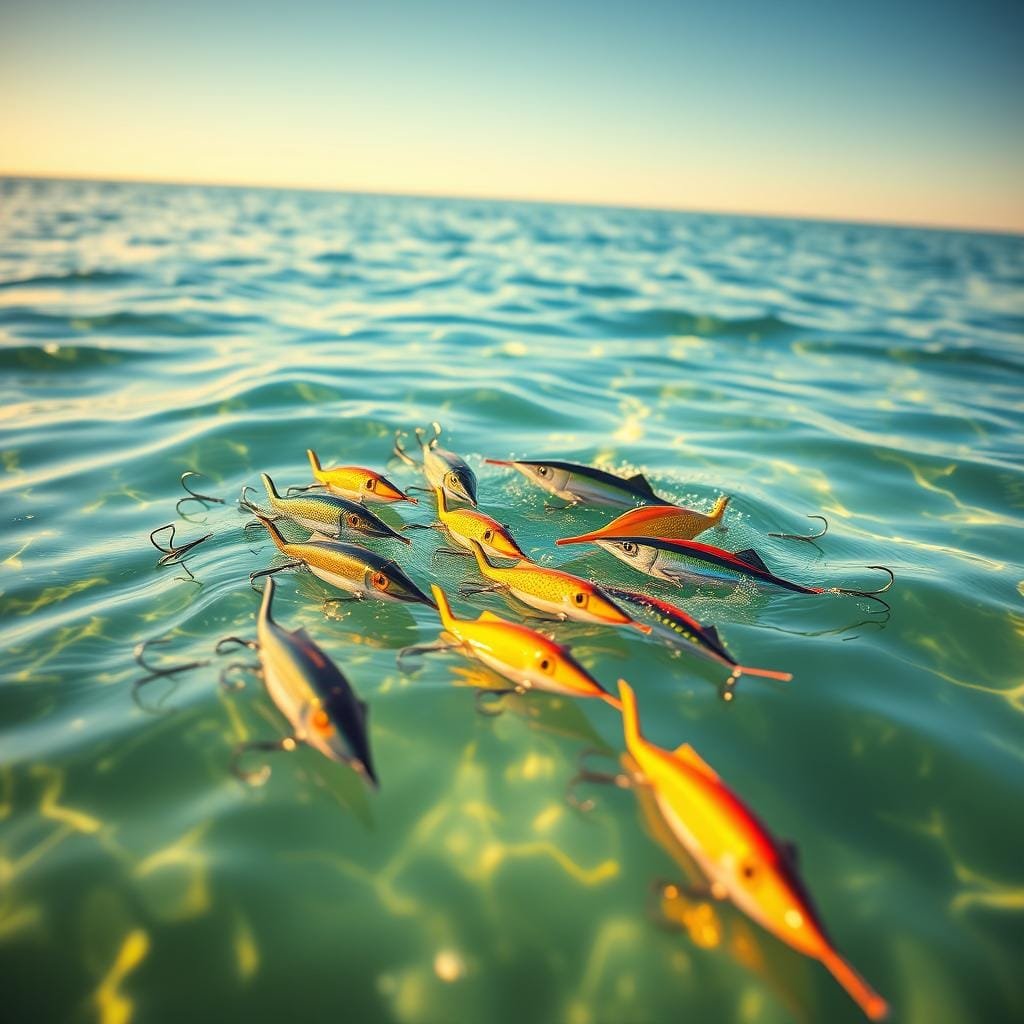
Color is key to getting fish to bite. The best lure colors mix contrast, flash, and what fish eat. This helps fish follow the lure, even in tough conditions.
Purple/black/silver as a confidence combo
Use purple black silver every day. It looks great near the boat and holds up in rough water. It works well in all kinds of light and water.
Many teams keep this combo ready. It’s reliable and works well in different places. It’s a good choice when you’re not sure what to try.
One standout bright lure to steal attention
Put one bright lure in your spread to grab fish’s attention. Colors like chartreuse or hot pink work well. They make the first move and set the day’s pace.
Lures that splash and smoke are even better. Place this lure where it’s easy to see. For tips on setting up your spread, check out this guide on trolling blue-water lures.
Match-the-hatch with dolphin, squid, and mackerel patterns
To catch marlin, match what they’re eating. Use a dolphin pattern when mahi are around, a squid pattern at dawn, and a mackerel pattern when bait schools are seen. This covers all the bases.
Choose colors like Liquid Dolphin, Liquid Squid, and Tinker Mackerel. They look like what fish eat. Try different sizes to match real bait. Then, see what works best in the moment.
Building a Tournament-Grade Spread
A winning marlin spread setup starts with balance. Think noise up close, finesse out back. Keep tweaking until every lure feels just right. Use brands like Zacatak, Fathom, and Black Bart to adapt to changing light and chop.
Short corners for your biggest, noisiest lures
Put your heaviest lures in the white water. They should pop, smoke, and track hard. A plunger or slant-face works best here.
The Pepal Grande large head is great for aggressive bites. A Mo’ Head Medium is versatile for changing seas. Keep leader lengths and height the same for clean cycles at your speed.
Refine your spread by adjusting rigger height and distance. This makes the heads dive, pop, and reset in rhythm. Use these spots to lift fish into the pattern and set up the next strike.
Long riggers back in clean water for smaller profiles
Long riggers are for finesse. Use slightly smaller lures in cleaner water for a calmer track. A balanced bullet or jet works well here, even in chop.
When seas calm, switch to a more active head. This keeps the action without disrupting the rhythm.
For more depth, check out this guide on rigging trolling lures. It explains how head shape, skirts, and leader length affect behavior by position.
Height, distance, and speed tuning for peak action
Start at 5–7 knots and adjust in 0.2-knot bumps. This ensures every lure runs true. Adjust halyards for smooth bubble trails, then move lures a few feet at a time to match their rhythm.
This tuning is ongoing; wind and current will change things all day.
- Height: Lift for more smoke and tracking, drop for grip in chop.
- Distance: Stagger to avoid crossover and let each bait work its lane.
- Speed: Small tweaks fix blowouts and revive sleepy heads.
End with a far-back shotgun lure to catch boat-shy fish. A Double O bullet or jet is perfect here. It completes a smart, tournament-ready spread that adapts to changing conditions.
Sea Conditions and Boat Speed Tuning
Smart crews make marlin lure tuning a living thing. They watch the wake and adjust the speed. They keep the lure spread balanced for calm or rough seas.
Calm water: higher speeds and experimentation
Flat seas mean you can go faster and try new things. Try going a bit faster and spread the lures wider. Play with how far apart the lures are to see what works best.
Use sea state adjustments to add UV squid chains when it’s sunny. Put a small lure or flap behind the last squid to get bites in thin water. Find the right speed for a steady splash-pop.
Rough water: proven swimmers that stay down
In choppy seas, choose lures that dive deep and stay down. Slow down a bit because the waves add action. Spread the lures out more to clear foam.
Choose lures that stay face-up in the water. Make the lures farther apart to avoid tangles. Use bigger lures in broken water to stand out.
Adjusting drop-back and stagger to manage white water
As seas get rough, move the spread back so each lure breathes at the wake’s edge. Adjust the drop-back so lures dive and smoke without skipping. This is key for managing foam.
Adjust the timing between the corners and the rigger. Make sure only one lure pops at a time. If a lure blows out, add a bit more distance or slow down.
| Sea State | Target Speed | Lure Choices | Placement & Stagger | Key Tuning Notes |
|---|---|---|---|---|
| Calm | 7.5–9.5 knots | Pushers, chuggers, bullets, UV squid chains | Tighter lanes, creative lure stagger, test wider spreads | Experiment; track best cadence; use bright teasers for visibility |
| Moderate Chop | 7–8.5 knots | Heavier heads (Fathom), plungers, scooped Kona heads | Move baits back into cleaner lanes; lengthen corners | Trim to keep lures face-up; add weight or angle to stop skip |
| Rough | 6.5–7.8 knots | Proven swimmers with ballast, straight runners, larger profiles | Extended stagger; maximize distance for foam clearance | White water management first; waves add action—don’t overspeed |
best bait for marlin
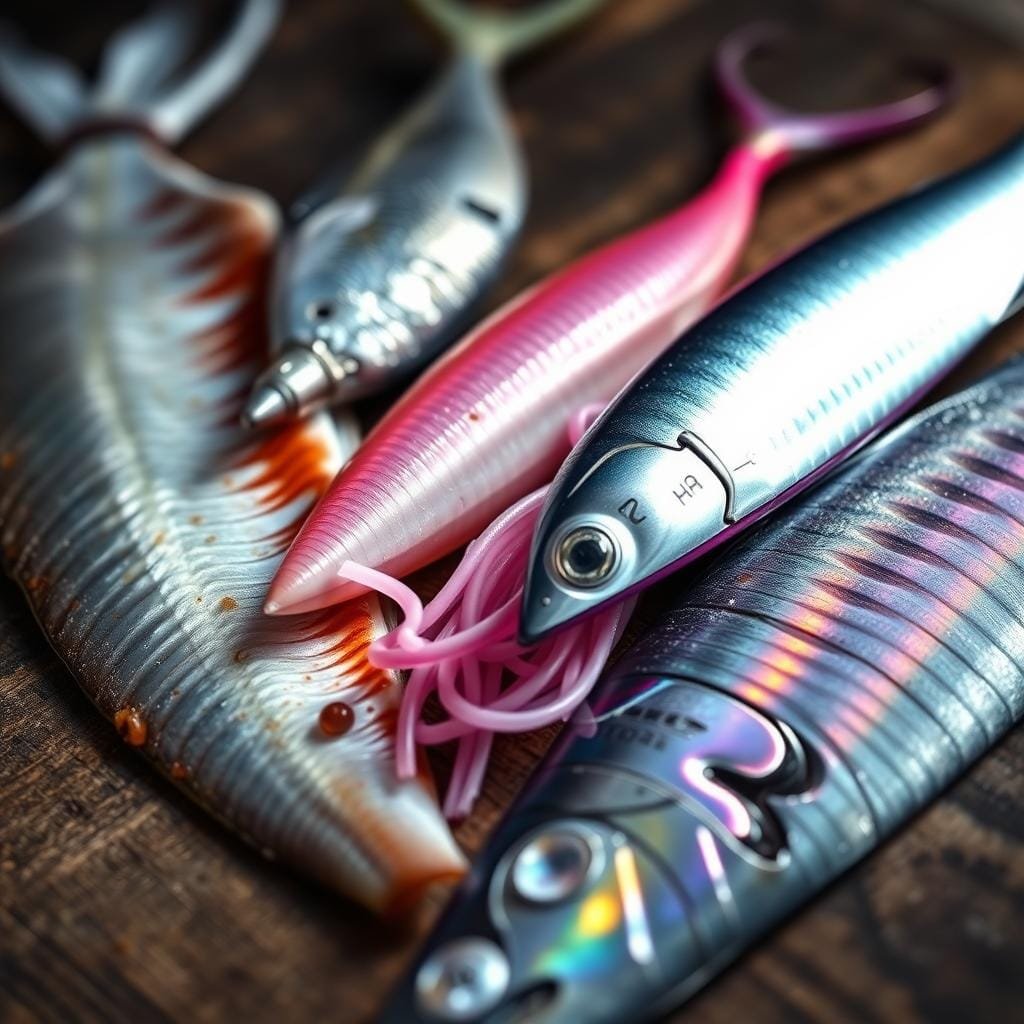
Marlin like things that move and make clean trails. They also like sounds and smells. The best bait is easy to see in the water.
Why marlin respond to squid chains and small tuna imitators
Marlin love to eat squid and small tuna. Squid chain teasers and small tuna lures are perfect. They glow in the water and attract fish from far away.
Use tuna-mimic skirts to look like easy food. A Pepal Grande teaser makes a big splash. Keep a Double O bullet ready for lazy bites.
Live bait vs. artificial: when to switch and why
On calm days, live bait is better. But on windy days, artificial lures work better. They cover more water.
Change your teaser if fish don’t bite. Use a soft-head teaser for longer follows. Keep both ready to switch fast.
Tease-to-pitch tactics to convert window shoppers
Tease and switch gets their attention. Big splash, then lifelike action, then a perfect bait. Hard-head teasers make a clean pull.
Drop a bait into the wake when a fish attacks. Keep the boat moving and feed on the turn. Set the hook when it feels tight.
| Scenario | Primary Trigger | Recommended Piece | Why It Works | Quick Switch Cue |
|---|---|---|---|---|
| Calm, clear water | Visibility at distance | UV squid chain teaser with add-on flap | UV pop plus tail action mimics deep squid | Fish fade late → swap to soft-head teaser |
| Chop and mixed swell | Stability and smoke | Pepal Grande as teaser, Double O bullet shotgun | Holds face, throws bubbles, easy straight bite | Short strikes → pitch bait marlin on next pass |
| Skittish fish behind the boat | Lifelike follow-through | Soft-head teaser, small tuna lure in natural tones | Longer follows and natural wiggle seal the deal | Missed snap → tease and switch immediately |
| Fast-moving feeders | Speed and profile | Bullet-style small tuna lure on long rigger | Tracks straight at higher speed, matches prey | No commitment → drop back a live bait vs artificial marlin option |
Top-Rated Marlin Lures You Can Rig Today
These proven picks from Fathom Offshore make it easy to drop in and get to work. Each head shape fills a specific lane in the spread. The color ranges cover common forage. If you want ready to fish marlin lures without the guesswork, start here.
Pepal Grande Large 14″ for short rigger chug and as a teaser
The Pepal Grande 14 is a tournament regular for a reason. On the short rigger, it throws a tight chug. It stays hooked up in wash and doubles as a teaser when you want a clean pitch-bait shot. It’s offered rigged on 500 lb mono with a MUSTAD 7691-S for a plug-and-play setup from Fathom Offshore.
Mo’ Head Medium 11″ for bubble trails and versatile size class
The Mo’ Head Medium 11 has a deep concave face that grabs air. It paints a long bubble trail. It’s the largest of the brand’s medium class, so it bridges school mahi to blue marlin without feeling oversized. Run it on the long corner or short rigger when you need lift, thump, and a visible track in mixed seas.
Double O bullet lure for the shotgun insurance bite
A Double O bullet lure in Large or XL shines way back on the shotgun. The straight run and low profile convert boat-shy fish that fade off loud heads. Keep one parked high and clean to pick up the follower that refuses the close baits.
Mistress, Calico Jack Slant, and Game Changer for mid-spread variety
Rotate a Mistress lure, a Calico Jack Slant, and a Game Changer lure through the long rigger lanes for action variety. These medium sizes track true. They cover key forage looks like Liquid Squid and Yellowfin. They keep your pattern honest when the bite gets selective.
- Spread role: Pepal Grande 14 for short rigger/teaser; Mo’ Head Medium 11 for bubble trail lanes; Double O bullet lure for shotgun; mid-spread mix with Mistress lure, Calico Jack Slant, and Game Changer lure.
- Price cues: Pepal Grande from $69.99; Mo’ Head Medium from $46.99; Double O Large from $69.99.
- Colors: Liquid Dolphin, Liquid Squid, Liquid Spanish, Tinker Mackerel, Purple Paua, Chartreuse, Yellowfin.
- Rigging: Choose ready to fish marlin lures from Fathom Offshore to match corner, rigger, and shotgun positions.
Set the near lanes with chuggers and plungers. Keep your far slot honest with a clean bullet. With this mix, you cover noise, bubble, and speed—exactly what a picky blue needs to commit.
Squid Chains and Teasers That Pull Bites From Afar
When you need to reach far, make a marlin teaser setup. It should show life from a distance. Use a balanced teaser chain for attraction without losing control in choppy water.
Look for clean bubble trails and steady tracking. Make sure it’s easy to swap out for quick changes.
UV-loaded squid chains for long-distance visibility
A UV squid chain glows like real prey in sunlight. It helps fish see it from far away. Fathom’s squid chains use UV to mimic squid flash, making them clear in white water.
Run one on the long rigger for more attraction. Keep the chain moving with the boat for best effect.
Snap-on lure or flap behind the last squid for extra action
Attach a lure or bait strip to the last squid with a snap swivel. A flap teaser adds extra action. It pulses and stays down-sea, keeping fish interested.
For a sneak attack, use a hookless teaser. It draws the fish in, then you can slide in a bait. This keeps the fish hooked without tangling.
Soft-head teaser advantage for extended follows
A soft head teaser gives you more time with fish. Swap to it when a hard head doesn’t work. Many have had long follows and bites on soft teasers.
Choose the right style for the conditions. Mix materials and positions for the best response to wind and current. Use a UV squid chain and a soft head teaser together for the best spread.
- Core elements: UV squid chain up high, adaptable teaser chain lengths, and a fast-swap snap for the last squid.
- Add-ons: flap teaser for pulse, hookless teaser for tease-to-pitch control.
- Placement: long rigger for reach, short corner only when seas allow clean breath and smoke.
Rigging Essentials and Hooksets
Smart marlin rigging means using parts that last. Make sure your lures stay straight, connections are clean, and hooks are sharp. Adjust your setup to fit the sea conditions.
Premium mono leaders, chafe gear, and flared heavy-wall crimps
Use a heavy mono leader Momoi X-Hard for tough fishing. Add chafe protection at all points. Use flared heavy-wall crimps for strong connections.
Make sure your leader is stiff. This keeps your lures straight and stable. It helps them move smoothly through the water.
Stainless MUSTAD 7691-S double-spun single hooksets
Choose a stainless MUSTAD 7691S hookset for strong catches. Double-spun single hooks are great for this. They have a small profile for less drag.
Set the hook point right with the lure’s keel. This keeps it running straight. For blue marlin, set the hook gape just past the skirt tail.
Burnt leader ends and proper thimbles for tournament standards
To meet tournament rules, use neat, burnt leader ends. Fit stainless thimbles in all high-wear spots. This prevents slipping and heat damage.
Match all component sizes for best results. This keeps your lure action smooth and prevents failures.
| Component | Why It Matters | Best Practices | Rigging Tip |
|---|---|---|---|
| mono leader Momoi X-Hard (400–500 lb) | High abrasion resistance and controlled stretch under load | Measure twice; trim clean; test knots and crimp sets | Stiffer leader helps straight heads track upright in mixed seas |
| chafe protection with stainless thimbles | Prevents wear at hook eyes and ringed connections | Size thimbles to the loop; no daylight gaps | Use heat-shrink or tubing to quiet rattle at the keel |
| heavy-wall crimps (flared) | Even compression for strong, repeatable connections | Match crimp ID to leader OD; finish with smooth flare | Back up with burnt leader ends for slip security |
| MUSTAD 7691S hookset | Penetration and strength for big fish at high drag | Align point with lure keel; hone to sticky sharp | Use double-spun single hooks to cut drag and boost hookup |
| double-spun single hooks | Cleaner tracking and safer handling than twins | Set gape just aft of the skirt; secure with heat-shrink | Check balance so the lure breathes without rolling |
| Tuning for conditions | Maximizes action across the spread | Adjust height, distance, and speed as seas change | Heavier heads stabilize when wind chop builds |
Ready-to-Fish Packs and Colorways That Cover You Coast to Coast
Don’t waste time setting up. Use a ready-to-fish marlin pack that’s tournament-ready. Fathom rigs its marlin lure kit with top-notch Momoi X-Hard leaders and more. You can start fishing fast, from the Gulf to the canyons.
Choosing the right colors is key for marlin fishing. Fathom offers a wide range, like Liquid Dolphin and Liquid Squid. Use different colors for different spots to keep your lure in the action.
Focus on seven key things when building your pack: size, shape, color, and more. This way, you can adjust to changing conditions without a big change. Zacatak and Fathom make it easy to catch marlin with their kits.
FAQ
What are the top marlin baits and lures to get the best bites right now?
Start with the Fathom Offshore Pepal Grande Large 14″ on the short rigger. Add the Mo’ Head Medium 11″ mid-spread. Use a Double O Large/XL bullet in the shotgun.
Use UV-loaded squid chains as teasers. Match colors to local forage like dolphin, squid, and mackerel. Keep one purple/black/silver in the water at all times.
How do blue, black, white, and striped marlin differ when setting a spread?
All four species hit fast. But they vary in size and aggression. Blues and blacks favor bigger teasers and can handle heavy tackle.
Whites and stripies often respond to smaller, precise swimmers. Rotate head shapes and sizes by time of day and weather to keep all species engaged.
Why do marlin key in on small tunas and deepwater squid?
Small tunas and squid are staple forage in blue water. Lures and teasers that pulse, chug, or glow like squid, or flash like skipjack and frigate tuna, trigger instinctive strikes.
UV-loaded squid chains help marlin see the “meal” from farther away in sunlit conditions.
How do subspecies and local forage influence your spread?
Pacific and Atlantic blue marlin feed similarily. But local bait—tinker mackerel, blackfin, yellowfin, and squid—guides color and size. Pack Liquid Dolphin, Liquid Squid, Yellowfin, Blackfin, and Tinker Mackerel patterns so you can pivot fast when the bite shifts.
When do soft-head teasers shine for more follow-through?
Use soft heads when fish swipe but won’t keep teasing on hard resin. Crews report extended follows and more chew time on soft teasers, buying seconds to execute a clean pitch. They’re clutch on picky fish and calm, clear days.
What are the advantages of hard heads for controlled teasing and retrieval?
Hard resin heads track clean, hold shape at speed, and pop free of jaws fast—ideal for tease-to-pitch. They give predictable action in rougher seas and are easier to yank from a hot fish without foul-ups.
Should I mix hard and soft materials in my starting spread?
Yes. Start with a 50/50 blend and adjust based on mate feedback. If fish fade off hard heads, swap a teaser to soft. If you need sharper pops and quick pull-aways, lean back into hard resin.
Are 11–15 inch lures the standard size for blue marlin teasers?
That range is the sweet spot for most blue marlin teasers. It’s big enough to command attention in white water yet manageable for fast retrieval. Pair with heavier heads to keep them in the wash.
When should I go big with 20-inch heavy tackle options?
Step up in areas with giant fish or when you need a dominant target in rough seas. Very large, multi-pound teasers raise big marlin, but rig streamlined retrieval aids so you can rip them away for a pitch.
Why do heavier heads help stability and upright tracking?
Weight keeps a lure planted, swimming deeper and straighter through chop. Proper ballast makes straight faces track top-up and reduces spin, so action stays consistent as speed and sea state change.
What makes pushers and straight-cut heads a stability must-have?
Straight 90° pushers deliver a tight wiggle and reliable smoke-swim rhythm. They hold in most conditions, making them anchor pieces when tuning the entire spread to run right at the same speed.
How do plungers and Super Plunger-style heads raise fish?
Their angled faces dive, swim, and pop with noise, creating a repeatable cycle that draws bites. Classics like the Super Plunger style stay consistent across sea states and speeds when tuned.
Why pick scooped Kona heads for swimmers with life-like action?
Konas produce a natural, sinuous swim that screams “alive.” They’re speed sensitive, but when balanced and weighted, they’re deadly on fish tracking the spread in clean water.
When do tubes and chuggers deliver best results?
Tubes excel in calm to moderate seas when surface bait is present, skittering like a predator on top. Chuggers push water and create big turbulence, helping smaller hooks look bigger and louder.
Why are bullets and jets ideal for the shotgun or bridge pole?
Bullets and jets run straight with a clean bubble trail, perfect way back for boat-shy or lazy marlin. Fathom’s Double O Large/XL is a proven “insurance policy” in that far-back slot.
Is purple/black/silver really a must-run color?
Yes. It’s a universal confidence combo that catches worldwide. Keep one purple/black/silver swimming all day, specially in mixed light or when unsure what bait the fish are on.
Should I run one bright standout lure to steal attention?
Absolutely. One high-vis standout can dominate on certain days, drawing the majority of looks and bites. Don’t be afraid to let it be the star when it’s getting crushed.
How do I match the hatch with dolphin, squid, and mackerel patterns?
Mirror the forage you mark or see in the spread. Use Liquid Dolphin, Liquid Squid, Liquid Spanish, Tinker Mackerel, Yellowfin, Blackfin, Chartreuse, and paua finishes to mimic local bait color and sheen.
What belongs on the short corners for a tournament-grade spread?
Run your biggest, noisiest lures in white water—think Pepal Grande Large 14″ for a consistent chug as a hook bait or teaser. Heavier heads here stick and cycle tight without blowing out.
How do I rig long riggers back in clean water?
Place slightly smaller, balanced swimmers on long riggers. Give them clean lanes and adjust halyard height so they smoke and surface on tempo without tangling neighboring lanes.
How do height, distance, and speed unlock peak action?
Start with lure-specific sweet spots, then fine-tune halyard height and drop-back distance until each lure runs its best cycle. Nudge speed until all heads perform optimally—harmony beats chaos.
What changes in calm water for speed and experimentation?
In calm seas, bump speed, test new heads, and stagger distances. Noisier lures shine, and you can shorten drop-backs to stack more targets without washing them out.
How should I adjust in rough water so lures stay in?
Choose proven swimmers and heavier heads, lengthen distances to escape white water, and ease back the throttle slightly. Let the sea add action while your lures stay planted.
How do I adjust drop-back and stagger to manage white water?
Extend drop-backs to find clean lanes when the wake grows. Stagger distances so smoke trails don’t overlap. Raise or lower halyards to keep heads breathing on their cycle.
Why do marlin respond so well to squid chains and tuna imitators?
They track UV glow and turbulence from far away, then commit when the profile matches squid or small tunas. Fathom’s UV-loaded squid chains and tuna-mimic colorways convert lookers into biters.
When should I switch between live bait and artificials?
If fish follow but won’t eat plastics, switch to a soft-head teaser and be ready with a pitch bait. In dirty water or heavy chop, artificials with weight and noise often outproduce.
What are effective tease-to-pitch tactics for window shoppers?
Tease with a hard head for control, or swap to soft for longer follows. Rip the teaser clean, drop a well-placed pitch bait into the hole, and maintain boat speed so the bait swims true.
Why is the Pepal Grande Large 14″ a short rigger favorite?
It delivers a strong, consistent chug that raises blue marlin and doubles as a top teaser for pitch baiting. Liquid Dolphin is the top-selling color, with multiple tournament wins behind it.
What makes the Mo’ Head Medium 11″ so versatile?
Its big concave face drags air and throws a long bubble trail, pulling bites from bull dolphin to blue marlin. It’s the largest in Fathom’s medium class and bridges gaps in the middle of the spread.
How do Double O Large/XL bullets act as a shotgun insurance bite?
They run dead straight and clean way back, tempting boat-shy or less-aggressive marlin. Many crews keep one parked on the bridge pole to mop up late-day bites.
What fills out mid-spread variety beyond the headliners?
Fathom’s Mistress Medium 9″, Calico Jack Slant Medium 9″, and Game Changer Medium 10″ add angles and cadences that keep fish interested when conditions or light change.
How do UV-loaded squid chains pull bites from afar?
UV additives glow in sunlight, mimicking real squid and boosting long-distance visibility. That glow helps fish lock in and track your teasers through glare and chop.
Why add a snap-on lure or flap behind the last squid?
The concealed snap swivel lets you clip a lure, bait, or flap for extra kick and scent. It’s a fast way to turn looks into eats without re-rigging the whole chain.
Do soft-head teasers really extend follows on picky fish?
Yes. Crews report marlin holding and chewing soft heads longer. If fish stop on hard heads, a soft teaser often keeps them lit for the perfect pitch window.
What rigging essentials should every marlin angler trust?
Premium mono like Momoi X-Hard leaders, proper chafe gear, flared heavy-wall crimps, and clean thimbles. Add balanced weighting and tidy leader management for safety and performance.
Why are stainless MUSTAD 7691-S double-spun singles a go-to?
They’re fully stainless for strength and corrosion resistance, and the double-spun single layout delivers reliable penetration on big marlin with fewer fouls than doubles.
What do burnt leader ends and proper thimbles do for tournament standards?
Burnt ends prevent unraveling and snagging, while thimbles protect loops from chafe and load. Together with clean crimps, they create durable, tournament-grade connections.
How do ready-to-fish packs and broad colorways help coast to coast?
Pre-rigged packs mirror proven tournament setups, saving time and guesswork. With colorways like Liquid Dolphin, Liquid Squid, Liquid Spanish, Blackfin, Yellowfin, Tinker Mackerel, Chartreuse, Mother of Pearl, Natural Paua, and Purple Paua, you can match hatch from the Carolinas to Hawaii. For rigging or prep help, call 910-399-6882.