Chasing muskies needs clear choices and calm hands. This guide shows the best bait for muskie. It explains why each bait is good and how to use it.
You’ll learn about muskie lures and tackle setups. You’ll also get muskie fishing tips from experts like Larry Dahlberg and Jim Saric.
Expect to find trophy muskie baits for every situation. You’ll see deep vertical jigs and softbait rigging. There are also bucktail tweaks and spinnerbait tips.
Learn when to use smaller baits and how to choose based on the season. Discover boatside tactics that help you catch muskies.
Whether you’re starting or improving your muskie gear, these picks are for you. They focus on the right retrieve, gear, and timing. This will help you catch more muskies.
Muskie mindset: timing, windows, and why they’re called the fish of 10,000 casts
Muskies strike in bursts, not all day. That’s why they’re called the fish of 10,000 casts. A good muskie timing strategy uses data and instinct. It keeps you ready when they bite.
Feeding windows driven by weather and moon phase
Feeding times for muskies often happen with weather changes. This includes pressure drops and wind shifts. Also, moon phases like moonrise and moonset are key.
On cold fall days, these windows get shorter but more precise. Look for rock reefs, points, and open-water edges. This fall muskie tips on Pipestone show how timing and structure are important when water cools to mid-40s.
Why big muskies feed less often and are more selective
Large muskies eat high-protein foods like suckers and trout. They then rest because they have a slow metabolism. This is why they’re called the fish of 10,000 casts.
Match your muskie timing strategy to their mood. Use big lures and slow movements when they’re calm. When they get active, fast and moving lures can work well.
Fishing often versus obsessing over perfect conditions
Yes, timing with moon phases and weather can help. But fishing more often is key. Many trophies are caught when anglers use the right lures at the right time.
Fish more, keep track of conditions, and treat each hour as a countdown. Mix discipline with repetition. This way, you’ll catch muskies when they’re most active.
Proven legend picks from top muskie anglers
These trusted baits come from anglers who shaped modern muskie fishing. They cover shallow cabbage, deep breaks, and everything between. They have retrieves that trigger fish that look but won’t bite. Here’s how to put them to work with confidence.
Larry Dahlberg’s Mr. Whiggley and neutral-buoyancy rigging
Larry Dahlberg Mr. Whiggley moves like real life. Use fine lead shot or tungsten to make it sink level. This lets you move from a stop to fast without losing glide.
To reach deeper fish, use a Carolina rig or add lead wire to braid. The redhorse color catches big fish. Fish it across the water column and use pauses.
Jon Bondy’s deep game with the Original Bondy Bait
Jon Bondy Original Bondy Bait works deep. It falls like shad, cisco, suckers, and whitefish. It tracks clean and stays snag-free in current and rock.
Drop, lift, and let it fall on a tight line. Many tournament wins come from this vertical game. It’s great when fish slide off structure and settle on breaks.
Dick Pearson’s Grinder spinnerbait as a “crescent wrench”
The Dick Pearson Grinder spinnerbait is versatile. Work it over weeds, rocks, and wood at any speed. Use it in shallow cabbage, deep rock, or troll it.
Black skirts with silver or flame willowleaf blades are top choices. It’s simple, tough, and consistent in tough cover.
Jim Saric’s Cowgirl confidence bait for coverage and conversions
The Jim Saric Cowgirl covers water and moves fish. Twin #10 blades throw a powerful thump. Flashabou breathes on the pause. It’s famous for boatside conversions.
Run it from spring through late fall. It may not be best for deep, cold edges. But it keeps you in the game for that one strike on a tough day.
Steve Heiting’s double-10 nuances and pulse retrieve
Steve Heiting double-10 patterns have big numbers. He likes all-black with black-nickel blades and black holoform tails. Jointed bodies cast well and hook clean.
Use a pulse retrieve: five or six steady cranks, then a burst. This pop often trips following fish before the turn. It sets up a strong boatside finish.
Doug Johnson’s evolving favorites: bucktails, jerkbaits, and topwaters
Doug Johnson muskie baits span eras. From Mepps Giant Killer to Suick and Bobbie jerkbaits, and topwaters for windy nights. A 10-inch Believer tears through weeds; a 10-inch Jake trolls true on big contours.
In recent seasons, double-10 flashabou bucktails lead the way. A green-on-green combo has been deadly on specific Lake of the Woods spots. Confidence colors matter.
best bait for muskie: picks by category and when to throw them
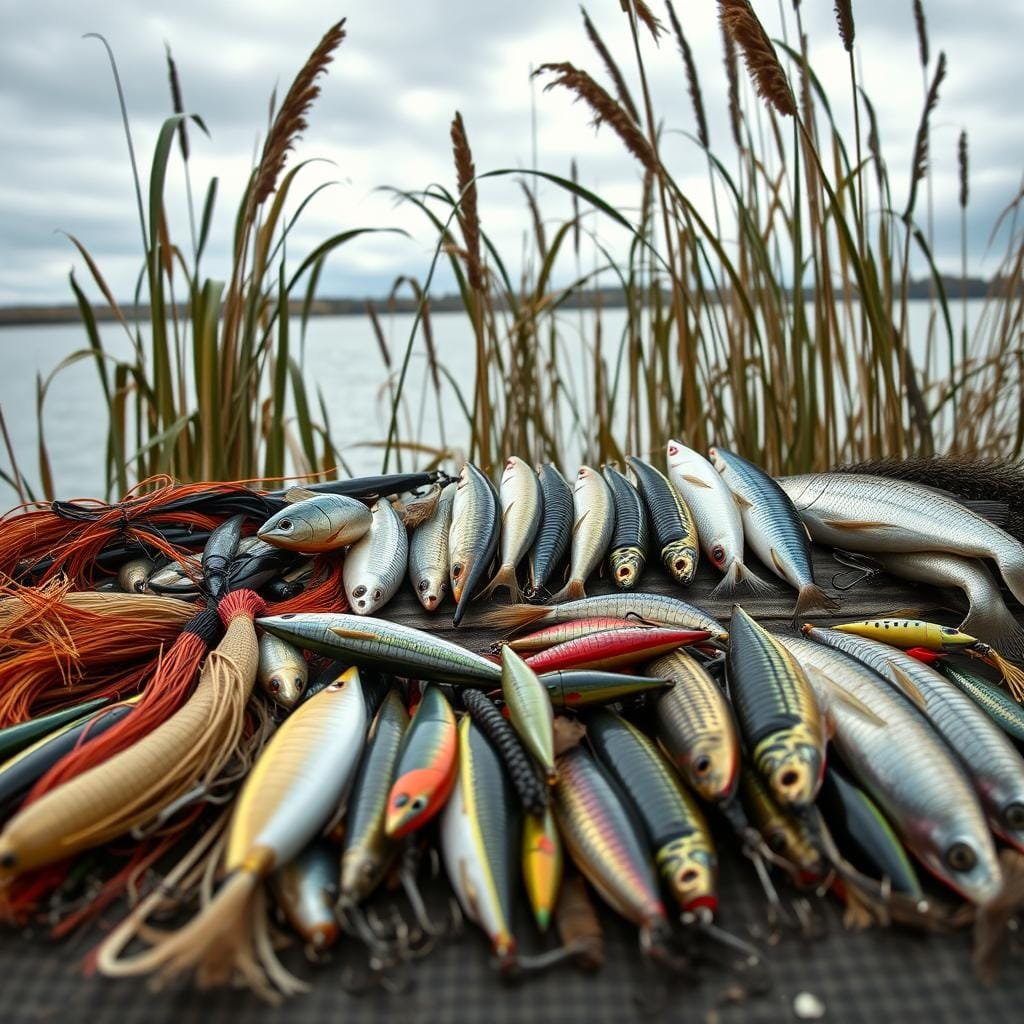
First, match the mood of the water. Then, pick your muskie lure. Change lures as the water changes. Water temperature, depth, and what’s eating help pick the right one.
Keep your retrieves smooth. Make wide turns in the boat. Adjust how fast you move until the fish say yes.
In-line spinners/bucktails for warm-water coverage
When it gets warmer than 50 degrees, bucktails work fast. They catch fish well at the figure-8. Try Mepps H210s or Musky Mayhem Double Cowgirls for a strong flash.
A single #8 Colorado from Bucher Tail or Mepps is good for sneaky moves. It lets you change speed without losing the bait.
Run bucktails high over weeds and crank across points. Speed up in windy or choppy water. Near the boat, pulse the blades to get fish to bite.
This method covers a lot of water. It’s simple and gets you consistent bites.
Diving cranks for edges, pauses, and cooler temps
When it cools down or fish go deep, diving cranks are best. Try a 10-inch Believer or 10-inch Jake. They dive deep and pause well.
Cast far along weedlines or first breaks. This puts you in the right spot.
Hit hard, then stop. Many bites come when you pause. Mix straight cranks with sweep-and-hold to catch neutral fish.
Glide baits for hang time and direction changes
Glide baits make wide swings and hang in the water. Balanced, slow-sinking ones or Suick Phantom work well. Use them above rock, sand, or sparse weeds.
Speed up for charged fish, but keep the glide steady. Half-turns of the reel add life without overworking the bait.
Soft swimbaits for realism across the water column
Swimbaits mimic real food from top to bottom. Savage Gear 4D Line-Thru Perch is good for drawing fish. Count it down over humps or slow-roll along timber.
You can also jig them vertically. Add a stinger if fish nip the tail. Keep the movement smooth and steady.
Topwater crawlers and prop baits for loud reaction strikes
Topwater muskie options like Lee Tauchen’s Top H2O are great from late spring to fall. They make a big splash. Crawlers and jointed styles make a deliberate splash, while walk-the-dog baits glide on top.
Fish them at dawn, dusk, or under clouds. In windy water, make it louder. In calm water, downsize and slow down.
Vertical jigs/bladebaits for deep and current
For deep or current-rich water, go vertical. Bladebaits like Shumway Fuzzy Duzzit and Vibrations Tackle Echotail dive fast. The Original Bondy Bait and Bondy Hang 10 hit deep holes and channel edges.
Use a crisp lift-fall with bottom contact, then pause. Short hops in current keep you in the zone without drifting past fish.
- Primary muskie lure categories to rotate: bucktails, muskie crankbaits, glide baits, swimbaits for muskie, topwater muskie, bladebaits muskie.
- Key triggers: speed bursts, pauses, directional changes, and boatside cadence.
- Where to start: warm weeds with bucktails, cooling breaks with cranks, deep or current with vertical metal.
Deep water advantage: vertical jigging tactics that win tournaments
Big fish go deep when it gets tough. That’s when deep muskie tactics really shine. By focusing on vertical jigging muskies in 20 feet or more, you catch fish most boats miss. Your bait stays in the strike zone longer.
Jon Bondy created a system using Bondy Bait techniques. These baits stay vertical, fall fast, and avoid snags. The 7-ounce Original Bondy Bait drops nose-first like a shad or sucker. Black and white colors work well; white pops up when fish bite on cisco.
Why 20+ feet is ignored—and loaded with big fish
Many anglers shy away from deep water. They worry about losing contact. But muskies love the bottom edges and humps. Targeting these spots lets you catch heavy tackle muskies that attack a bait like a wounded meal.
Gord Pyzer says vertical jigging works great in heavy current. Less line means better feel and quicker hooksets. The straight pull drives hooks home.
Lift-fall cadence with 7-ounce Bondy-style baits
Make a loud entry. Let it fall freely on a tight line. Then, pop it 1–3 feet and let it crash back. This lift-fall cadence makes neutral fish bite.
Watch for “mushy” weight on the fall. Many hits feel like weeds. Sweep hard and keep pressure—vertical jigging muskies often eat below the boat.
Boat control over contours and breaklines
Set the bow into the wind and use the trolling motor to hover on the contour. This muskie boat control keeps your line straight up and down. So, the lure tracks true and stays in the zone.
Stop along primary breaklines, saddles, or river holes. Hold the exact depth line while you work the cadence. If you drift off, reset and repeat the pass.
Gear: extra-heavy rods, 80 lb braid, stout leaders
An 8-foot extra-heavy rod with 80-pound braid transmits the thump and loads fast. Many anglers run 175–200-pound stainless or downrigger-cable leaders for abrasion and zero stretch at the bite.
Lock the star drag tighter than usual for heavy tackle muskies. Short line and straight angles reduce surge. This lets you drive hooks and steer fish away from the motor.
| Element | Why It Matters | Tournament-Proven Tip |
|---|---|---|
| Depth: 20–45 ft | Concentrates overlooked giants on edges and holes | Park on prime breaks and reset quickly after each drift |
| Lure: 7 oz Bondy-style | Nose-down fall mimics bottom-feeding forage | Use black in low light; switch to white on cisco/whitefish bites |
| Cadence: Lift–Fall | Triggers reaction strikes from neutral fish | Short, sharp pops; control the fall on a semi-tight line |
| Line/Leader | 80 lb braid with 175–200 lb stainless for drive and durability | Tighten drag to keep hooks buried during vertical surges |
| Boat Control | Bow into wind to maintain vertical presentation | Use spot-hold or micro-corrections to track the contour |
| Current | Straight-line pulls improve hook penetration | Shorten scope so the bait stays under the boat |
Bucktails that vacuum muskies: single #8s to double-10s
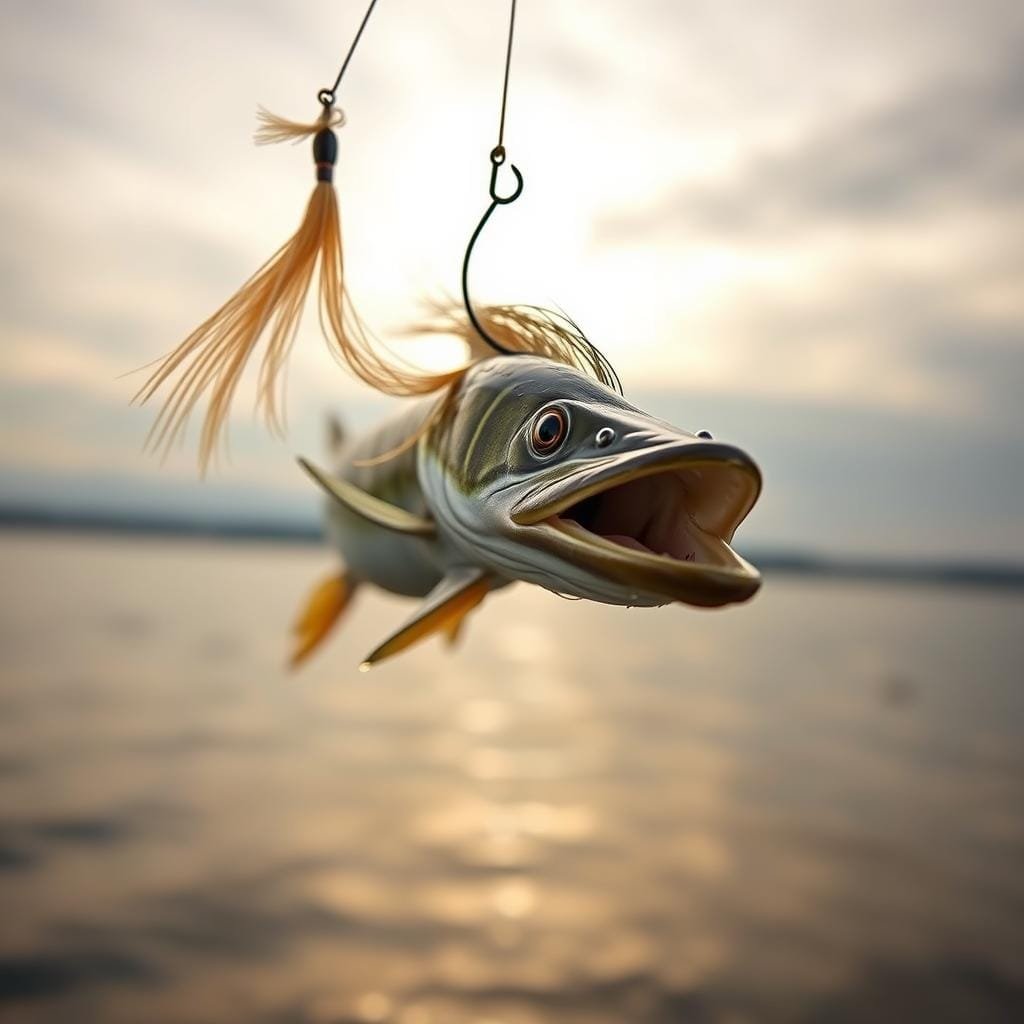
Muskies like certain vibes, lifts, and speeds. That’s why anglers switch between single #8 Colorado and double-10 bucktails. This lets them match the fish’s mood. Always keep colors bold, hooks sharp, and aim with purpose.
When a single #8 Colorado shines (stealth and speed range)
Lee Tauchen uses a single #8 Colorado for quiet, fast casts. It’s perfect for when fish are shy. One client caught a huge muskie in the morning with this bait.
For sneaky approaches, use soft blades. A flashabou bucktail in muted colors works well. It moves quietly and tracks well in tight spots.
Double-10 sound/vibration and boatside conversions
Double-10 bucktails are great for active fish. They make a deep sound that attracts muskies. The Double Cowgirl and Mepps H210 are top choices for this.
Steve Heiting caught many muskies with all-black double-10s. He likes black-nickel blades for less flash and black holoform tails for a natural look.
Color choices: black-on-black, reduced flash, and breathing flashabou
All-black is good for any time because it’s easy to see. Black-nickel blades and dark skirts reduce glare. For a lively look, use a flashabou bucktail.
In clear water, choose colors that don’t scare fish. In murky water, use darker colors to make the bait stand out.
Retrieves: burn, slow roll, and pulse for triggers
Try different retrieves to see what works. Burn the bait to get a reaction, slow roll to keep it in the zone, and pulse for a sudden movement.
At the boat, do a wide, fast figure-8. This can turn a curious fish into a hungry one, thanks to the Mepps H210 or Double Cowgirl.
Spinnerbaits that go anywhere: weeds, wood, rocks
When cover gets tough, use muskie spinnerbaits that don’t get stuck. Dick Pearson calls the Drifter Tackle Grinder a “crescent wrench.” It goes through weeds, rocks, and wood, and works at any speed. Its unique shape lets you explore places most can’t.
Grinder-style safety-pin spinnerbaits for versatility
The Drifter Tackle Grinder has a special arm and a single hook. It moves straight and bends instead of getting stuck. Use black skirts with silver or flame willowleaf blades, from 1 to 5 ounces, to match the water.
This design keeps the bait up in laydowns and by boulders. It also lets you cast further down the edge. This means you spend more time in the strike zone, catching more fish.
Surface gurgle over cabbage vs. slow-rolling deep rock
For cabbage muskies, make the blade gurgle. Move the Grinder high and steady. This makes the skirt move and the willowleaf flicker.
When fish are deep, use slow-rolling spinnerbaits. “Grind” the bait just off bottom. This imitates a wounded fish and keeps the bait clean.
Snag resistance and trolling options
Safety-pin design helps the lure go through thick cover. The single hook points up, so it slips through gaps. This lets you cast into tight spots.
On the troll, the Drifter Tackle Grinder works well at many speeds. Use heavier heads for deep edges or lighter ones for shallow areas. This keeps your spread effective, whether you’re after cabbage muskies or reef fish.
| Scenario | Recommended Setup | Retrieve/Troll Speed | Key Benefit |
|---|---|---|---|
| Shallow cabbage (3–8 ft) | Drifter Tackle Grinder, 1–2 oz, black skirt, silver willowleaf | Steady surface gurgle, high in column | Triggers cabbage muskies with flash and wake |
| Deep rock edges (12–25 ft) | Grinder, 3–5 oz, black skirt, flame willowleaf | Slow-rolling spinnerbaits near bottom | Bottom contact without snagging; thump draws strikes |
| Wood and laydowns | Grinder, 2–3 oz, black skirt, silver blade | Medium retrieve with pauses after deflection | Safety-pin spinnerbait muskie profile deflects and stays clean |
| Trolling breaks and points | Grinder, 3–5 oz mixed colors | 2.5–4.0 mph, adjust for depth | Tracks straight, covers water fast, holds depth |
Neutral, random, and deadly: softbait rigging like Mr. Whiggley
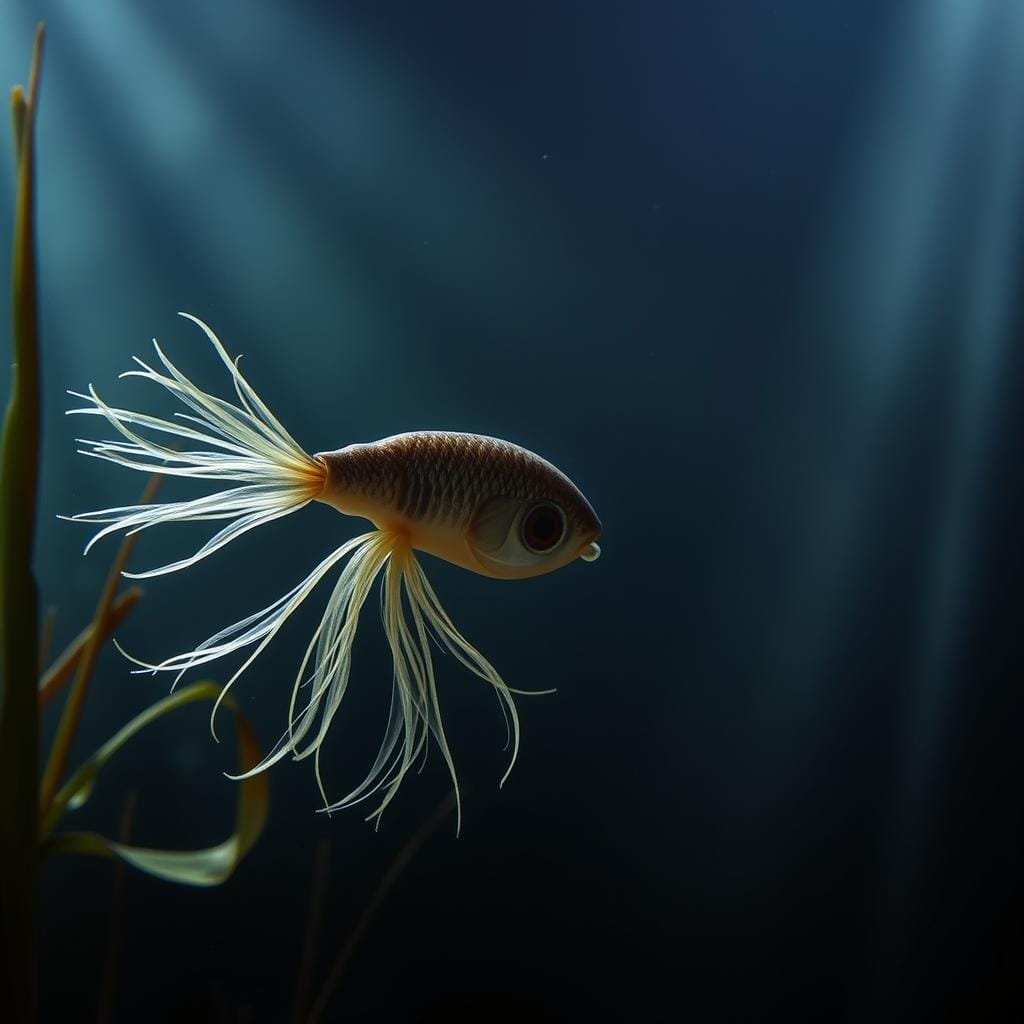
When muskies get wise, subtle wins. Larry Dahlberg made Mr. Whiggley rigging to keep bait level and quiet. It works at any speed.
A neutral buoyancy softbait holds a horizontal posture. It drifts, flutters, and darts on command. This turns on pressured fish.
Balancing with lead shot/tungsten for horizontal sink
The trick is balance along the belly, not a lump in the middle. Use fine lead shot or tungsten weighting soft plastics on the ventral side. This keeps the lure flat.
It sinks level and pauses without tilting. Add weight in tiny moves. Test in a tub and listen to the bait. If it noses down, shift a bit back.
Dialed right, the bait hovers between pulls and then breaks into a random glide. This is the heart of Mr. Whiggley rigging. It makes any neutral buoyancy softbait better.
Carolina rigs and spliced lead-core wire tricks
For deeper edges or current, spread the load. Many pros run Carolina rig muskies setups. This lets the lure wander while keeping contact.
A long leader and sliding sinker keep the glide intact. This avoids a yo-yo drop.
Splicing a three-foot section of 0.062-inch lead wire into your hollow braid is another clean move. This carries the bait down without killing the swim. You keep the hover and the random kick, yet reach fish you’d miss with a centered weight.
Color patterns that get chewed: redhorse case study
Match the forage and let action seal the deal. The redhorse color muskie pattern works on clear lakes and rivers. It looks natural in sun or low light.
Guides across the Midwest report big fish that ignored blades and rubber but ate a neutral buoyancy softbait in a redhorse look on the first clean sweep. Keep one ready as a cleanup tool after traffic rolls through. Lean on careful tungsten weighting soft plastics to keep that posture perfect.
Downsizing to up your odds: when “bass-sized” baits beat big rubber
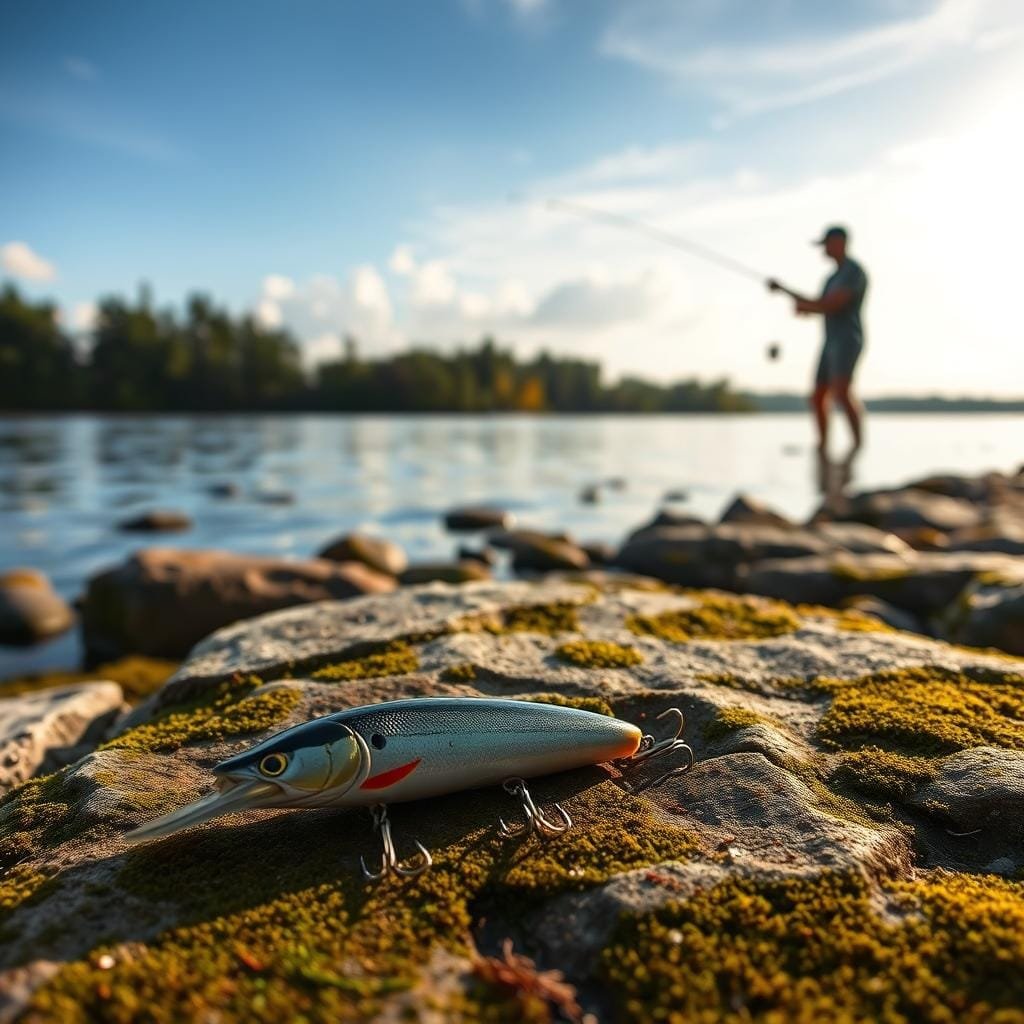
When it gets tough, big baits don’t work as well. Downsizing to smaller baits is smart when fish get picky. Choose baits that look like shad or perch and move quietly through the water.
Cold fronts and conditioned fish that won’t commit
Cold front muskies don’t chase much. They like to slide along and drift away. Use smaller baits and make short casts to keep them interested.
Guide Steve Huber says downsizing can make fish bite. It’s not magic. Just make your bait move less and pause more.
Spinnerbaits, #5 in-lines, 5–7 inch minnowbaits, buzzbaits, spooks
Use small spinnerbaits in thick weeds and near rocks. A Mepps #5 is great for covering water. For fish that won’t bite, try 5–7 inch minnowbaits that move slowly.
When the water gets choppy, buzzbaits and Zara Spooks work well. Move them in a special way, then stop near cover. Many bites come when you stop moving.
Lighter tackle tradeoffs, drag smoothness, and 27 lb sevenstrand leaders
Medium baitcasting gear is perfect for this. A 6 to 6.5 foot rod helps small hooks stay in place. Use a good reel and 14–20 lb line for smooth drag.
Use a 27 lb sevenstrand wire leader to keep your bait looking right. It won’t mess up the action of your lure. You might catch smallmouth and pike too, but muskies can be big.
Seasonal muskie locations to pair with the right bait
Knowing where muskies are in each season helps you fish better. Choose the right bait based on the water’s temperature and what’s available to eat. The key is to fish where they are, use the right bait, and match your fishing speed to theirs.
Spring: 10–15 feet near bait and walleye spawners
In spring, fish near bait schools and walleye spawners in 10–15 feet. Look for deeper bays, points, and river holes as the water gets warmer. Soft swimbaits and diving cranks from Rapala, Livingston, or Musky Innovations work well here.
Use slow lifts and glidey sweeps. Keep your baits near the bottom or just above marks. Look for short windows of opportunity when the water warms up and gets stained.
Summer: weedbeds in 3–8 feet, bucktails and topwaters—watch temps
In summer, muskies hide in weeds from 3–8 feet, on the windward side. Use bucktails like a Mepps Double Blade or a Musky Mayhem Double Cowgirl. Then, switch to topwaters from Heddon or Whopper Plopper for action.
When the surface temperature hits about 70°F, slow down to protect the fish. Stay on the move, watch for weed tips to find bait, and fish during the early and late hours.
Fall: aggressive fish on weeds to open water migrations
In fall, muskies become more active as they move from weeds to open water. Early, fish the deeper weeds, inside turns, and sharp breaks. Late, cover the basins and bait balls on points and humps. Crankbaits from Joe Bucher Outdoors, glide baits like a Phantom, and soft swimbaits work well here.
Warm spells can trigger a topwater bite. But most days, a pull-pause cadence that follows the thermocline bait layers is more effective.
Winter rivers: deep holes/eddies and methodical presentations
In winter, muskies hide in deep holes, current seams, and eddies. Use slow, deliberate presentations with vertical Bondy-style jigs, heavy bladebaits, or neutrally balanced soft plastics hovered just off bottom.
Focus on soft edges below riffles and the tailouts of big pools. Bite windows are short, so keep your presentations tight and repeat your drifts confidently.
- Baits for weeds: bucktails and topwaters for speed and commotion.
- Baits for edges: cranks, glides, and soft swimbaits with pauses.
- Baits for deep/current: vertical Bondy-style jigs and heavy blades.
By mixing these techniques with seasonal muskie patterns, you can stay on the bite all year. This includes spring, summer, fall, and winter muskies.
Figure-8 mastery: converting followers at the boat
Most muskies come to your feet. So, plan for a smooth muskie figure 8 on every cast. Keep a foot of line out, dip the lure, and make wide turns.
This trick alone helps turn followers into hard boatside muskie strikes.
Reading attitude and speed during the turn
First, check the fish’s posture. If it’s high and tight, it’s interested. Speed up and make wider turns.
Keep the bait under water and go fast on the straight parts.
Line length, rod sweep, and opposite-direction hooksets
Use 8–18 inches of line outside the tip for control. Bury the rod and make big ovals. Keep the tension steady to avoid slack.
When it bites, set the hook the opposite way. This move gets more bites than lifting straight up.
Why big bucktails excel at boatside changes
Double-10s are great because they change sound and feel at every turn. This change makes followers bite. Jim Saric says the Cowgirl works well because of its heavy action and flash.
Steve Heiting says always end with a full figure-8. Even hidden fish bite when the bucktail moves up and down. This sets up a good hookset.
Smart gear pairing for casting big and small baits
Finding the right muskie rod and reel setup saves time and catches more fish. Start with power, then choose line and leaders based on bait size. This makes your casts smooth and your hooksets strong, no matter the bait.
7’6”–8’ heavy baitcasters, high retrieve reels, and 50–80 lb braid
A good start is a 7’6”–8’ rod with a high-speed reel. This combo gives you the power and control you need. For big baits, use 50–80 lb braid to drive hooks and shorten fights.
For bigger baits, choose reels with more capacity and rods with longer grips. This helps with figure-8s. For more tips, check out this early-fall gear rundown and bait families.
Leader choices: heavy fluoro versus steel for teeth and action
Leaders are key. Fluorocarbon is stealthy but can break off. Steel is tough but might affect bait action.
Start with pre-made leaders from trusted brands. For tough fishing, use 80 lb braid with stainless steel for durability.
When lighter braid helps distance with smaller lures
For small lures, use lighter braid for better distance. Choose 30–40 lb for spinners and small minnowbaits. This improves accuracy and hookups.
Balance is important. A Shimano Tranx muskie reel works well with small baits. But, a mid-size reel and rod are better for rhythm. Add a short wire for thick teeth without losing bait action.
Color, speed, and cadence: dialing in triggers across lure families
Adjusting color, speed, and cadence can make fish bite. Choose muskie colors that match the water’s pressure and light. Black double-10s with black-nickel blades and holoform tails are great for sneaking up on fish.
Steve Heiting caught 21–27 muskies with these lures in one season. This shows how well they work. Flashabou tails move well at any speed. Jim Saric says this “living” look is why Cowgirls attract fish.
Focus on the retrieve’s rhythm, not the time. Use big bucktails to get fish’s attention over weeds. Slow-roll them in dim light or after a storm. Then, add a quick pulse to make the blades flash.
This quick flash can turn a curious fish into a hungry one. If fish seem slow, slow down your retrieve. Keep the bait deep to give them more time to decide.
For vertical fishing, use a lift-fall motion with 7-ounce baits. Lift quickly, pause, then let it drop. Repeat this to make the bait look appealing to fish.
In softbait systems, like Mr. Whiggley, make the bait sink evenly. Add random movements to mimic a hurt baitfish. This can make even neutral fish bite.
Stick to your color choices but be ready to change. Black is good for sneaking up on fish. White works well in fall when fish are active. Use natural colors in clear water.
Adjust your muskie triggers based on the situation. Use fast retrieves for active fish and slow ones in cold water. Mix your muskie colors with the right retrieve and a pulse to keep fish interested.
FAQ
What’s the single best bait for muskie if I’m starting from scratch?
Start with a double-10 bucktail like the Musky Mayhem Cowgirl or Mepps H210. It moves fast and triggers bites. Use a 7’6”–8’ heavy baitcaster and a Shimano Tranx reel.
Choose 50–80 lb braid and a steel or heavy fluorocarbon leader.
When should I fish deep with the Original Bondy Bait?
Fish 20–35 feet deep, best in current or on cisco/whitefish bites in fall. Use an extra-heavy rod and 80 lb braid.
Try Gord Pyzer’s 200 lb stainless downrigger-cable leaders. Work a lift-fall cadence to keep the bait vertical.
How do moon phase and weather affect muskie feeding windows?
Muskies bite around fronts, wind shifts, and moon phases. Watch wind direction and barometer trends. Fish hard during these times.
When it’s off, use efficient coverage or vertical options. Consistency beats waiting for perfect conditions.
Why do big muskies feed less often?
Large fish eat big meals and digest slowly. They need long breaks between eating. This makes timing and lure control key.
Neutral presentations like Mr. Whiggley can tease big fish into biting.
What’s special about Larry Dahlberg’s Mr. Whiggley rigging?
It has a neutral buoyancy for a natural glide. Dahlberg balances lead shot or tungsten for a horizontal sink.
For depth, he uses a Carolina rig or splices lead wire into braid. The redhorse color is known for success, like a 56-inch Mille Lacs fish.
Single #8 Colorado vs. double-10 blades—when does each win?
A single #8 Colorado, like the Esox Assault, is great for stealth. It works in wide speed ranges and shallow water.
Double-10s, like Cowgirls and Mepps H210s, have more thump and sound. They lead in converting bites when fish are active.
How do I retrieve bucktails to trigger more bites?
Mix speeds. Burn it in warm water and slow-roll in cold or low light. Use Steve Heiting’s “pulse” retrieve.
Finish with a deep, wide figure-8. Black-on-black with black-nickel blades and black holoform tails is low-flash and often fools pressured fish.
What makes the Drifter Tackle Grinder so versatile?
It’s a safety-pin spinnerbait that works like a “crescent wrench.” It can surface-gurgle, slow-roll, or troll. The arm deflects and resists snags in wood, weeds, and rock.
Black skirts with silver or flame willowleaf blades are staples.
Are downsized, bass-sized lures legit for muskies?
Yes, they’re great during cold fronts or for pressured fish. Use 3/8–1/2 oz spinnerbaits, Mepps #5 in-lines, and 5–7 inch minnowbaits.
Buzzbaits and Zara Spooks also catch big muskies. Use smooth drags, 30–40 lb braid, and a 27 lb sevenstrand wire leader.
What diving crankbaits work when glides or bucktails stall?
10-inch Believers and Jakes, and Super Cisco–style profiles, catch fish on edges and breaks. Long pauses trigger hits. In weeds, try a 10-inch Believer with a stop-and-go rise.
For trolling, a 10-inch Jake is a classic producer.
How do I fish glide baits for more hangs and eats?
Choose balanced, slow-sinking models. Work short taps for wide sway and let it hang. Add occasional micro-twitches to mimic a wounded baitfish.
Speed up when fish get hot, then transition into a big, underwater figure-8.
What are the go-to topwaters for muskie?
Crawlers, prop baits, and walk-the-dog styles shine from late spring to early fall. Lee Tauchen’s Top H2O and the Suick Weagle are proven.
Even outside “textbook” windows, sound and commotion can trigger reaction strikes, over shallow weeds or during warm evening winds.
How should I control the boat for vertical jigging in wind or current?
Stop along the contour or breakline, point the bow into the wind. Use your trolling motor to hold the exact depth line.
Keep the bait vertical with a lift-fall cadence that splashes on entry, sinks fast, and stays tight to bottom. This maximizes bottom contact and minimizes snags.
What line and leader setup should I run for big muskie lures?
For casting big blades, cranks, and rubber, use 50–80 lb braid with a heavy fluorocarbon or steel leader. Fluoro is stealthier; steel provides tooth-proof insurance with minor action impact.
In deep vertical work, go 80 lb braid and a 150–200 lb class leader. Pre-made leaders from trusted brands are fine.
When is it smart to stop targeting muskies in summer?
Stop when surface temps hit around 70°F. Higher water temps increase post-release mortality. If you fish warm periods, shorten fight times, keep fish in the water, and be fast with tools and photos.
What seasonal spots should I check first?
Spring: 10–15 feet near bait and walleye spawners in bays and river wintering holes. Summer: hydrilla/milfoil in 3–8 feet with bucktails and topwaters. Fall: deeper weeds, sharp breaks, and then open water near cisco or whitefish.
Winter rivers: deep holes and eddies out of current—go slow and methodical.
How do I read and finish a figure-8 correctly?
Keep about a foot of line outside the tip, make wide, submerged turns, and watch the fish’s body language. If it’s hot, speed up and widen. If it’s neutral, slow down and deepen.
When it eats, sweep the hookset opposite the fish’s direction to drive hooks home.
Do soft swimbaits have a place in muskie fishing?
Absolutely. Line-thru models like the Savage Gear 4D Line-Thru Perch mimic real forage and can be counted down to any depth or jigged vertically. They excel around edges, suspended bait schools, and pressured fish that shy from metal and flash.
Is color really that important for muskies?
Yes, but keep a simple system. All-black with black-nickel blades offers a low-flash profile that often beats pressure. White excels on fall cisco/whitefish bites. Natural forage matches—like Dahlberg’s redhorse on softbaits—build confidence.
Change color, speed, and cadence before swapping lure families.
Why fish 20+ feet when most anglers stay shallow?
Big muskies often hold tight to bottom or current seams in that zone, even on pressured waters. Few anglers present there, so a Bondy-style vertical jig is a fresh look that has fueled nearly two dozen tournament wins across North America.
What spinnerbait sizes and blade styles should I carry?
Stock 1–5 ounce safety-pin spinnerbaits like the Drifter Tackle Grinder with willowleaf blades in silver and flame. Use black skirts as a base and add a few color combos for water clarity changes. They excel in wood, weeds, and rock, and you can troll them when you need steady depth and speed control.
Can muskies hit while I’m fishing for other species?
Definitely. Many fish are caught by anglers throwing plugs for stripers, spinnerbaits for smallmouth bass, or jerkbaits for walleyes—like on the Delaware River. Time on the water intersects feeding windows, sometimes better than chasing a forecast.
What’s a reliable “stealth” bucktail setup for pressured lakes?
An all-black single #8 Colorado on a moderate-fast 8-foot rod, 50–65 lb braid, and a short black wire leader. Fish it slow to medium over shallow weeds, then pulse or burn when you spot a follower. Finish with a full figure-8 every cast.