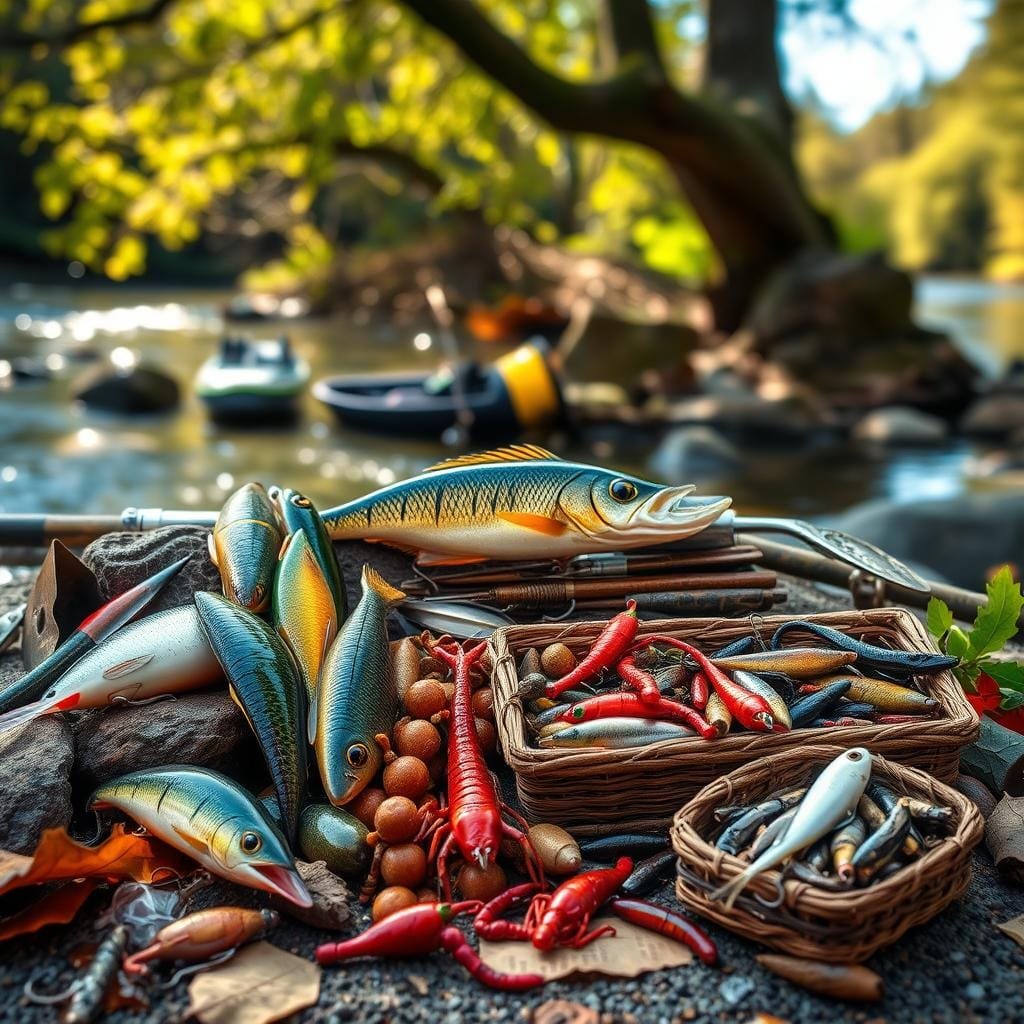
This guide shows the best lures for USA bass fishing. It covers lure choices, rigging tips, and when to use them. Whether you fish in rivers or the Great Lakes, we’ll help you find the best bait.
Our top picks include the Berkley PowerBait MaxScent Flat Worm and the Great Lakes Finesse Juvy Craw. We also recommend the DUO Realis Spinbait80 for clear water. Other favorites are the Z-Man Finesse TRD, Megabass Ito Vision 110, and Savage Gear Ned Craw.
These lures work well from spring to fall. We match each lure with the right tackle for different fishing conditions. You’ll learn how to catch trophy smallmouth bass with ease.
Jerkbaits like the Rapala X-Rap are great in cold weather. The Strike King Coffee Tube is perfect for rock flats. Paddletails are excellent for gravel areas.
This guide helps you fish better in highland reservoirs and the Great Lakes. It offers tips for clear water, reliable retrieves, and the best gear for U.S. waters.
Why Smallmouth Bite: Forage, Seasons, and Behavior
Smallmouth fish eat and live in certain ways. They move based on light, wind, and food. First, find out what they eat. Then, follow their seasonal patterns to know where and how deep to fish.
Match the hatch: crawfish, gobies, smelt, and shiners
Start from the bottom. Crawfish and gobies live on rocks and sand. Smelt and shiners are found over breaks and bait balls. Use the right lures to match what they eat.
Choose colors and sizes that match their food. Use browns for craws, green pumpkin for gobies, and silver or smoke for smelt and shiners. Change your lure size and color based on the water and wind.
Predictably unpredictable: how mood swings affect lure choice
Smallmouth fish can change quickly. What works in the morning might not work later. Try different lures to see what they like.
Use a Megabass Ito Vision 110 or Rapala X-Rap for a pause. A DUO Realis Spinbait80 or paddletail works when they’re not committing. Finesse lures like drop-shot worms or marabou jigs are good for lazy eaters.
Seasonal patterns: shallow spawning zones to mid-depth roaming
In the early season, fish are shallow. Look for them in 15 feet or less on big rocks and sand-and-grass. Use a Livingston Lures Jerkmaster 121 for short, aggressive rips.
As the water warms, they move to points and mid-depth flats. Use glide baits, paddletails, and spy baits to cover water. Adjust your fishing based on the wind, sun, and bait movement.
Drop Shot Dominance: Berkley MaxScent Flat Worm and Shad Shapes
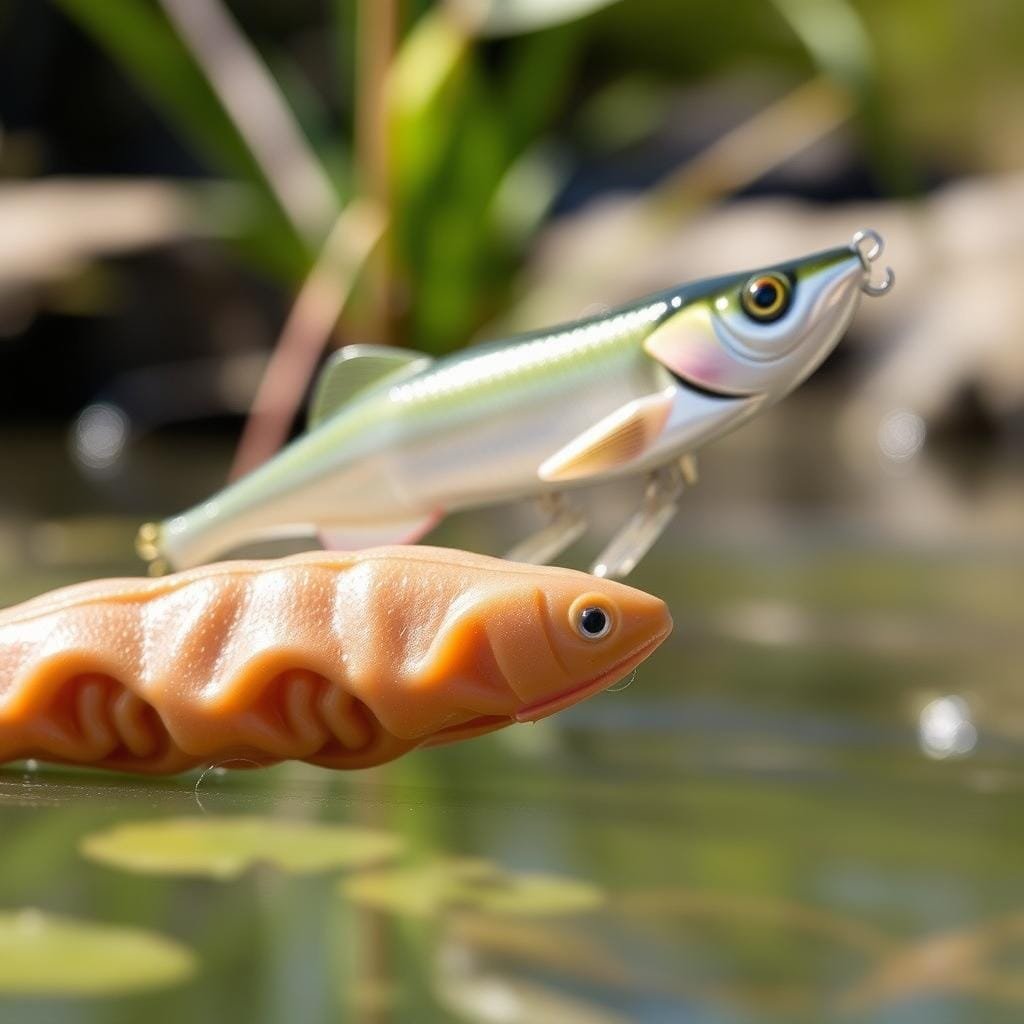
When fishing gets tough, a clear water drop shot is hard to beat. The Berkley MaxScent Flat Worm is a hit because it tricks big smallmouth into biting. Adding a shad shape worm smallmouth option helps catch fish in different spots.
Why the MaxScent Flat Worm converts hesitant biters
The MaxScent formula lets out scent that smallmouth follow from far away. This is why many anglers love it for drop shot fishing. Its flat shape moves on slack line, teasing fish without scaring them off.
Even in super clear water, it looks natural. This lets fish bite longer, giving you time to set the hook.
Rigging tips: leader length, hook style, and clear-water colors
For clear water, use 6–8 lb fluorocarbon. Tie it to a size 1–2 drop-shot hook. Choose a VMC Spinshot or Gamakatsu G-Finesse.
Leader length should be 12–24 inches over rock or sand. Shorten it near grass or boulders. Colors like gobies, smelt, and green pumpkin work well when it’s sunny and calm.
Move slowly. Let the weight sit and the worm do the work. If it’s crowded and bites are slow, slow down even more.
Alternative pick: Yamamoto Shad Shape Worm for pressured lakes
On pressured lakes, the Yamamoto Shad Shape Worm is a great choice. It looks like a baitfish and works well when fish are hesitant. Use it on a nose-hooked setup with a light wire hook for long casts.
Switch between the Berkley MaxScent Flat Worm and the Yamamoto Shad Shape Worm. This mix keeps your fishing effective, no matter the conditions.
Tube Tactics for Clear Water Smallies
When the water is clear, smallmouth bass watch every move. A smallmouth tube jig is perfect for this. It mimics craws and gobies with subtle drags and short hops.
Strike King Coffee Tube: scents, sizes, and best colors
The 3.5-inch Strike King Coffee Tube works well in many places. It has a special scent that makes fish bite longer. Its tails move in a way that looks real.
Use colors like green pumpkin and magic goby to match local fish. Drag it like a crawfish, then hop or crack like a goby. Use 1/16 to 1/4 oz weights for the right fall.
Great Lakes Finesse Juvy Craw: micro profile for crystal-clear bites
The 2.5-inch Great Lakes Finesse Juvy Craw is great with a Mini Pro Tube Head. It looks small and real. It’s tough for fish to break, but easy for hooks to go in.
In very clear water, its small size is key. Move it slowly and let the water help. This jig is perfect when you need to catch fish carefully.
Rigging options: exposed insert, Texas “Stupid Rig,” and swinging heads
An exposed insert with a light-wire hook works best on open rock. It’s simple and lets you feel when fish bite.
The stupid rig tube is good for fishing in tight spots. It doesn’t get stuck on rocks or wood. It moves well in the current.
For extra action, try a swinging head like the Freedom Tackle Zodiac. It swings freely and lets the bait move naturally. This helps keep fish on the hook.
| Tube/Bait | Best Use | Recommended Weights | Go-To Tube Jig Colors | Notes |
|---|---|---|---|---|
| Strike King Coffee Tube 3.5″ | All-around clear water; flats, breaks, and points | 1/16, 1/8, 1/4 oz inserts | Green Pumpkin, Magic Goby, Crazy Craw | Caffeinated scent; drag, hop, shake, or crack to mimic craws and gobies |
| Great Lakes Finesse Juvy Craw 2.5″ | Ultra-clear lakes, creeks, and rivers | Mini Pro Tube Head 1/16–1/8 oz | Natural Craw, Goby, Brown/Amber | Durable, micro profile that convinces wary smallmouth |
| Stupid Rig Tube (Texas-rigged) | Snaggy rock, wood, and crib fields | EWG tube insert 1/8–3/16 oz | Watermelon, Green Pumpkin, Smoke Purple | Weedless control in current; great hookup while staying clean |
| Swinging Head + Tube | When you need added roll and pivot | Freedom Tackle Zodiac 1/8–1/4 oz | Brown Craw, Magic Goby, Perch | Free-swinging action helps keep fish pinned, enhances bottom feel |
| Alternative Tubes | Extra sizes and hues | Match fall rate to depth and wind | NetBait STH Finesse, X-Zone X-Tube palettes | Use to fine-tune forage match and pressure conditions |
- Choose tube jig colors that mirror crawfish and gobies to boost confidence bites.
- Adjust weight to control fall speed and bottom contact without over-powering the presentation.
- Rotate between an exposed insert, a stupid rig tube, and a swinging head based on cover and current.
Ned Rig Confidence Baits That Always Get Bit
Ned rig smallmouth fishing is all about simple parts done right. Keep the bait small and in touch with the bottom. Let it float up to sell the bite. This method is the most reliable for catching Midwest finesse bass.
Z-Man Finesse TRD + Finesse ShroomZ: buoyancy and durability
The 2.75-inch Z-Man Finesse TRD on a Finesse ShroomZ head catches lots of bass. It floats well, so it stands up and falls slowly. This attracts bites in clear water and after cold fronts.
It works great on beds, in current seams, and on deep foraging fish. Stretch your value with one pack. For a leech-style play in summer, use a heavier mushroom head. This modified Ned approach is best from mid-June to August.
When to swap to craw-style Neds like Savage Gear Ned Craw
Switch to the Savage Gear Ned Craw when crayfish are the main meal. Its 2.5-inch body and natural colors mimic crayfish. Let it tick bottom, then dead stick to mimic a defensive pause.
Rotate in subtle options like Rapala Crush City Ned BLT or Duo Realis Wriggle ND Slim for a thinner profile. Keep the Z-Man Finesse TRD ready for leeches or gobies.
Heavier heads for bottom contact vs. snag-resistant river setups
Wind, chop, and 15–25 feet need heavier mushroom heads for bottom contact. In rivers with rock, wood, or crib fields, use weedless or Texas-capable heads. This keeps Midwest finesse bass tactics efficient all day.
Cast long, let it settle, then hop or shake with slack. If current pulls, go one size heavier. If you’re ticking too often, step lighter. Simple weight changes unlock more bites fast.
| Bait/Head | Best Use | Key Advantage | Primary Forage Imitated | Go-To Depth/Water |
|---|---|---|---|---|
| Z-Man Finesse TRD + Finesse ShroomZ | Tough, pressured bites | Buoyant stand-up posture and extreme durability | Leeches, gobies, juvenile baitfish | Bank to 25 feet; lakes and clear rivers |
| Savage Gear Ned Craw + Mushroom/Weedless Head | Crawfish-focused feeds | Ultra-realistic craw profile; fish hold on | Crayfish | Gravel and rock; current seams and points |
| Heavier Mushroom Head (up to 5/16 oz) | Wind and deeper structure | Consistent bottom contact and longer casts | Leech crawl and bottom forage | 15–25 feet; offshore humps and flats |
| Weedless/Texas-Capable Ned Head | Snaggy rivers and cribs | Snag resistance without losing feel | Craws and gobies | Rocky runs, wood, and mixed cover |
Jerkbaits That Move Big Brown Fish
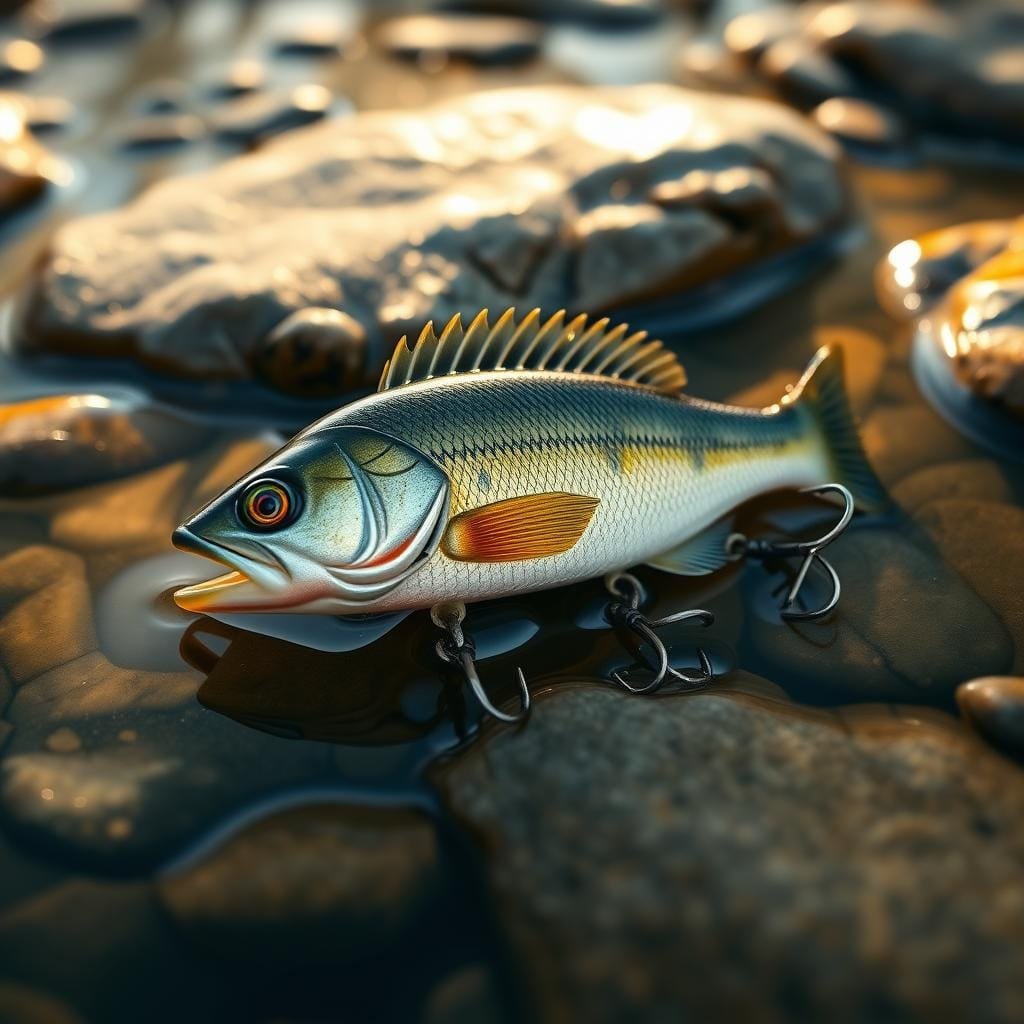
Cold fronts, clear water, and moody fish need a precise smallmouth jerkbait. Use a stop-and-go rhythm, then let it hang. As it gets warmer, speed up and snap harder to get chasers.
Megabass Ito Vision 110: casting, suspending, and color range
The Megabass Vision 110 casts far for its size. It has a smart weight transfer and suspends well. It’s great for catching big bass in clear water.
Try different colors like translucent shad, smelt tones, and perch flashes. Short, crisp jerks with longer pauses in cold water keep it in the strike zone.
Rapala X-Rap and Mavrik PXR: pause-time and cold-to-warm transitions
The Rapala X-Rap is perfect for sharp slashes and dead stops. Most bites come on the pause. Count down five to ten seconds in cold water, shorter as it warms up. Sizes 08 and 10 are good for most needs.
The Rapala PXR Mavrik casts long and stays steady. Its VMC RedLine hooks catch bites fast. This is great for smallmouth that swipe in wind or chop.
Livingston Lures Jerkmaster 121/121D: perch patterns and FFS visibility
The Livingston Jerkmaster 121 and 121D track straight and show up well. In northern lakes with perch, use light, dark, or chartreuse-perch colors. They pull fish from rock and grass.
Make it dart hard, then pause to let followers commit. Its slow-sinking/suspending action keeps it hovering where big fish study a bait before eating.
Gear setup: rod actions, 10–12 lb fluoro, and aggressive jerk cadence
A 6’10” medium to medium-heavy rod works for most jerkbaits. Use a 7’2” medium-heavy for deeper divers like the 121D. Pair with 10–12 lb fluorocarbon for low visibility and solid bite feel.
Start with jerk-jerk-pause in the morning or under cloud cover. As fish turn on, speed up and shorten the pause. This triggers reaction bites from followers.
| Jerkbait | Best Use Case | Key Edge | Recommended Line | Cadence Tip |
|---|---|---|---|---|
| Megabass Vision 110 | Clear water, long casts to roamers | Weight transfer and premium suspend | 10–12 lb fluoro | Short snaps, longer cold-water pauses |
| Rapala X-Rap | Cold mornings, pause-focused bites | Violent slash with pause strikes | 10–12 lb fluoro | Count the pause; size 08–10 for versatility |
| Rapala PXR Mavrik | Wind, long casts, mixed temps | Bullet casting, VMC RedLine grip | 10–12 lb fluoro | Tight snaps, medium pauses for chasers |
| Livingston Jerkmaster 121 | Perch lakes, mid-depth rock and grass | FFS visibility and slow-sink control | 10–12 lb fluoro | Aggressive jerks, hover near cover |
| Livingston Jerkmaster 121D | Deeper edges and suspended schools | Deeper track with strong sonar return | 12 lb fluoro | Hard snaps, shorter pauses to keep depth |
best bait for smallmouth bass
Use a tight smallmouth lure list for clear flats, rocky points, and rivers. Start with a drop shot using the Berkley PowerBait MaxScent Flat Worm. Keep a Yamamoto Shad Shape Worm ready for pressured fish.
For bottom roamers, tubes and craws are great. Try the Strike King Coffee Tube, Great Lakes Finesse Juvy Craw, and Savage Gear Ned Craw. These work well when fish want a stubby profile.
When you need easy bites, a Ned rig is perfect. Use a Z-Man Finesse TRD on a Finesse ShroomZ. Then, try Rapala Crush City Ned BLT, Duo Wriggle ND Slim, or Yamatanuki 2.5 for more glide.
For roaming schools, jerkbaits are best. Try Megabass Ito Vision 110, Rapala X-Rap, Rapala PXR Mavrik, and Livingston Jerkmaster 121/121D. These cover big water and show well on forward sonar.
Spy baits are deadly in slick, bright lakes. The DUO Realis Spinbait80 rides 8–17 feet. Add paddletails like Keitech Swing Impact FAT 2.8 or 3.8 on 1/8–1/4 ounce heads.
Round it out with an Outkast Feider Fly marabou hair jig for cold water. Use a Kalin’s Lunker Grub for windy banks. And a Chompers Skirted Twin Tail Hula Grub for football heads on rock.
This guide balances Great Lakes smallmouth baits with river smallmouth gear. You can switch fast as visibility, wind, and current change. For more details, see this best bait for smallmouth bass roundup.
| Category | Primary Pick | Alt/Notes | Best Use Case |
|---|---|---|---|
| Drop Shot | Berkley PowerBait MaxScent Flat Worm | Yamamoto Shad Shape Worm | Sight-feeding fish in 10–30 ft; clear water smallmouth lures for hesitant biters |
| Tube/Craw | Strike King Coffee Tube | Great Lakes Finesse Juvy Craw; Savage Gear Ned Craw | Rocky banks, goby/craw forage on the Great Lakes; bottom contact |
| Ned Rig | Z-Man Finesse TRD + Finesse ShroomZ | Crush City Ned BLT; Duo Wriggle ND Slim; Yamatanuki 2.5 | Pressure bites in 4–25 ft; rivers with light heads as river smallmouth gear |
| Jerkbait | Megabass Ito Vision 110 | Rapala X-Rap; Rapala PXR Mavrik; Livingston Jerkmaster 121/121D | Windy points, bait suspending over rock; long pauses or fast burns |
| Spy Bait | DUO Realis Spinbait80 | 3/8 oz; 8–17 ft | Sunny, calm days on flats; neutral fish that follow |
| Swimbait | Keitech Swing Impact FAT 2.8/3.8 | VMC Hybrid Swimbait Head 1/8–1/4 oz | Covering water on breaks; smelt/cisco lakes; slow roll and count-down |
| Hair Jig | Outkast Feider Fly (1/16–1/8 oz) | Natural marabou, long casts | Cold water, spooky fish in gin-clear bays; subtle glide |
| Bonus Grub | Kalin’s Lunker Grub (3–5″) | 1/16–1/4 oz heads | Wind-blown shorelines; steady retrieve near bottom or mid-depth |
| Bonus Creature | Chompers Skirted Twin Tail Hula Grub | Football or swinging head | Dragging across rock piles; current seams and offshore humps |
Keep your smallmouth lure list tight. Rotate baits based on light and depth. Let the fish tell you which bait to use. From Great Lakes smallmouth baits to river smallmouth gear, this mix covers all bases.
Spy Baiting in Clear Water: DUO Realis Spinbait80
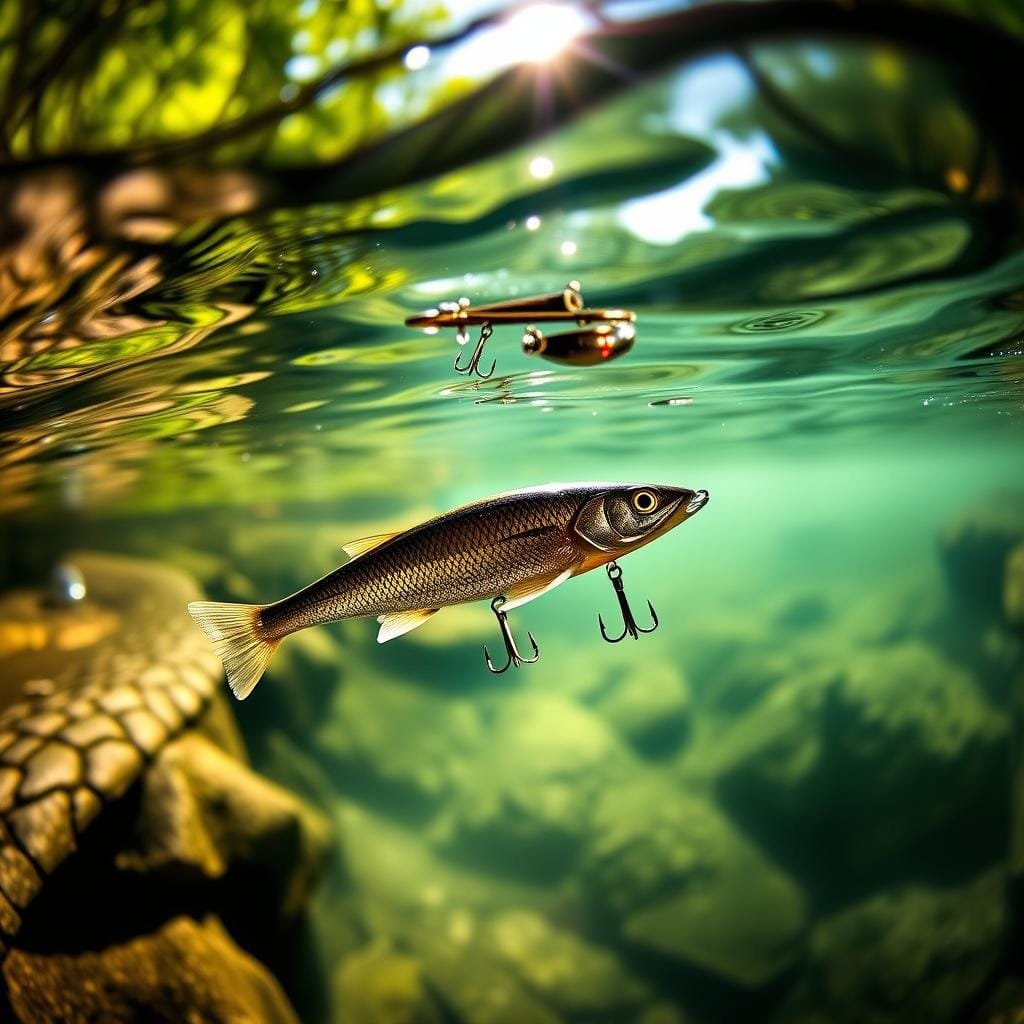
The DUO Realis Spinbait80 is top for catching smallmouth bass. It’s small and light, making it easy to cast far. It moves straight and catches fish in clear water.
On smallmouth deep flats, its special roll and flash make fish bite. This lure is perfect for when fish are hard to catch.
Subtle roll, micro-flash, and long casts for 8–17 feet
Move the lure slowly to keep it in the right spot. The Spinbait80’s flash is just right for shy fish. It’s great for fishing in 8–17 feet of water.
Use spinning gear to cast it far. This lets you cover more water without spooking fish.
Line choice and retrieve speed to maintain depth
Use 5–7 lb fluorocarbon or PE braid with a long leader. Start slow to keep it deep. Then, speed up a bit to keep the bait rolling.
On smallmouth deep flats, count it down and then fish it calmly. This patience pays off in clear water.
When to choose spybaits over jerkbaits or swimbaits
Choose the DUO Realis Spinbait80 when fish follow but won’t bite a jerkbait. Its quiet action convinces them to bite. It’s better than loud swimbaits in clear water.
In bright sun and light wind, its long cast and roll work best. It’s quieter than other lures.
| Scenario | Best Choice | Reason | Key Tweak |
|---|---|---|---|
| Ultra-clear, calm mid-day | DUO Realis Spinbait80 | Micro-flash and tight roll won’t spook neutral fish | Slow, steady retrieve on 6 lb fluoro |
| Fish following but not eating jerkbaits | Spy bait smallmouth approach | Subtle profile seals commitment from trackers | Long casts with spinning gear smallmouth setups |
| Smallmouth deep flats with roaming bait | Spinbait in 8–17 feet | Maintains depth and coverage over open-water zones | Count down, then hold depth with measured speed |
| Wind ripple with light current | Spinbait with slightly faster roll | Stays pinned in zone despite drift | Shorten pauses; keep line tight and low |
Swimbaits and Paddletails That Hunt
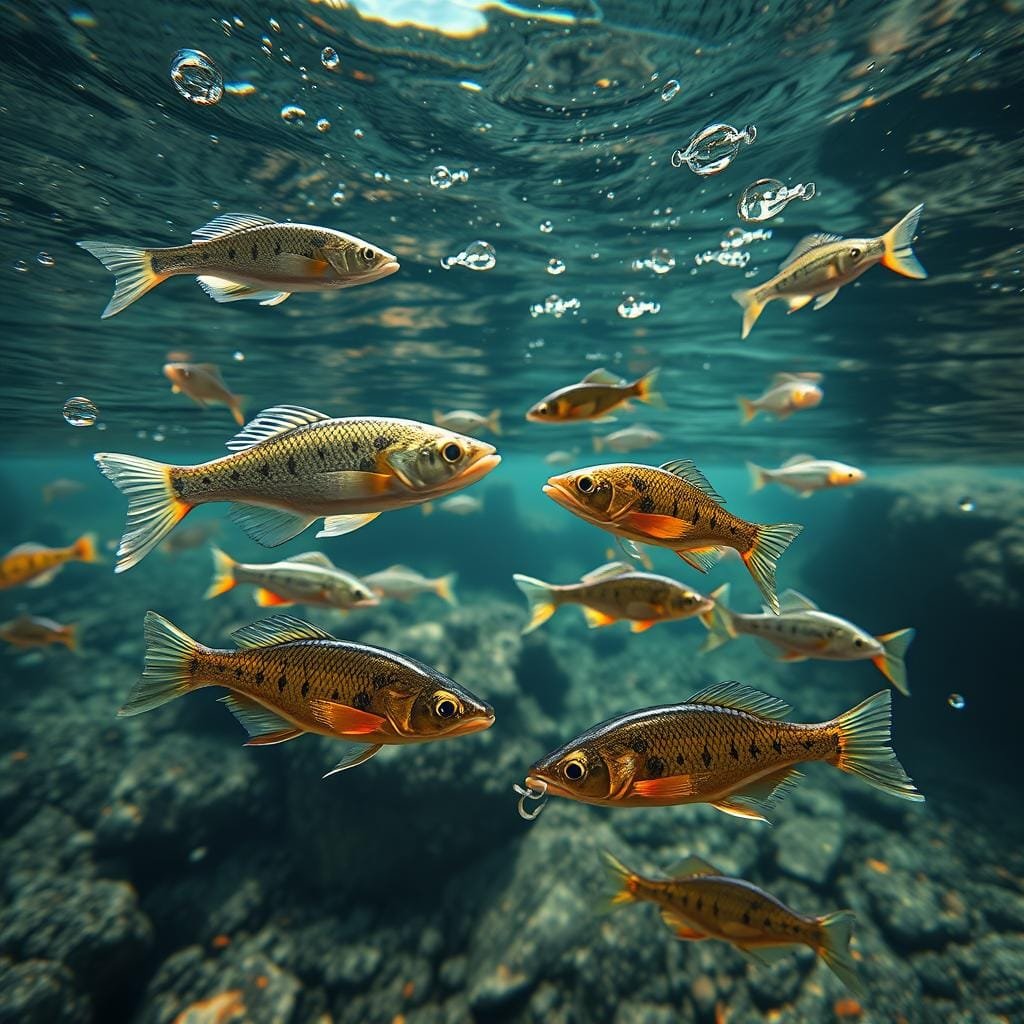
Swimbaits cover water and get smallmouth’s attention. A good paddletail jighead makes the bait swim straight. Slow down to let the tail show off.
Keitech Swing Impact FAT 2.8/3.8: head weights and screw-locks
The Keitech Swing Impact FAT works well on 1/8–1/4 ounce heads. Its body and tail move slowly but stay strong. For a straight swim, use a VMC Hybrid Swimbait Head with a screw-lock.
Choose the right head size for the water. Use 1/4 ounce for deep water and 1/8 ounce for shallow. Learn more about swimbaits for bass fishing here.
Reading tail thump and body roll for optimal speeds
Look for a steady tail thump and tight body roll. A heavy head makes the bait swim too slow. A light head makes it swim too fast.
Start with a medium speed and adjust. In cold water, move slowly. In warm water, speed up. The Keitech Swing Impact FAT works well at both speeds.
Color matching: smelt, cisco, and perch-based waters
In clear lakes, use a smelt color swimbait. It has translucent backs and pearl bellies. For sunlit areas, try cisco or shiner colors. Use perch colors near grass.
Choose colors based on depth. Dark heads work deep, and plain lead works in 10–15 feet. Use natural shades with a VMC Hybrid Swimbait Head. Switch between smelt, cisco, and perch to match the day’s forage.
Hair Jigs and Topwater for Trophy Moments
Two tools are great for catching big smallmouth bass. A marabou hair jig smallmouth approach works when they’re shy. A loud walker teases them on big flats and reef edges. Both need precise movement and smart reading of the water.
Outkast Feider Fly marabou: cold-water magic and sizes
The Outkast Feider Fly moves like a real baitfish. It’s perfect for catching fish in clear water. It comes in sizes from 1/16 to 1/8 ounce, great for shallow water.
Natural colors and careful tying help keep fish interested. Cast far, count down, and move it slow. This method works best in cold water and when the sun is high but the fish are not.
Ark Topwater Blower Twitch: walking big water, feathered treble advantage
The Ark Blower Twitch casts far and zigzags to attract fish. Its rattles and surface disturbance get noticed in windy or choppy water. The rear feathered treble is key when the bait stops.
Walk it steadily on big points or reefs, then pause near shade. On calm days, use a soft rod tip and wait until the rings disappear. This lets the feathered treble get extra bites.
Timing: low light, humidity spikes, wind vs. calm adjustments
Time your smallmouth topwater fishing for dawn, dusk, and cloudy days. High humidity makes the surface bite better, over rocks or grass.
In windy conditions, walk fast and keep the line tight. In calm water, slow down and pause more. Start with the Outkast Feider Fly in cool or cloudy conditions. Switch to the Ark Blower Twitch when fish go shallow or roam.
| Scenario | Primary Bait | Key Edge | Cadence Tip | Best Window |
|---|---|---|---|---|
| Clear, cold, neutral fish | Outkast Feider Fly | Lifelike marabou plume | Slow swim with subtle lifts | Midday sun, post-front |
| Windy reef or point | Ark Blower Twitch | Long cast and loud presence | Faster walk, fewer pauses | Rising wind, broken surface |
| Calm, high humidity | Ark Blower Twitch | Rear feathered treble at rest | Gentle walk, long stalls | Low light, hazy afternoons |
| Shallow cruisers on flats | Outkast Feider Fly | Natural glide in clear water | Countdown and slow, steady pull | Late spring to early summer |
Simple River-and-Creek Kits That Always Produce
Keep your river smallmouth kit simple and strong. Use one spinning rod and 4- to 8-pound line. Add a short fluoro leader and light jigheads.
Carry a small popper, tube, Ned rig, and swimbait or curl-tail grub. This setup catches craws, minnows, and leeches. It lets you move easily in clear water.
For tubes, try the Great Lakes Finesse Juvy Craw on the Mini Pro Tube Head. It’s great for finesse river bass. Use a Texas-style “Stupid Rig” for snaggy runs.
Add a Z-Man Finesse TRD on a Finesse ShroomZ for slow drifts. Keep a Kalin’s 3- to 3.5-inch grub or Keitech Swing Impact FAT for longer casts. Use 1/16 to 1/4 ounce head weights for the right depth.
Don’t forget a topwater like Rebel’s Pop-R at dawn. Also, have a small hard bait for twitching flats. Rapala’s Original Floating Minnow or Yo-Zuri’s Pin’s Minnow work well.
Check out this guide to creek smallmouth lures for more ideas. This kit is light, casts far, and keeps the bites coming.
It’s all about coverage and confidence. Try different lures in different spots. With the right gear, wading smallmouth is easy.
FAQ
What are the absolute top baits for smallmouth bass right now?
Top baits include the Berkley PowerBait MaxScent Flat Worm on a drop shot. Also, the Strike King Coffee Tube and Z-Man Finesse TRD with a Finesse ShroomZ head are great. Don’t forget the Great Lakes Finesse Juvy Craw, Megabass Ito Vision 110, and Rapala X-Rap. Rapala PXR Mavrik, Livingston Lures Jerkmaster 121/121D, DUO Realis Spinbait80, Keitech Swing Impact FAT 2.8/3.8, Outkast Feider Fly, and Kalin’s Lunker Grub are also excellent choices.
How do I match the hatch for smallmouth—crawfish, gobies, smelt, and shiners?
Use tubes, small craws, and craw-style Neds for crawfish. Compact tubes and green/brown patterns work for gobies. Jerkbaits, spybaits, and translucent paddletails are good for smelt and shiners.
Colors like green pumpkin, goby, perch, and smelt/silver are effective in clear water. Adjust the size and weight based on depth and current.
Smallmouth feel “predictably unpredictable.” How should I rotate lures?
Start with a search pair—jerkbait plus a paddletail or grub. If they follow but don’t eat, try a Spinbait80 or a drop-shot Flat Worm. Switch to a tube or Ned when they’re pinned to the bottom.
Keep three cadences ready: aggressive jerk-pause, steady spy-bait grind, and bottom-contact hops or drags.
What seasonal moves should I watch from spring through fall?
Early season, target 15 feet or less around big rock, sand/grass, and spawning areas with jerkbaits and hair jigs. Postspawn to summer, fish roam mid-depth breaks—paddletails, spybaits, and Neds shine. Fall pushes bait—jerkbaits, tubes, and swimbaits play as fish school and feed up.
Why is the Berkley MaxScent Flat Worm so deadly on a drop shot?
The MaxScent formula, flat profile, and subtle quiver keep fish curious and committed. It convinces pressured smallmouth to bite and hold longer, making it a staple in clear water. Colors like goby, green pumpkin, and smelt tones are favorites nationwide.
How should I rig a drop shot for clear northern water?
Use a light-wire drop-shot hook, 6–10 lb fluorocarbon leader, and set leader length from 8 to 24 inches. Pair the Flat Worm with natural hues. Downsize your weight in shallow water and go heavier when drifting or in wind to hold bottom.
Is there a reliable drop-shot alternative to MaxScent?
Yes—the Yamamoto Shad Shape Worm remains a pressure-beater with a clean profile and lively tail. It’s a great change-up when scent isn’t the trigger or when fish want a more translucent look.
What makes the Strike King Coffee Tube a must-carry?
Its scent, precision-cut tails, and proven 3.5-inch size produce everywhere from creeks to the Great Lakes. Top colors include green pumpkin, magic goby, and crazy craw. Rig 1/16 to 1/4 oz inserts; go exposed hook for sparse cover or Texas “Stupid Rig” around rock and wood.
When does the Great Lakes Finesse Juvy Craw outfish a standard tube?
In ultra-clear water, on pressured fish, and in rivers or creeks where a micro craw matches juvenile forage. It pairs with a Mini Pro Tube Head, stays compact, and holds up to multiple bites without tearing.
What tube rigging options cover most situations?
Use an exposed insert head for open rock and short hops. Texas “Stupid Rig” an EWG tube insert to slide through wood, cribs, and snaggy current seams. For extra action and a higher hookup ratio, try a swinging head like the Freedom Tackle Zodiac in 1/8–1/4 oz.
Why is the Z-Man Finesse TRD with a Finesse ShroomZ so consistent?
ElaZtech buoyancy stands the bait upright, slows the fall, and feels natural. It triggers bites in cold fronts, clear water, and pressure. It’s also durable, so one pack covers a lot of fish, from shallow banks to 25 feet.
When should I switch to a craw-style Ned like the Savage Gear Ned Craw?
When smallmouth are keyed on craws, specially on rock transitions and flats. The realistic body and colors crush during crawfish “chew” windows, or when a standard stick-style Ned gets short-bitten.
Should I use heavier Ned heads or go weedless in rivers?
In lakes and wind, heavier mushroom heads—even up to 5/16 oz—keep you in touch with bottom. In rivers and snaggy cover, go lighter and weedless or Texas-riggable heads to reduce hang-ups while maintaining bottom proximity.
What sets the Megabass Ito Vision 110 apart?
It casts long without killing action, suspends predictably, and offers a deep, natural color lineup. It’s a trophy and numbers producer that excels from cold to warm water with cadence tweaks.
How do Rapala X-Rap and PXR Mavrik fit into the jerkbait game?
The X-Rap is a classic pause bait—most strikes come on the pause, sizes 08 and 10 cover smallmouth forage. The PXR Mavrik adds bullet casting and sticky VMC RedLine hooks, making it a modern workhorse in wind and open water.
When should I pick the Livingston Jerkmaster 121/121D?
In clear northern lakes, specially with perch patterns. It’s visible on forward-facing sonar, runs true on 10–12 lb fluorocarbon, and shines with aggressive, erratic snaps to pull reaction bites and followers.
What’s the ideal jerkbait gear and cadence?
Use a 6’10” medium or medium-heavy for 110/121 and a 7’2” medium-heavy for deeper-diving 121D. Spool 10–12 lb fluorocarbon. In cold water, lengthen pauses; as temps rise, speed up with sharper snaps—think jerk-jerk-pause and adjust to mood.
What’s the single best bait for smallmouth bass if I can bring only one?
If forced to pick one, a 2.75-inch Z-Man Finesse TRD on a Finesse ShroomZ head covers the most situations, from rivers to deep structure. If you can bring two, add the Berkley MaxScent Flat Worm on a drop shot.
How do I fish the DUO Realis Spinbait80 in 8–17 feet?
Make long casts on light line, count it down, then reel just fast enough to keep a steady roll and micro flash. Avoid rod twitches; the bait works best on a straight, subtle retrieve along edges and over clear flats.
What line and retrieve speed keep a spybait in the zone?
6–8 lb fluorocarbon helps it track and sink properly. Retrieve slow to moderate to prevent it from rising. If you tick weeds or rocks, slow down or increase your count-down before starting the retrieve.
When do spybaits beat jerkbaits or swimbaits?
In calm, clear conditions when fish follow but won’t commit, or when paddletail thump spooks them. A Spinbait80’s finesse flash often seals the deal on suspended or roaming smallmouth.
What heads and sizes pair best with the Keitech Swing Impact FAT 2.8/3.8?
Use 1/8–1/4 oz jigheads to control the lower water column. Screw-lock heads like the VMC Hybrid Swimbait Head or STC Prowler Finesse keep the bait pinned and swimming true at any speed.
How do I read tail thump and body roll on paddletails?
The thin tail should kick at slow speeds with a subtle body roll. If it spins or blows out, upsize the head or slow down. In cold water, barely crawl it; in warm water, speed up over breaks and grass edges.
What colors should I choose for smelt, cisco, and perch waters?
Go natural and translucent—smelt/silver, pro blue, alewife, Tennessee shad, and subtle perch patterns. In bright sun, clearer baits shine; in clouds or stain, add a hint of chartreuse or darker back.
When does the Outkast Feider Fly marabou outproduce plastics?
In cold water and during neutral moods. Its natural plume draws fish from a distance without spooking them. Run 1/16–1/8 oz in natural browns and blacks on light line and let the hair breathe.
How do I fish the Ark Topwater Blower Twitch for big-water smallmouth?
Make long casts, walk it steady, and let the rattles call them up. The feathered rear treble converts pauses into bites. Speed up in wind; in calm water, add short pauses over isolated structure.
What are the best times for hair jigs and topwater?
Hair jigs shine in cold water and postfrontal lulls. Topwater peaks June through September, specially in low light, on windless days, and during humidity spikes. Fish will travel a long way to crush a popper or walker.
What’s a simple, packable kit for rivers and creeks?
Bring a small popper, a 3.5-inch Coffee Tube, a Ned rig with a Z-Man TRD, and a 2.8-inch Keitech or a Kalin’s Lunker Grub. Add 1/16–1/4 oz heads and a weedless tube setup. One medium-light spinning rod and 6–8 lb fluoro leader will cover wading, kayak, or bank missions.