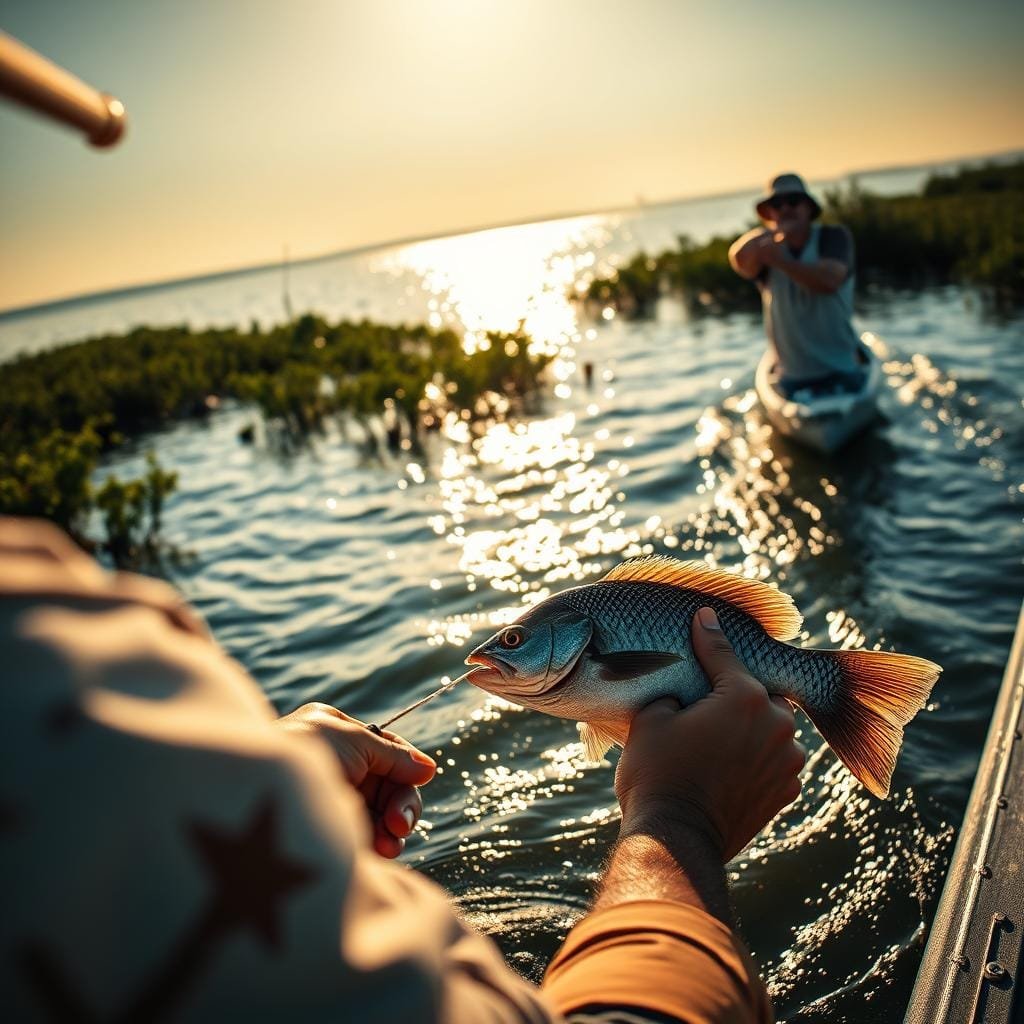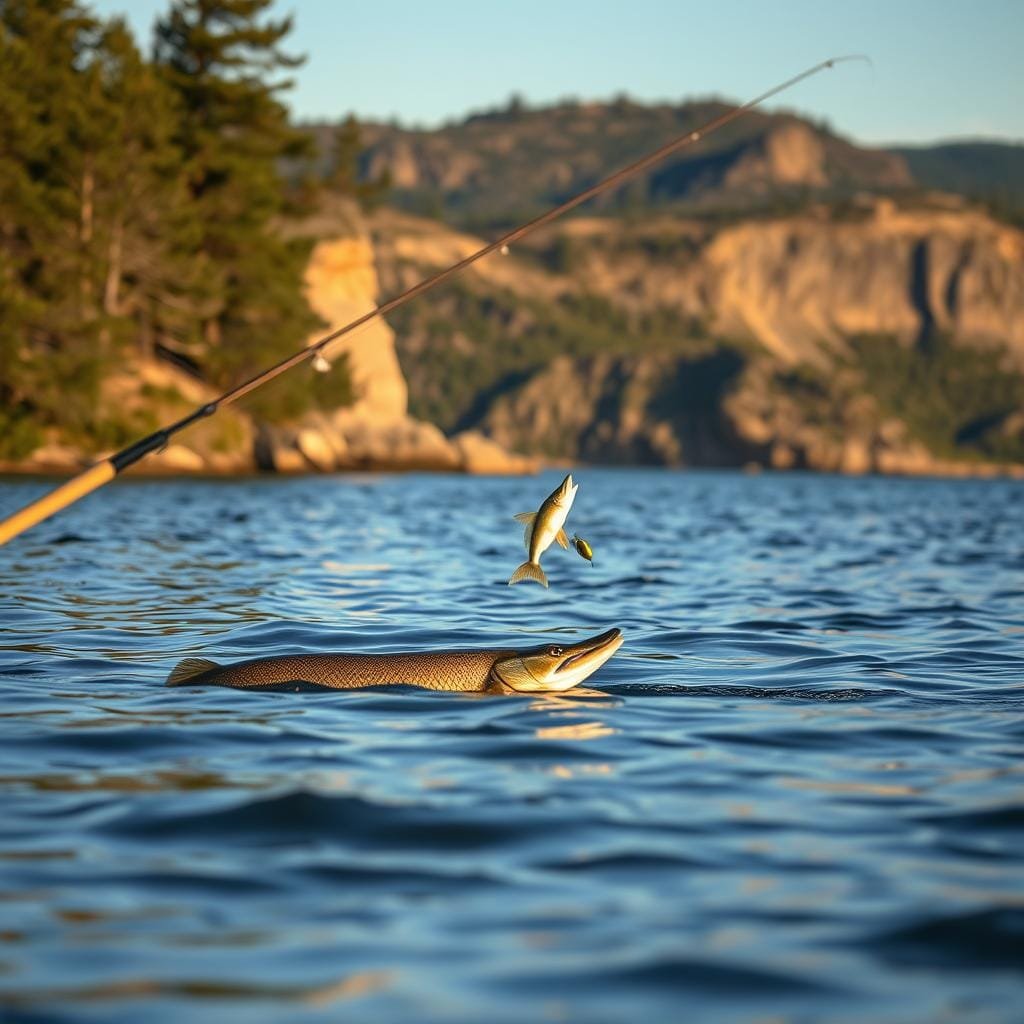
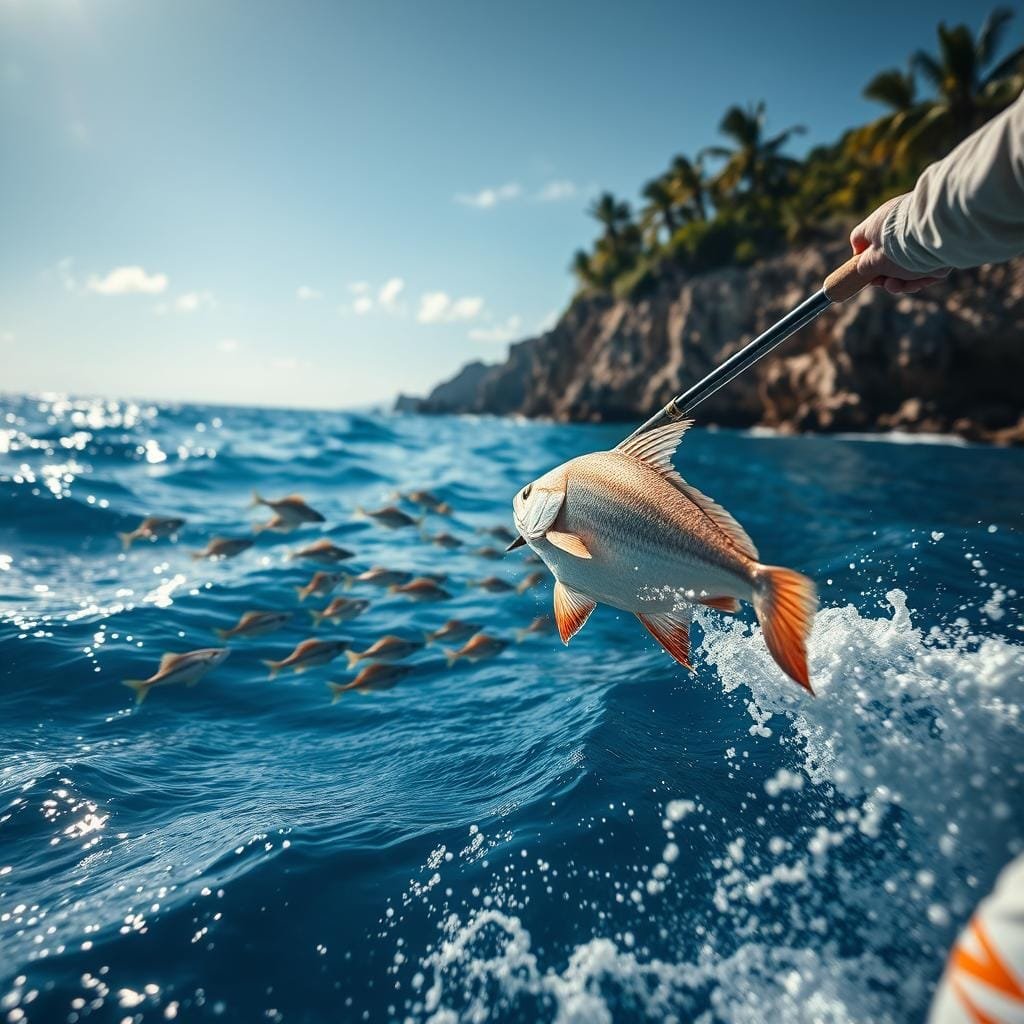
Greater amberjack, or Seriola dumerili, are known as “reef donkeys.” They are very strong and never stop fighting. This guide will teach you how to catch them with the right techniques and gear.
Amberjack like to hang out near wrecks, reefs, and deep springs. They can be found from 60 to 250 feet deep. But, they can come up to the surface if they see bait or a hooked fish.
In the spring, they gather around big structures to spawn. To catch them, you need strong tackle and to pull hard. Also, avoid using steel or rock near them.
Live bait and lures work well for catching amberjack. Blue runners, pinfish, and squid are good choices. Diamond and butterfly jigs also attract them. A surface popper can make them jump out of the water.
In the Gulf of Mexico, captains use special techniques to catch them. They mark depth bands and quickly drop to the right spot. Then, they pull hard to lift the fish up. This method helps catch big amberjacks and saves your fishing gear.
To catch amberjack, fight smart and clean up after. Keep steady pressure and make short gains. Use a belt or harness to stay comfortable. Bleed and ice your catch fast for good fillets. Cook them well to avoid any health issues.
Amberjack basics: behavior, habitats, and when they bite
Amberjack are bold and fast. They like to be near structure. Knowing where they live helps you fish better.
Where they live: wrecks, reefs, springs, and rig legs (60–400 feet)
They like to be close to steel and rock. Places like reefs and wrecks are their homes. They can be found from 60 to 400 feet deep.
They stay near the structure and then attack their prey. On sonar, look for thick arches over wrecks or reefs. Live chumming can bring them up from the bottom.
Seasonal patterns and spawning windows in spring
The AJ spawning season is in spring. But when it starts can vary. Before they spawn, they eat a lot near the edges.
During their peak spawning time, they move between structures. But they always look for places where current meets cover.
Why structure matters and how pressure affects size classes
Structure helps them find food. That’s why fishing spots with metal and deep water are good. Current makes them more active.
Too many fish can make them smaller. Fishing pressure changes the size of the fish. More small fish in busy spots, bigger ones in quiet ones.
how to catch amberjack
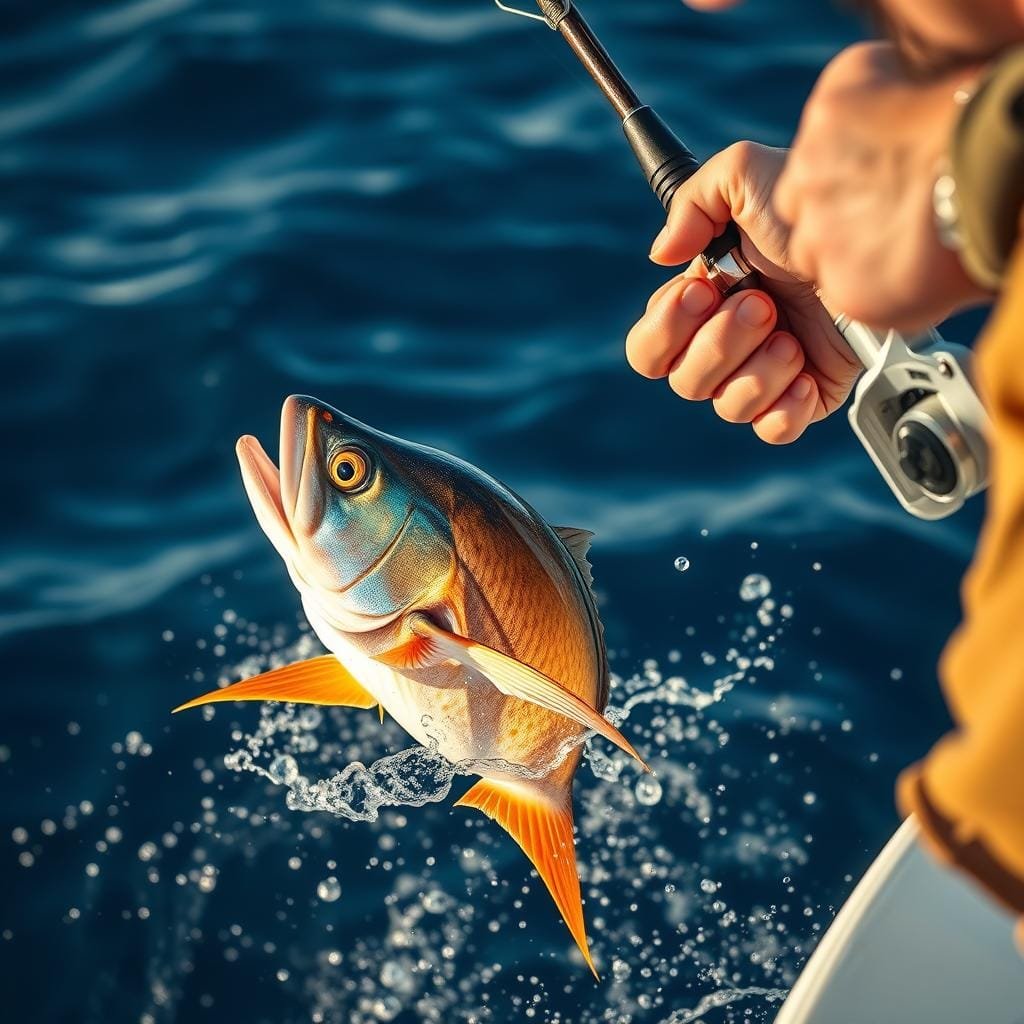
Start with sturdy gear. Use a setup with 50 lb or heavier braid and a reel like a Penn International 50. This lets you pull hard from the start. Mark your line in 20-foot bands for precise fishing over wrecks and reefs.
Sabiki up 20–30 hardtails at a nearshore rig. Then, head to structure with clean water and a good drift. Use sonar to find the right depth, usually 175–250 feet. This keeps you on target and ready for action.
Rig live baits on a slip sinker or Carolina setup. Use 150–250 lb mono and a 200–400 lb leader. Choose 8/0–13/0 circle hooks based on bait size. Pick 8–32 oz leaders based on current.
When barracuda show up, drop a downrigger or freeline with light chum. Chum can bring fish up from the wreck. This opens space for a good fight. Be ready to move the boat at hookup.
Large blue runners, pinfish, or squid are great lures. But don’t forget artificials. Try diamond, butterfly, and slow-pitch metal with different rhythms. Mixing live bait and jigs keeps the fish guessing.
On the bite, pull hard and keep the rod tight. The first few minutes are key. Use a harness or cushioned butt. Pull the fish away from the wreck quickly. This prevents losing fish and makes fishing repeatable.
Best live baits for AJs: hardtails, pinfish, runners, and more
Hungry amberjack love bold, lively baits. Small jacks, grunts, and hardy reef bait work well. It’s smart to have many options ready.
Top live baits and sizes that trigger strikes
Blue runners and jumbo pinfish are great for AJs. Grunts, mullet, and squid also work. But, tougher baits last longer.
- Blue runners: 8–14 inches; fast, durable, and easy for AJs to track.
- Pinfish: palm-size to 1 pound; thump hard and swim down on their own.
- Big options: skipjack or small bonito can pull giants out of structure.
Large baits can attract big fish. They help weed out smaller ones.
Sabiki strategies: catching and caring for hardtails
Use rigs, rips, and buoys up to 400 feet for quick bait missions. Sabiki rig tips include downsizing hooks in clear water. Add a 1–3 oz sinker to reach schools fast.
- Drop at platforms in 100–170 feet until the well holds 20–30 runners.
- Bleed no baits; keep them pristine in a high-flow, round livewell.
- Change weak baits early—fresh kicks out-fish tired ones every time.
Stagger sabiki depths until you mark bait on sonar. Then, stay glued to that band to fill the tank efficiently.
Rigging live baits: slip sinker/Carolina rigs and leader choices
For Carolina rig amberjack setups, use heavy mono with circle hooks. Just enough lead to hold depth is key. Start lighter and scale up if needed.
- Standard: 150–200 lb mono leader, 8–12 oz egg sinker, 8/0–10/0 circle.
- Heavy: 200–400 lb leaders, 16–32 oz lead, 11/0–13/0 circle for bruisers.
- Hook placement: nose-hook runners; bridle larger baits to keep them lively.
Keep leaders short around steel to turn fish fast. Lengthen in clear water when they act wary.
When to freeline, downrig, or troll live baits
Freeline pinfish or runners in gentle current. Splash the rod tip to coax them up. Then, drop a hooked bait into the chaos.
- Downrigger amberjack: send livies below barracuda layers and hold a fixed depth over wreck edges.
- Slip sinker drops: count down to 150–250 feet and hover above the structure.
- Troll live runners along rig legs to cover water when marks scatter.
If the bite stalls, rotate baits and change depth by 20-foot increments. Reset angles with the wind and current until you see clean, vertical drops on the screen.
| Bait | Best Size | Primary Rig | Depth Approach | Why It Works |
|---|---|---|---|---|
| Blue runners (hardtails) | 8–14 in | Carolina rig amberjack, 150–200 lb leader | Drop to 150–250 ft; hover over structure | Tough, fast swimmers that draw reaction bites |
| Pinfish | Palm-size to 1 lb | Freeline or slip sinker | Suspended fish or light current | Natural “thump” and tendency to swim down |
| Grunts/Mullet | 6–12 in | Slip sinker; short leader near steel | Work wreck edges and rig legs | Readily available and stay active on hook |
| Skipjack/Small bonito | 2–5 lb | Heavy Carolina or bridle | Deep drops for trophy fish | Big profile that tempts largest AJs |
| All livies with cudas present | Stout, lively | Downrigger amberjack | Below barracuda zone | Protects baits and pins depth on target band |
Go-to artificial lures that crush amberjack
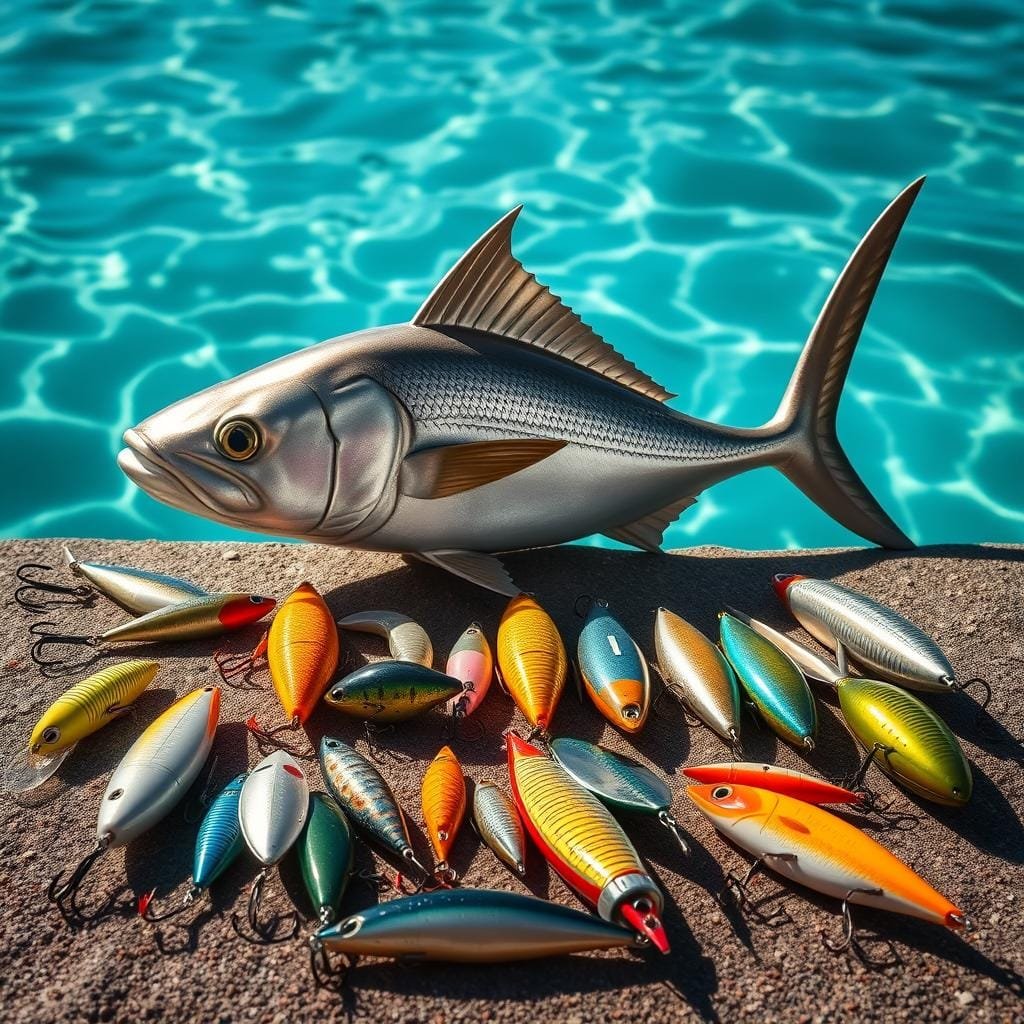
When live bait is hard to find, try smart artificial lures. Amberjack jigs work well around wrecks and rigs. They also do great when the current pushes bait tight to steel. Use heavy tackle and move slowly to let the lure do its job.
Vertical metal jigs: diamond, butterfly, and slow-pitch profiles
Diamond jigs and West Coast iron like the Salas 6X drop fast. They call fish when AJs stack deep. Shimano butterfly jigs with a single or twin assist hook hold well in violent runs.
For slow pitch jigging AJs in heavy current, choose flat, wide bodies. These glide and flash on the fall. Work the water column in bands. Speed bursts with sharp lifts trigger bites when AJs are racing.
A slower jigging cadence and long falls keep the jig in the zone. This is when fish want a flutter instead of a sprint.
Bucktails, paddletails, and blade styles for wreck work
A stout bucktail for amberjack, dressed with a curly tail, gets down and stays straight. Pair a 4-ounce paddletail on a strong jighead for thump you can feel. Both hold up when you need to steer fish off beams and crossmembers.
Blade styles and metal spoons mop up after a flurry. If a bucktail bends, swap to a heavier hook model from brands like Spro or Tsunami. Keep pressure constant.
Surface poppers and flies when fish rise to chum
When chum pulls them up, topwater poppers amberjack love loud, hard pops. Rip a Yo-Zuri or Halco with two or three violent chugs, pause, then repeat. Explosions follow the pause more than the splash.
Fly anglers can play too. A 10-weight with a chartreuse streamer and short roll casts gets crushed when fish pin bait under the foam. Keep leaders stout.
Color, weight, and cadence tweaks for current and depth
Match weight to depth and drift so your lure reaches 120–300+ feet without scoping off the target. Silver, sardine, and pink-gold patterns cover clear water; chartreuse and blue help when clouds stack or current muddies edges.
Rotate profiles and refine jigging cadence until they eat: butterfly jigs for flash, compact slabs for speed, and longer amberjack jigs for a wider sweep. Small tweaks—an extra crank, a longer fall—often flip the switch on slow pitch jigging AJs.
Heavy-duty tackle that survives reef donkeys
Amberjack hit like wrecking balls. So, build your tackle with torque, drag, and shock control. Use heavy tackle AJs with reels that stay smooth and rods that turn fish fast. If unsure, size up and keep them off the metal.
Conventional vs. spinning: when each shines
Conventional is best for vertical drops and heavy live baits. Use Accurate BX2, Penn International 50W/80W, and Shimano TLD 50 with stout rods. Spinning is great for poppers and sight work when AJs rise. Use Shimano Stella or Penn Slammer with tall-capacity spools for long runs.
Use a fighting harness or a cushioned rod butt for grinding. It keeps the rod loaded and your back fresh while pinning fish away from wrecks.
Mainline and leader: braid strengths and 150–400 lb mono leaders
For mainline, use 50–80 lb braid to cut current and drive hooks home fast. Some run 150–250 lb mono main for stretch and abrasion, mainly with stand-up sets. Tie braid and mono leaders cleanly. Use short 150–400 lb mono leaders to take rub when fish bulldog the steel.
AJs aren’t line shy. Choose braid and mono leaders based on structure and size class, not looks. For community science on greater amberjack and other jacks, see the South Atlantic citizen-science notes that mention otoliths and fin clips.
Hooks and weights: 8/0–13/0 circle hooks, 8–32 oz sinkers
Match circle hook sizes to bait and current. Use 8/0–10/0 for hand-size pinfish or runners, and 11/0–13/0 for jumbo hardtails. Stay with strong-wire patterns to prevent flexing under drag. For egg sinker weights, start at 8 oz on slow drifts and push to 16–32 oz when current rips or you’re fishing 250–400 feet.
Carolina rigs with sliding egg sinker weights keep baits natural yet pinned in the strike zone. Crimped 200–400 lb leaders and heavy swivels stop twist and heat.
Fighting belts, harnesses, and cushioned rod butts
A fitted belt and fighting harness lock leverage to your legs, not your lower back. A Luna Sea Cush-it or similar butt pad saves hips during long lifts. Keep drag high, stance square, and pump short to make steady gains without giving the fish an inch.
| Scenario | Reel/Rod Class | Mainline | Leader | Circle Hook Sizes | Egg Sinker Weights | Notes |
|---|---|---|---|---|---|---|
| Deep wreck drop (200–350 ft) | Penn International 50W, stand-up 80–130 | 80 lb braid or 150–200 lb mono | 200–400 lb mono | 10/0–13/0 | 16–32 oz | Hammer drag early to clear structure |
| Mid-depth live bait (120–200 ft) | Accurate BX2 or Shimano TLD 50, heavy conventional | 65–80 lb braid | 150–250 lb mono | 8/0–11/0 | 8–16 oz | Short leader for quick lift, long for abrasion |
| Surface poppers over marks | Shimano Stella 14000–20000, Tallus 80–130 | 65–80 lb braid | 130–200 lb mono | 8/0–10/0 (inline circles for stickbaits) | N/A | Use a fighting harness for long runs |
| Heavy current rig legs | Shimano TLD 50, broomstick stand-up | 80 lb braid with mono topshot | 300–400 lb mono | 11/0–13/0 | 24–32 oz | Go heavy; AJs are not line shy here |
Set up for heavy tackle AJs from the start. Balanced tackle, smart circle hook sizes, and tuned egg sinker weights work together. This way, you can lift fast, turn heads, and keep your crew fresh for the next drop.
Boat positioning and sonar: put baits in the strike zone
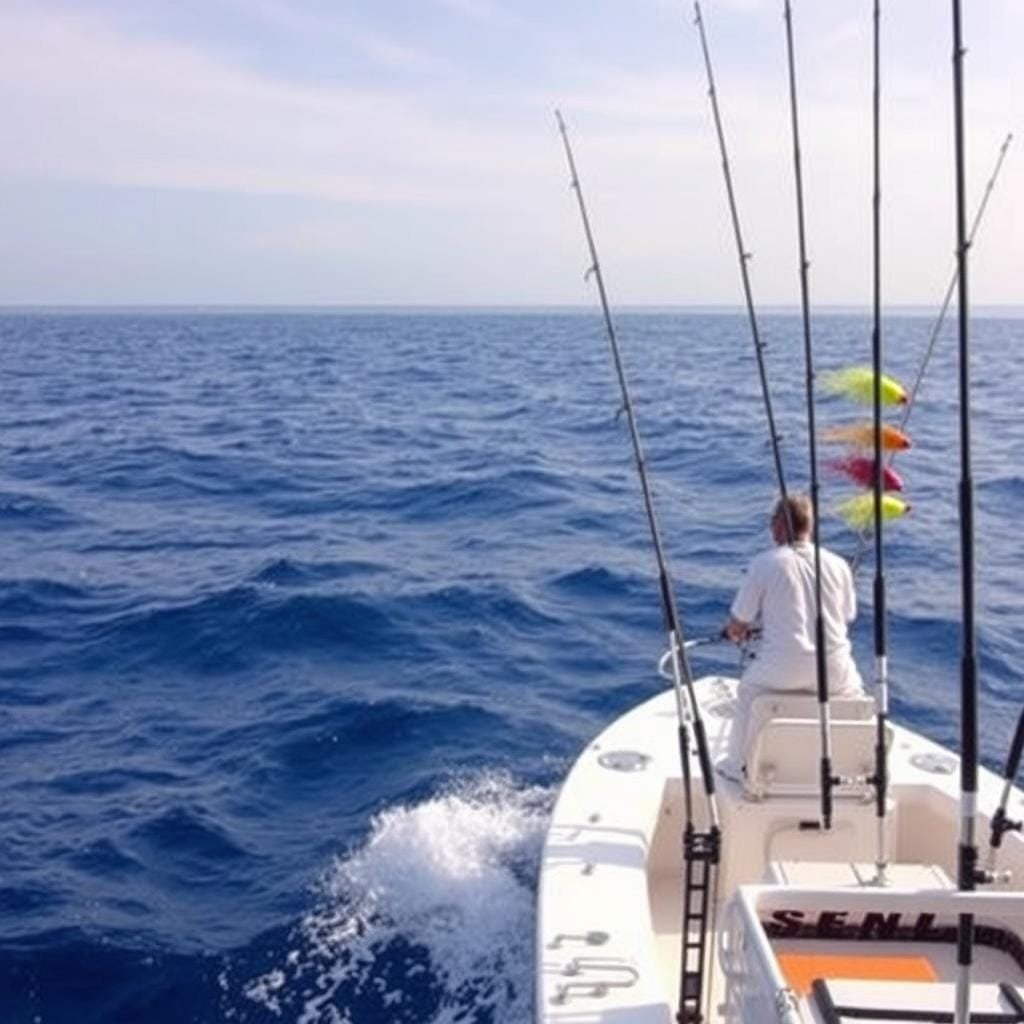
Lock in your drift before you drop. Use sonar for amberjack to see where fish ride above the steel. Then, set a clean line that keeps baits in range without sliding under the rig. Keep crew ready to shift gears the moment a rod loads.
Reading arches over structure and marking depth bands
Start by reading fish arches that stack just off the wreck crown. On a Garmin, Simrad, or Furuno, the biggest marks hang 10–40 feet above the metal. Pin a waypoint, then note the depth band where the returns are thick.
Mark lines every 20 feet with colored tape or Sharpie. If arches sit at 150–220 feet, drop to that band fast. If the bait sinks past, count cranks to return to the zone. Repeat passes until you get clean bites without snagging.
Approach angles, current lines, and safe rig distance
Test the approach angle current with a short drift upwind and up-tide. Slide to a safe lane that keeps the boat 60–120 yards from the legs, depending on seas and traffic. This gap lets you work baits without gifting fish the structure.
Refine boat handling rigs so the bow points into the set, not the swell. Small throttle bumps hold your track. Keep your team synced so drops start as you cross the depth band, not after you’ve drifted off it.
Using the boat to pull hooked AJs away from steel
When a fish eats, go forward into the drift and turn the bow off the rig. That motion starts pulling fish from structure before it can pinwheel to the legs. Keep pressure steady and communicate drag changes out loud.
Short, controlled moves beat big swings. Nudge ahead to gain the first 30 feet, then ease into a slow arc that widens the angle. Watch the screen and keep the fight path clear of cross-members while the angler gains line.
Presentation tactics that trigger strikes
Amberjack hit when your bait lives at their level. Treat every drop like a mission in depth control amberjack work. Make small moves, watch the sonar, and adjust pace so your lure or bait stays in the bite zone longer.
Counting down to 150–250 feet and line-marking in 20-foot increments
Start deep, often 150 feet or more, and count the fall. Use line marking 20 feet with tape or ink so you can repeat exact bands around wrecks and rigs. If you miss a thump, reel 10–20 cranks and pause to re-engage followers riding the structure.
On calm days, AJs slide up the column. Keep your marks honest and reset the count as current changes. Precise marks make it easy to return a jig or live bait to fish you saw seconds ago.
Jigging cadence: sharp lifts vs. slow-pitch glide
Match mood and current with slow pitch vs speed jigging. A fast, sharp lift can trigger reaction bites tight to steel. When fish sulk midwater, let a slow-pitch flutter hang in their face and glide.
Switch profiles and work angles until the rod talks back. Keep the motion balanced—clean lifts, crisp drops, and brief stalls—to make metal act like a fleeing or wounded baitfish.
Chumming tricks: live freebies and surface splashing
Feed the school with live chum amberjack tactics. Toss a few runners or pinfish, then freeline a bait in the chaos. Tap the rod tip to splash like a busted pod; once they rise, a popper or fly keeps them fired up.
When a fish shakes a bait and peels away, free-spool a few feet and brace for the second hit. School competition often seals the deal.
Downrigger and controlled-depth deployments
Use downrigger AJs strategies to park baits under barracuda and hold them in tight depth bands. Pair the ball with a sturdy leader and send a live runner just below the predator line, then drift across the mark.
Controlled drifts and subtle throttle bumps keep offerings centered on the strike band. For more ideas on jig weights, live bait moves, and mid-column tricks, see this guide from Florida Sportsman.
The fight: don’t let up and win the first five minutes
When a big AJ eats, act fast. Fighting amberjack is a sprint, not a jog. Stay focused and keep the pressure on.
Hammer down at the hookset and keep rod loaded
Drive the hook hard. Then, lean in and keep the rod bent. Never give up.
Do two or three hard cranks, lift, and repeat. This helps pull the fish away from wrecks or rig legs. Use a harness or Cush-it butt to protect your back while applying steady pressure.
Short pumps, measured gains, and controlled drag
Use short pumps: lift a foot, gain two cranks, and drop smoothly. Keep the drag tight but safe for your line class. Let the fish take short runs, then go back to work.
Small wins add up fast in the water column.
Boat-assist tactics to clear structure fast
Call for a boat assist fight as soon as the rod loads. The helm should ease into reverse or angle off the structure. This quick move buys you feet of water and keeps the fish from wrapping you in metal.
Handling doubles when schoolmates follow
When schoolmates rise, have a pitch bait or jig ready. One angler fights while another drops. The captain keeps the spread clear.
Communicate position, line angle, and pump timing. This keeps both fish away from danger.
| Moment | Action | Why It Works | Pro Tip |
|---|---|---|---|
| Hookset | Hammer down, keep rod loaded | Stops the initial dive toward structure | Two power cranks before the first lift |
| First 60–120 seconds | Short pump technique with tight drag | Creates steady gains without slack | Lift 12 inches, gain two turns on the drop |
| Fish surges | Let it run briefly, maintain pressure | Prevents pulled hooks while wearing it down | Keep the rod angle at 45–60 degrees |
| Near structure | Boat assist fight, angle away | Clears rig legs, wreck edges, and rocks | Helm bumps in reverse to change the line |
| School rises | Deploy pitch bait for doubles amberjack | Maximizes the bite window | One angler calls angles; the other drops |
Depth and location targets across the Gulf and beyond
First, set your depth. Then, look for life in the structure. The best spots in the Gulf for amberjack are near bait, current, and clean water edges. Use sonar to find mid-column marks. Place your baits just above them for quick strikes.
120–300+ foot wrecks, reefs, and Gulf oil platforms
Begin on wrecks and springs at 120–200 feet. Hardtails and runners are common here. As the sun gets higher, move to 175–250 feet. Even when it seems quiet, fish are there.
When fishing oil platforms, check the upcurrent legs. Let your baits pass by the shadow line. Keep a jig or live bait ready for a quick drop to 300 feet. The bigger fish are often below the main school.
If barracuda are everywhere, try a fast vertical jig. This can trigger reaction hits.
Productive blocks: West Delta, Main Pass, South Pass
Focus on rig rows and pipeline intersections. West Delta amberjack like platforms with steady bait shows and rips. Check nearby structures before moving on; the next spot might be hot.
Main Pass South Pass AJs prefer platforms and reefs in 200–300 feet. Start by sweeping baits through 175–250 feet. Then, go deeper. These areas are quick to reload after tide changes, so come back when the current changes.
Midnight Lump and bluewater edges when rigs are slow
When rigs are quiet, try the Midnight Lump. Current breaks and bait showers can lead to a quick bite. Keep one bait deep while chumming; you might catch two at once.
Bluewater rips and color changes are great alternatives. Fish the edge, catch mahi on top, and drop a jig under the weedline. Rotate through these spots to find fresh fish and clean water.
Live-bait rig recipes from proven captains
Anglers love the amberjack Carolina rig. It puts bait right where fish bite. It’s strong when fish pull hard.
Choose the right bait and tackle for the water. Use live speedos and other hardy baits when you can. Adjust hook size and weight for the conditions.
Carolina rigs with stout mono leaders for bruisers
Begin with 50–80 lb braid and a strong swivel. Add an egg sinker for depth. Then, tie 6–10 feet of 150–200 lb mono.
For sharp wreck edges, use 200–400 lb mono leaders. Rig live baits on circle hooks 8/0–13/0 through the nostrils.
- Standard wreck setup: 8–16 oz weight, 200 lb mono, 10/0 hook for 150–220 feet.
- Max pressure near rigs: 16–24 oz weight, 300–400 lb mono, 11/0–13/0 hook.
- Freeline drift on slack: downsize weight but keep the bite leader stout.
When to step up to 200–400 lb leaders and big circles
Use heavier gear for tight fish or short, brutal runs. Heavy mono leaders 200–400 lb resist chafe. Circle hooks 8/0–13/0 won’t roll out under heavy drag.
- If you feel constant scuffing, upgrade leader class mid-drift.
- Oversized baits call for larger circles to keep the point exposed.
- When marking true giants, pre-rig a big-gear rod with the heavier set.
Weight selection by depth, current, and drift speed
Egg sinker selection is key. In 150 feet with light current, 8–12 oz works. For 250–300+ feet or hard tide, 16–32 oz is better.
| Scenario | Depth | Current/Drift | Egg sinker selection | Leader | Hook |
|---|---|---|---|---|---|
| Wreck edge, moderate flow | 150–200 ft | 0.5–1.0 kt | 8–12 oz | 200 lb mono | 10/0 circle |
| Rig legs, heavy pull | 200–280 ft | 1.0–1.8 kt | 16–24 oz | 300–400 lb mono | 11/0–13/0 circle |
| Deep hump, variable drift | 280–340 ft | 1.2–2.0 kt | 24–32 oz | 250–300 lb mono | 10/0–12/0 circle |
These tweaks keep your bait in the strike zone. Balance egg sinker selection with leader class. Keep circle hooks 8/0–13/0 ready for fast changes.
Common mistakes that cost fish
Big AJs punish sloppy choices. Most amberjack mistakes come from bad gear, too much pressure, and wrong angles. Make sure your gear is ready before you drop it. This way, you’ll keep more hooks in fish and less metal on the bottom.
Going too light on rods, reels, and line
Too light tackle means a bad start. Use strong rods and reels with 100–130 lb braid and 200–400 lb mono leaders. This stops break-offs when a big fish digs into structure.
Lock drags early. A firm lift and steady crank beat hesitation. Running 8/0–13/0 circle hooks keeps the bite pinned while you pour on pressure.
Letting fish reach wrecks, rocks, or rig legs
Hit them hard as soon as the hook lands. Steer off the beam. One or two short pumps should pull the fish into open water. Pausing lets the fish wrap and you lose metal and time.
Use the boat to angle away from wrecks and rig legs. Aim for separation in the first minute, not later.
Underworking jigs and ignoring current-driven angles
Many anglers barely twitch the lure. That’s a big mistake. Drive the jig with crisp lifts, then controlled drops that keep contact. Mix fast rips with a pause to trigger the chase.
Read the current before dropping. Start your drift up-current so your line tracks vertical over the mark. Poor angles create instant snag risk and more break-offs rigs, the hallmark of avoidable jigging errors.
Underestimating barracuda and shark interference
Expect barracuda sharks amberjack chaos around busy wrecks. Cuda clip tails off livies; sharks tax every slow fight. Drop live baits below the midwater cuda zone with heavier sinkers or a downrigger, and shorten fight times with stout gear.
Keep a spare rod rigged; when predators show, redeploy fast and change depth bands to keep your spread intact.
Safety, ethics, and table fare
Big amberjack are tough and need care. Always think about safety first. Treat each fish with respect.
Fight fatigue management and crew communication
Long fights can make you tired. Wear a good stand-up belt. Use a harness or butt cushion to avoid bruises.
Take turns fighting and drink water. Keep your messages clear. Say “color,” “run,” or “short pumps” to the helm.
Bleeding, icing, and fillet care for firm meat
Bleed fish right away and keep them cold. This keeps the meat firm and tasty. On the way back, keep the fish cold.
At the dock, remove dark bloodlines carefully. Skin them slowly. This meat cooks well and stays good in stews.
Parasites and ciguatera awareness: cook thoroughly and know local advisories
Amberjack often have parasites. But they’re safe to eat when cooked well. Avoid eating them raw.
In some places, there’s a risk of ciguatera. Follow local advice. Choose smaller fish if advised to do so.
If unsure, freeze parts of the fish. Label them with date and location. Share safety tips with your crew. This keeps everyone safe and makes the trip fun.
Regional notes: Texas to Florida and Panama to Kona
Gulf Coast AJ fishing is all about structure and current. Texas amberjack hang out on wrecks and near the shelf break. They like blue runners and squid.
In Louisiana, rigs AJs are found on West Delta, Main Pass, and South Pass. The Midnight Lump is also good when bait is present. Florida amberjack are found in springs, ledges, and towers. Chumming can bring them up high for poppers or flies.
Using live bait and a slip sinker rig is key. Mark your line every 20 feet. Pulling hooked fish off steel saves gear and fish.
Heavy tackle is a must. Use Penn International or Shimano TLD 50-class outfits. Add Tallus rods, 200–400 lb mono leaders, and strong drags. Switch to surface poppers when fish go shallow.
For jigs, try a Salas 6X or slow-pitch profile. This covers current swings and keeps you in the bite window.
Pressure affects fish size. Lighter traffic means bigger fish. This is why Panama and Kona amberjack are so big.
Work seamounts, pinnacles, and rig legs like in the Gulf. Use pinfish or blue runners down deep. Then chum to lift the pack.
See this overview of essential fish habitat. It shows how reef-linked predators use structure across the Gulf.
Season and current are key. Spring has steady action. Fish stage on edges from Texas to Florida. Loop-current fingers and bluewater rips can change things overnight.
When Louisiana rigs AJs get tough, try nearby color breaks. Keep bait fresh, cadence crisp, and the first five minutes tight. That’s where trips are made.
FAQ
What makes amberjack such powerful fighters, and where do they live?
Greater amberjack, also known as “reef donkeys,” are very strong. They live in wrecks, reefs, and deep springs. They can be found from 60–400 feet deep.
Big amberjacks usually stay deeper but can come up to the surface when chummed.
When do amberjack bite best and when do they spawn?
Amberjacks bite best in the spring. This is when they spawn. They feed all year around wrecks and reefs.
But, the tide, current, and pressure matter. Chumming can make a slow bite fast and raise them 100+ feet.
How does fishing pressure and structure affect amberjack size?
Heavy fishing pressure makes big fish go deeper and be moodier. In places like Panama and Kona, you can find really big ones.
Structure is key—wrecks, reefs, and platforms are where they ambush.
What are the best live baits for amberjack?
Blue runners, jumbo pinfish, grunts, mullet, bluefish, and squid are all good. Use big baits for the big ones.
Have a pitch bait ready when schoolmates follow a hooked fish.
How do I catch and care for hardtails on the way out?
Use Sabiki rigs around rigs, rips, buoys, and nearshore structure in 100–170 feet. Carry 20–30 healthy baits.
De-hook gently and keep the livewell well-oxygenated.
What live-bait rigs and leaders should I use?
Slip sinker/Carolina rigs work well. In rough areas, use 150–400 lb mono leaders. Use 8/0–13/0 circle hooks and 8–32 oz sinkers.
Go heavier near rig legs to avoid chafe and straighten-outs.
When should I freeline, downrig, or troll live baits?
Freeline while chumming when fish are high. Use downriggers to drop below barracuda. If searching, slow-troll livies or pull deep-divers.
Which artificial lures consistently catch AJs?
Vertical metal jigs like diamond jigs and Shimano Butterfly are staples. Slow-pitch profiles also work well. Bucktails with curly tails and heavy paddletail swimbaits crush over wrecks.
Add blade jigs for extra flash.
Do surface lures and flies work for amberjack?
Yes. Throw big surface poppers on heavy spinning gear when chum brings them up. A 10-weight fly rod with a chartreuse streamer will get wrecked when they’re on top.
How do I pick jig weight, color, and cadence?
Match weight to depth and current. Use heavier jigs for 175–300+ feet. Mix sharp pumps for reaction bites with slow-pitch glides.
Rotate colors and profiles until the arches commit.
Should I use conventional or spinning tackle?
Use conventional for vertical work and live-bait rigs. Spinning is better for surface poppers and quick pitch baits.
What mainline and leaders do you recommend?
Start with 50 lb+ braid on conventional outfits. Use heavy mono on stand-up tackle. Leaders of 150–400 lb mono handle abrasion.
Wire isn’t needed for AJs.
What hooks, sinkers, and weights are standard?
Use triple-strong 8/0–13/0 circle hooks with 8–32 oz sinkers. Scale weight to current and drift to keep baits in the strike zone.
What comfort and safety gear helps in long fights?
A fighting belt, harness, or a Luna Sea Cush-it rod butt saves your hips and ribs. Gloves, a steady stance, and crew communication keep fights clean and safe.
How do I read sonar and put baits in the zone?
Look for tall arches hovering over hard structure. Mark line in 20-foot increments and count down to the band you see.
Often, it’s 150–250 feet over 300–400 feet of water.
How should I position the boat around rigs and wrecks?
Set up with the current so baits track through fish. Keep safe distance from legs. Approach angles matter—give yourself room to plane fish away from steel on hookup.
Can the boat help win the fight?
Absolutely. The helmsman should bump away and change angles to pull the fish off the structure immediately after the hookup. Mobility saves tackle and fish.
What’s the best way to hit the right depth?
Count your drop to 150–250 feet, using line marks every 20 feet. Reel up 10–20 cranks if your bait sinks below the arches. Precision beats luck.
What jigging styles work for stubborn AJs?
Mix sharp pumps for reaction bites with slow-pitch glides when current is pushy. Many anglers underwork jigs—keep a rhythmic cadence and cover the column.
What chumming tricks actually raise amberjack?
Toss steady live freebies and splash the rod tip to mimic panic on the surface. A hooked fish often pulls the school topside—have a popper or pitch bait ready.
Are downriggers useful for amberjack?
Yes. Downriggers place baits below barracuda and into marked depth bands. They’re deadly when current is ripping or fish won’t rise to chum.
How do I win the first five minutes of the fight?
Hammer down at the bite, keep the rod loaded, and never let up. Separate the fish from structure first—then settle into short pumps and measured gains.
What drag and pumping technique should I use?
Set firm drag, maintain a deep rod bend, and take line in short, controlled bursts. Let the fish run when it must, but maintain pressure and stay smooth.
Any tips for doubles when the school follows?
Keep a rigged pitch bait ready. Communicate—one angler leads fish away while the second hooks up. Clear lines and manage angles to avoid tangles.
Where should I target amberjack in the Gulf?
Wrecks, reefs, and oil platforms in 120–300+ feet produce. In Louisiana, focus on West Delta, Main Pass, and South Pass blocks, watching for clean water and weaker current.
What’s Plan B if the rigs are slow?
Slide to the Midnight Lump or bluewater rips and edges. You may find roaming AJs and bonus mahi-mahi while you reset the program.
What live-bait rig recipes do captains trust?
Heavy Carolina rigs with stout mono leaders. For rig legs and big fish, step up to 200–400 lb leaders, 8/0–13/0 circles, and 8–32 oz weight depending on depth and current.
How do I choose leader size and weight?
Bump leaders heavier near abrasive steel or rocks, and when giants are around. Match sinker weight to depth, current, and drift so your bait tracks through the marks.
What are the most common mistakes with amberjack?
Going too light on gear, letting fish bury you in wrecks or rig legs, underworking jigs, and ignoring current and approach angles. Don’t forget barracuda and sharks—plan around them.