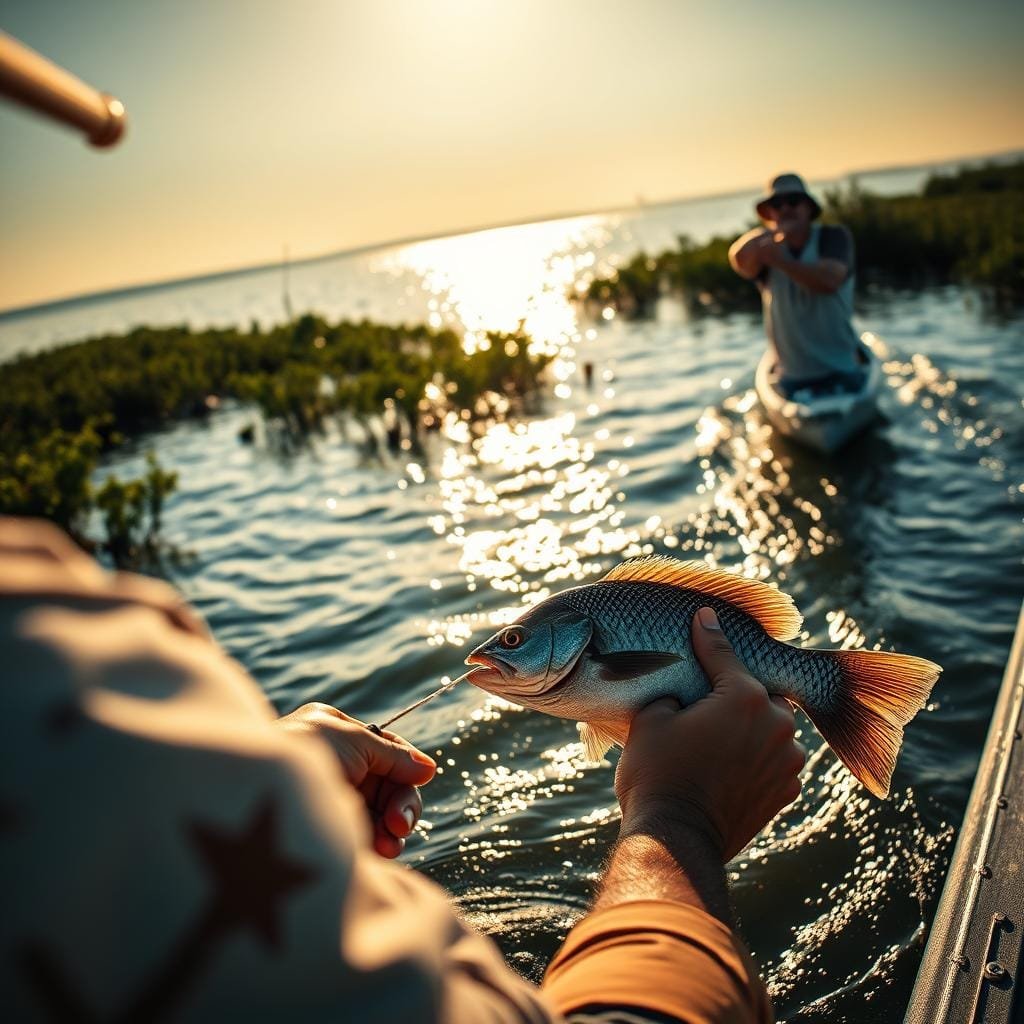
Amberjack are the bullies of the blue water. Anglers call them “reef donkeys” because they hit hard. They dive for metal and test every knot.
This guide will help you catch amberjack. You’ll learn proven tactics and how to rig your gear. You’ll also know the best spots to fish around wrecks, reefs, and oil platforms in the Atlantic, the Gulf of Mexico, and the Caribbean.
For action, start with live bait for amberjack. Blue runners, pinfish, mullet, threadfin herring, and grunts are great choices. Squid and fresh dead baits work when fish sulk deep.
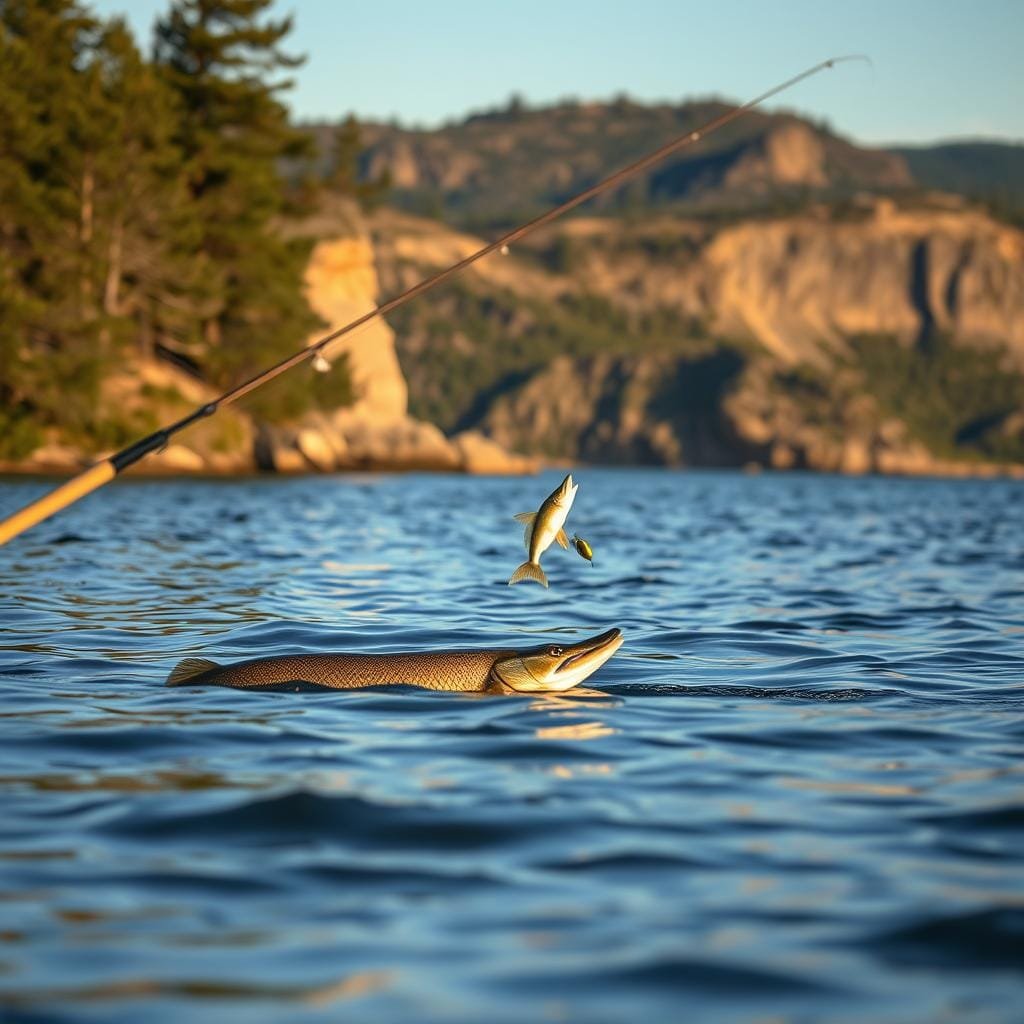
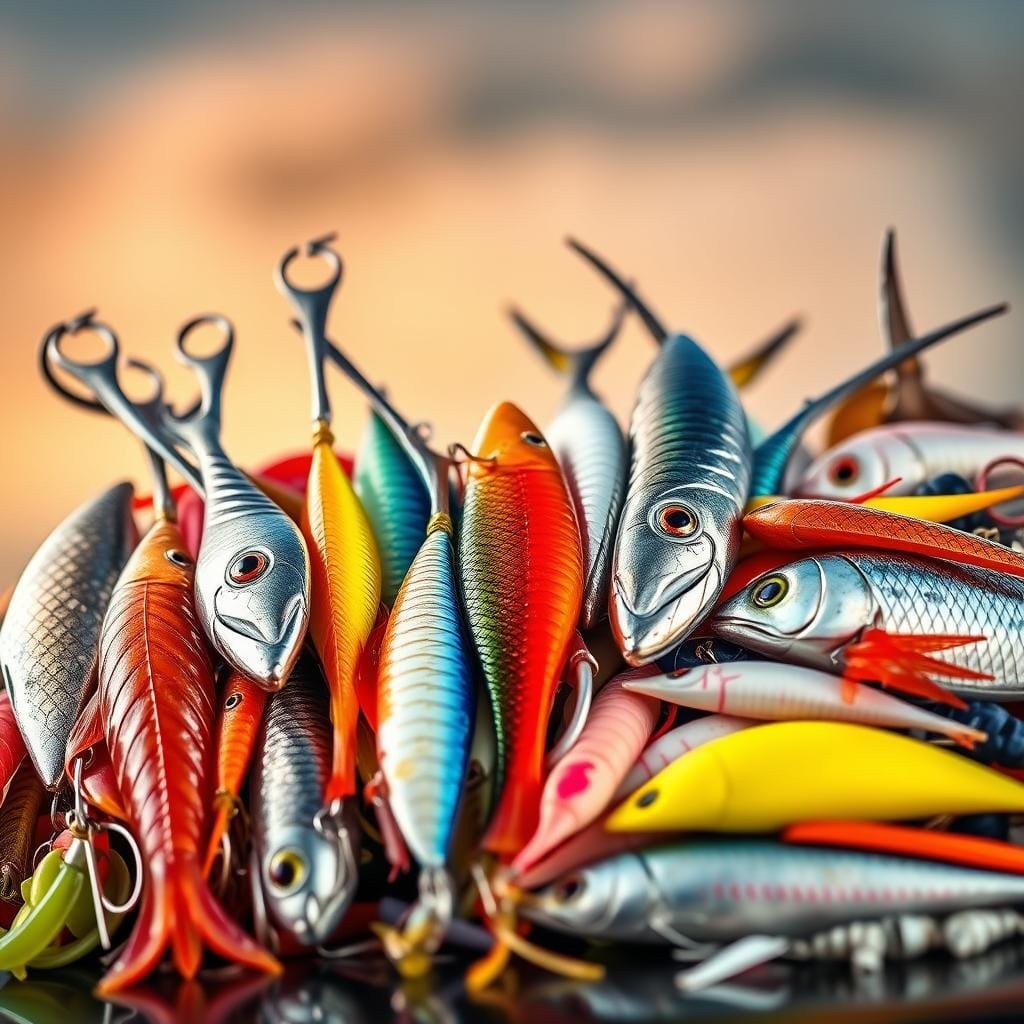
When the current rips or fish suspend, use amberjack lures. Try 4–8 oz butterfly, diamond, and blade jigs. Or drop a big bucktail. Popper strikes can happen after chumming or when a hooked fish fires up the school.
These fish live from 60 to 250 feet. They feed hardest at dawn and dusk. Use stout amberjack tackle: heavy-action rods, high-capacity reels, 50–80 lb braid, and 80–100 lb fluorocarbon.
Use strong swivels and 7/0–10/0 circle hooks. Keep pressure constant and use short pumps to turn their head before they reach the steel. The following amberjack fishing tips will help you catch more fish and save your gear.
Amberjack basics: habitat, depth, and behavior on reefs and wrecks
Amberjack love places with structure and current. They hang out in warm waters near reefs, wrecks, and tall towers. This is why anglers use sonar to find them.
Where amberjack live: Atlantic, Gulf of Mexico, Caribbean, and beyond
In the Atlantic, they like hard bottoms and high spots. In the Gulf, they prefer platforms and pipelines. Texas and Florida’s limestone ledges are good all year.
Caribbean amberjacks like current-swept areas and bluewater edges. They also live in other tropical oceans. But, they follow the food and current.
Depth ranges and structure: 60–250 feet, wrecks, reefs, and oil rigs
Amberjacks usually live between 60–250 feet deep. On calm days, they look like big arches near hard bottoms or wrecks. They move up when bait schools or chum appear.
Natural ledges and wrecks offer shade and ambush spots. For more on why these places are lively, check out productive fishing structure. Oil rigs also attract them, from the top to the bottom.
Daily and seasonal patterns: dawn/dusk activity and spring spawning
They are most active at dawn and dusk. But, steady current can keep them going all day. Look for birds and rips to find them.
In spring, they move and stack differently. Some go on migrations, while others stay put. Baitfish and squid guide them, making your fishing honest.
Species overview: Greater, Lesser, and Almaco jack differences
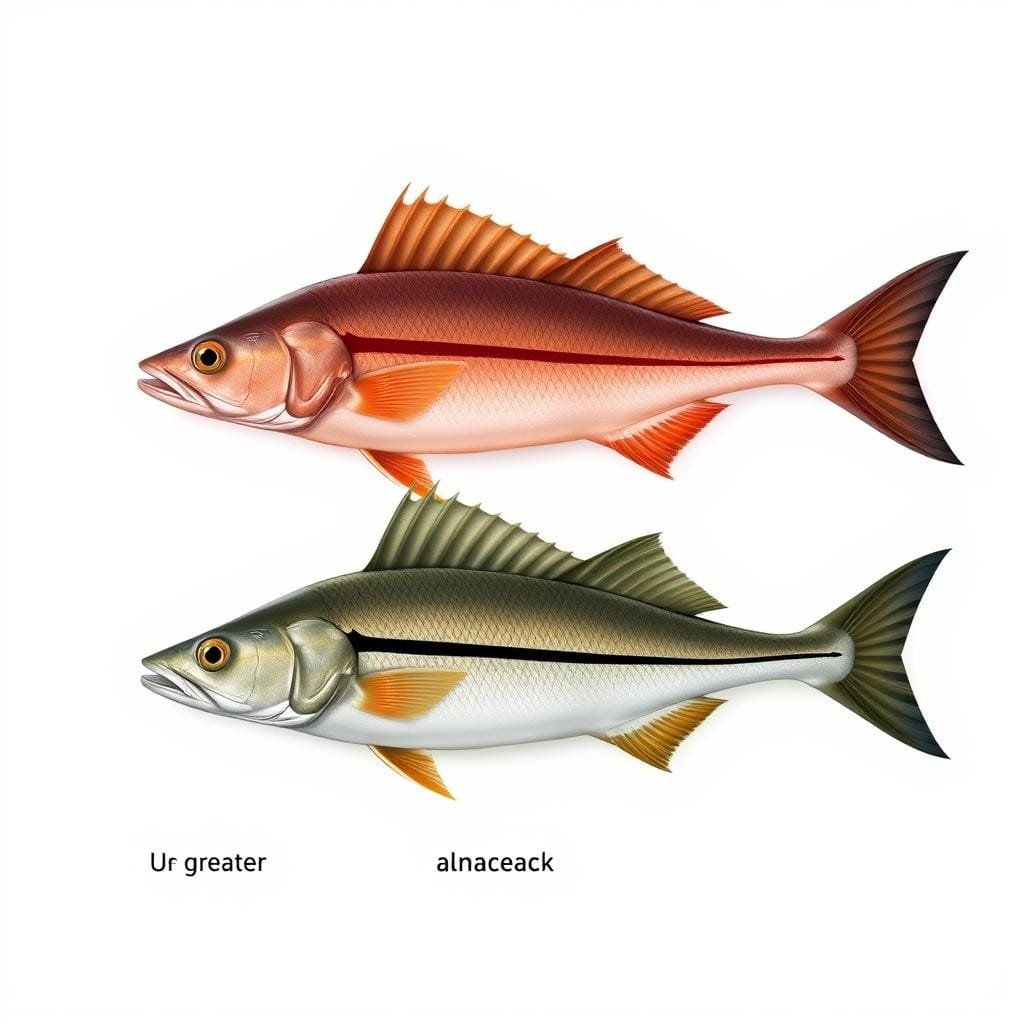
Three close cousins drive most amberjack talk offshore: Seriola dumerili, Seriola fasciata, and Seriola rivoliana. Knowing how to tell them apart helps pick the right bait and tackle. This way, you can catch fish that match their size.
Greater amberjack traits and size
Seriola dumerili is the biggest. It has thick shoulders, a blunt head, and a bold amber stripe. Its back is olive to bluish-black, and its belly is bright silver.
Greater amberjacks are usually 3–4 feet long. But, some can grow over 100 pounds. Look for their tall second dorsal fin and deep body. They like offshore wrecks, reefs, and oil rigs.
Lesser amberjack and nearshore encounters
Seriola fasciata is smaller, usually 1–2 feet long. It’s found nearshore as well as offshore. Its color is similar, but its body is slimmer with a bigger eye.
When comparing lesser and greater amberjacks, size and eye size are key. The stripe is there, but the fish is less bulky. This means you can use lighter bait and smaller leaders.
Almaco jack ID cues and depth versatility
Seriola rivoliana is in the middle for size, about 2–3 feet long. It has a dark band from eye to tail base and a yellow or golden operculum. Its dorsal and anal fins are longer and more pointed.
For good almaco jack ID, look for its sleek, high-shouldered profile. Almacos can be found from surface bait schools to hundreds of feet deep. They like reefs, wrecks, and open water.
| Species | Scientific name | Key ID markers | Common size range | Typical haunts |
|---|---|---|---|---|
| Greater Amberjack | Seriola dumerili | Thick body, bold amber stripe, olive/blue back, silver belly | 3–4 ft; can exceed 100 lb | Offshore wrecks, reefs, oil rigs |
| Lesser Amberjack | Seriola fasciata | Smaller, slimmer build, larger eye, similar stripe | 1–2 ft; light tackle class | Nearshore and offshore structure |
| Almaco Jack | Seriola rivoliana | Pronounced dark band, golden operculum tint, long falcate fins | 2–3 ft; midweight fighter | Reefs, wrecks, and open water from surface to deep |
Heavy hitters: why tackle up for these “reef donkeys”
Hook an amberjack and the rod loads to the cork. This surge shows you the power of amberjacks. They are called reef donkeys for a reason.
Power and fight rating: why they earn the nickname
These fish are at the top of saltwater fight ratings, about an 8 out of 10. They break metal jigs and live baits. They try to bulldog straight down.
Expect buckled rods, groaning drags, and bent hooks if your gear is weak.
Their pull is relentless. Amberjack power builds in waves. You must stay calm, breathe, and make every turn count.
Keeping fish out of structure: constant pressure strategy
The first 30 seconds are key. Apply constant pressure from the hookset. Drive the fish off the wreck.
Use short pumps to lift a foot or two, then gain line as the rod recovers.
Do not give slack. If the fish finds rocks or a beam, it’s over. Keep angles tight, let it run in open water if needed, and resume steady climbs when the surge eases.
Safety and stamina: harnesses, rod butts, and short pumps
Long battles can bruise and sap energy. Clip into a fighting harness to spread load across your hips. A quality rod butt cushion, like the Luna Sea Cush-it Slip-On, keeps the EVA out of your ribs and extends your stamina.
Pair that comfort with the short pumps technique for smoother control. Small lifts, quick recoveries, and smooth cranking protect your back and keep pressure honest from strike to scoop.
Gear setup: rods, reels, line, and leaders that survive the battle
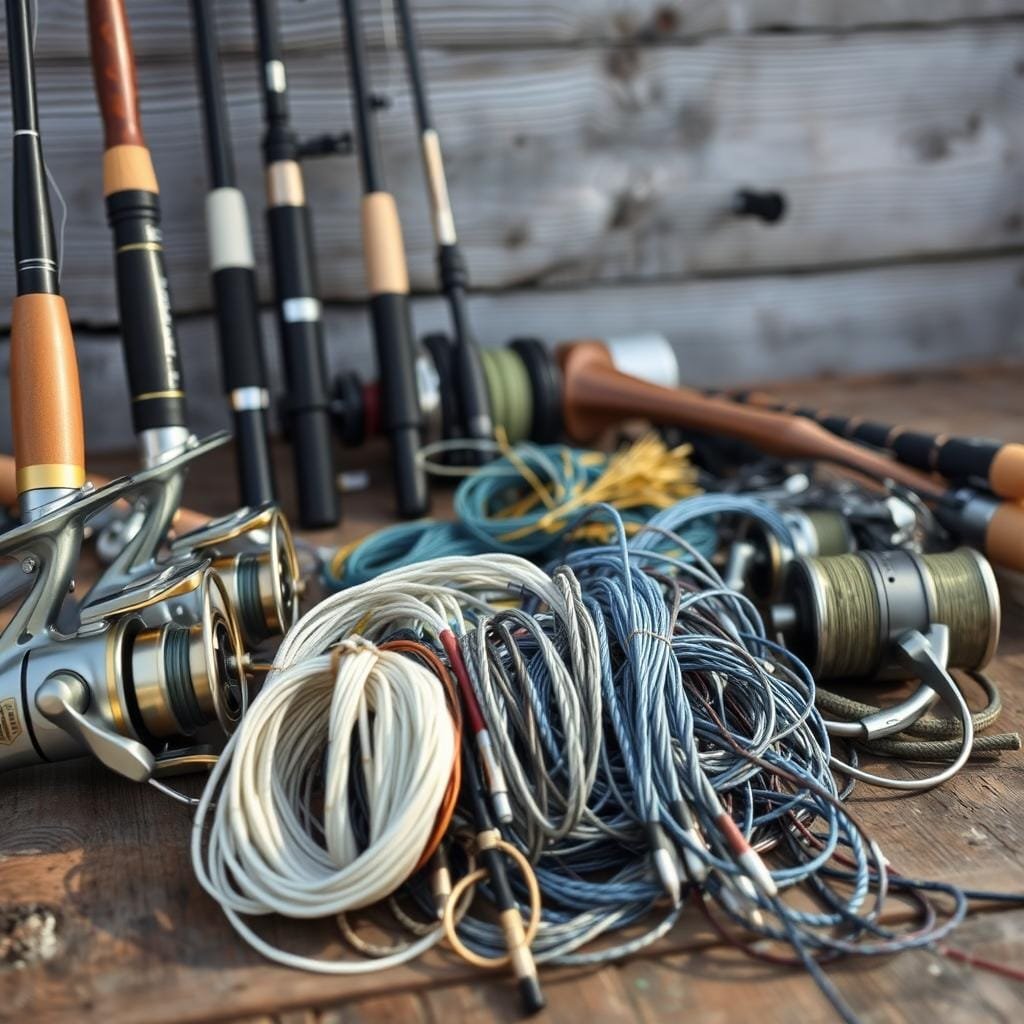
Purpose-built tackle turns chaos into control. Use strong amberjack rods and reels. They must last when fish dive for steel and coral.
Rods and reels: heavy-action, high-drag spinning or conventional
Choose heavy-action rods with fast tips for quick lifts. Pair them with a high-drag reel that works well past 25 pounds of drag. Conventional reels like Accurate BX2/BX or Shimano Talica are good for torque. Spinning reels like Shimano Stella SW or Penn Slammer IV are great for drag and capacity.
Make sure your setup has at least 300 yards of 50–80 lb braid. This helps handle fast runs and keeps you in touch with fish.
Main line and leader: 50–80 lb braid and 80–100 lb fluoro leaders
Braided main line boosts sensitivity. Use 50–80 lb braid to a short, scuff-resistant section. For tough spots, use a 100 lb fluorocarbon leader. Amberjack don’t have sharp teeth, so skip wire.
Check your connections. Use a PR knot or FG knot for smooth guides and strength. Finish with a tough crimp or improved clinch on the leader end.
Terminal tackle: strong swivels, 7/0–10/0 circle hooks, proper sinkers
Use premium terminal tackle. Heavy-duty swivels stop twist and keep the rig straight. Pair baits with circle hooks 7/0–10/0 for solid hookups.
Weight is key for angle and control. Use a slip sinker rig in strong current or when fish are deep. Choose enough lead to reach the zone without bowing the line. Lighten up when fish rise to make the bait move naturally.
This system ties everything together: amberjack rods and reels, a high-drag reel, 50–80 lb braid, and a 100 lb fluorocarbon leader. Add heavy-duty swivels, circle hooks 7/0–10/0, and a tuned slip sinker rig for a kit that lasts the fight.
Live bait that gets crushed: runners, pinfish, mullet, and more
Amberjack love baits that move fast and look alive. They like things that flash and vibrate a lot. Live bait works well when fish are near wrecks or swimming in the middle of the water.
Top live baits: blue runner, pinfish, threadfin, mullet, grunt
Blue runner bait is perfect for reefs and oil rigs. Pinfish are great in strong currents. They stay kicking even when it’s tough.
Threadfin herring add a lot of flash. Mullet have a big thump. Grunts are good in the chum line and can take a lot of drops.
Choose baits that match the fish’s mood. Use big ones for bigger fish. Try different baits until you find what they like.
Hooking methods: nose-hook vs. dorsal-hook for natural swim
Nose-hooking makes baits swim straight. It’s best for clear water. Dorsal-hooking makes baits move broadside. It’s good for pinfish and mullet near structures.
Use strong circle hooks. Adjust them so grunts can move freely. Check your baits often to keep them fresh.
Delivery systems: slip sinker rigs, freelines, and downriggers
Start simple with a slip sinker rig. It gets you down fast. Most bites happen before you hit bottom.
Switch to freeline bait when fish rise. This lets runners swim down naturally. Be ready for fast bites.
Downriggers are good for avoiding barracuda. Send baits below them and move them through the strike zone. Keep a freeline bait out to catch roamers.
| Bait | Best Hooking | Ideal Delivery | When to Use |
|---|---|---|---|
| Blue runner | Nose-hook | Freeline bait or slip sinker | Active fish midwater; covering wreck edges |
| Pinfish | Dorsal-hook | Slip sinker or downrigger amberjack | Heavy current; tight to structure |
| Threadfin herring | Nose-hook | Freeline bait | When flash draws packs off the wreck |
| Mullet | Dorsal-hook | Slip sinker | Selective bite; bigger fish around rigs |
| Grunts | Nose- or dorsal-hook | Slip sinker or downrigger amberjack | Durable bait for repeated drops |
best bait for amberjack
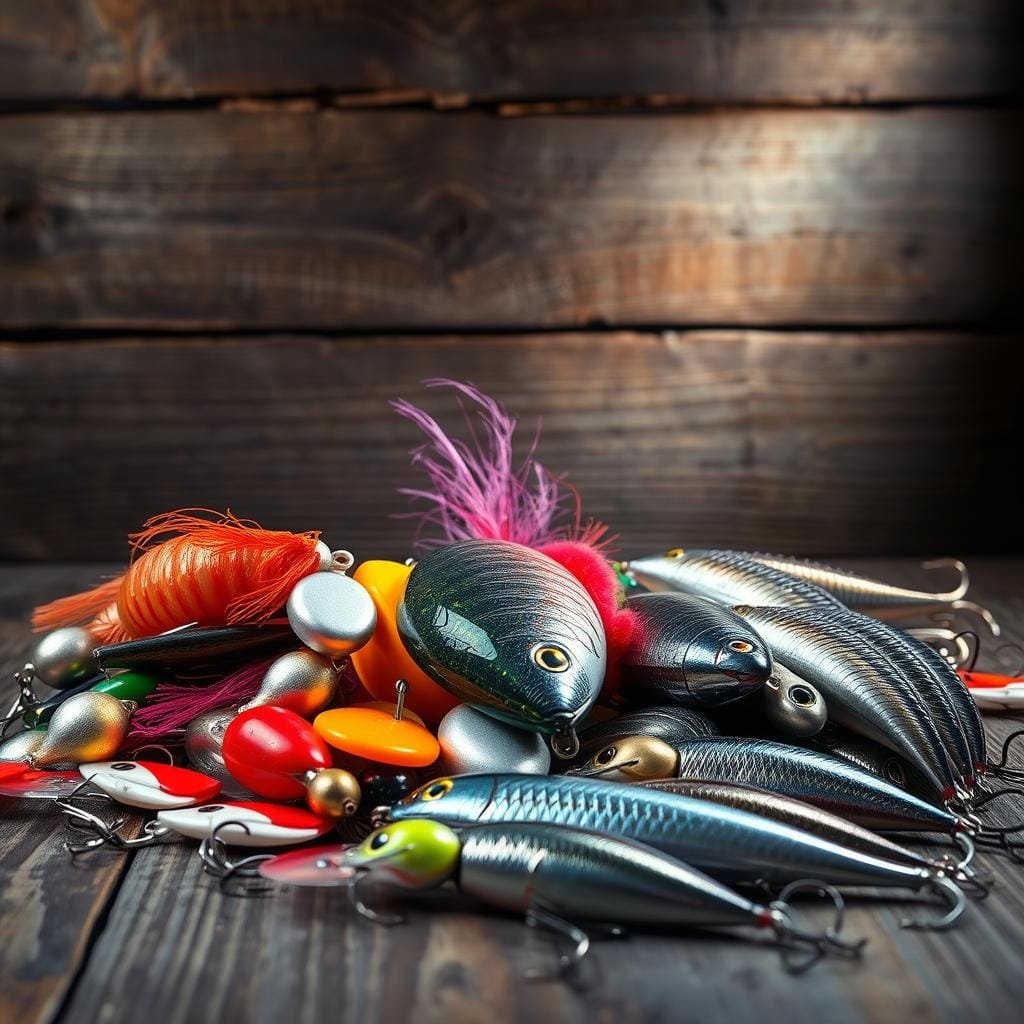
Big AJs like to eat around wrecks and rigs. The best bait for them is something that looks good, feels good, and smells good. It’s all about live vs dead bait, how they react, and how they eat in different currents and pressures.
Live bait advantages: flash, dash, and reaction bites
Live baits like lively runners and mullet flash and thump. This motion makes fish strike fast. When choosing between live and dead bait, live finfish usually get bigger bites.
Make sure your baits are lively and active. A quick swim and steady vibration help fish find them, even in windy conditions. Many prefer a healthy blue runner for a big catch.
When squid and dead baits shine
Squid is good when the current is calm and fish are slow. Its scent attracts fish. Dead sardines and cut baits work well near wrecks when live bait is hard to find.
On tough days, dead bait can be better. A butterflied bait sinks well and stays in the zone longer. It can also get bites from fish that ignore live baits.
Matching bait size to fish mood and current
Choosing the right bait size is key. Use bigger baits when fish are active and smaller ones when the current is strong. This helps attract the right fish.
Amberjack love big meals. They can even eat fish as big as tuna. But in strong currents, smaller baits work better because they sink fast and look natural.
| Bait Type | Primary Trigger | Best Use Case | Rig Tip | Why It Works |
|---|---|---|---|---|
| Live Blue Runner | Flash and vibration | Active schools on wreck edges | Nose-hook with 8/0 circle | Drives reaction strikes and matches amberjack feeding behavior |
| Live Pinfish | Constant thump | Moderate current over structure | Dorsal-hook for lift | Stays lively and visible in midwater |
| Threadfin Herring | Flash school mimic | Clear water, pressured fish | Nose-hook, light sinker | Natural shimmer draws curious followers |
| Squid (whole or strip) | Scent plume | Slow current, tentative fish | Double-hook stinger | Squid for amberjack keeps bites coming when live vs dead bait favors scent |
| Dead Sardine/Butterflied Bait | Glide and scent | High pressure or post-front | Slip-sinker to structure | Natural fall teases neutral fish into reaction strikes |
| Large Mullet/Grunt | Big profile | Trophy hunting in light current | Heavy leader, stout hook | Bait size selection targets dominant AJs without small pickers |
Artificial lures that produce: jigs, irons, poppers, and flies
Amberjack love metal and foam lures. Keep your line tight and move the lure fast. This makes them bite hard.
Vertical metal: butterfly, diamond, and blade jigs (4–8 oz)
Amberjack can’t ignore fast-moving jigs. Shimano Butterfly jigs are great for quick moves. Diamond jigs work well on wreck edges.
Blade jigs 4–8 oz are perfect for fast currents. They hit the mark quickly.
Drop the lure to the bottom, then pull it up fast. If fish are in midwater, start higher. Use single hooks to avoid losing fish.
Slow-pitch options: profiles, colors, and cadence tweaks
Slow-pitch jigging attracts fish with a slow move. Try different shapes and colors. Move the reel a little, then let it drop.
Start at the bottom and move up. If fish miss, try slower movements.
Surface fun: big poppers, spoons, jerkbaits, and streamer flies
Surface poppers are great for making a splash. Throw them hard, then pause. Spoons and jerkbaits catch fish that don’t want to pop.
Fly anglers can use a streamer fly on a 10-weight rod. Throw a chartreuse baitfish and strip it fast. A bucktail jig with a paddletail works well near the surface.
| Lure Type | Best Use Case | Weight/Size | Retrieve/Cadence | Notes |
|---|---|---|---|---|
| Butterfly jigging | Fast reaction bites on wreck edges | 4–8 oz | Rip 6–10 cranks, reset, repeat | Great in moderate current; swap to single hooks |
| Diamond jig | Search tool from bottom to midwater | 6–8 oz | Lift-and-fall with bursts | Perennial producer; durable and simple |
| Blade jig 4–8 oz | High current penetration and fast drop | 4–8 oz | Speed jigging with short pauses | Tracks straight; reaches depth quickly |
| Slow-pitch jigging | Neutral fish holding over structure | 120–250 g equivalents | Half-turn pops and controlled flutter | Change profile and color to match mood |
| Surface poppers | Chummed fish and followers near top | 6–8 inch, heavy cup-face | Rip–pause rhythm | Pairs well with heavy-action spinning gear |
| Bucktail jig | Subsurface sweep around bait schools | 2–6 oz with trailers | Steady pump-and-swim | Add paddletail or curly tail for thump |
| Streamer fly amberjack | Sighted fish on the rise | Chartreuse/white baitfish | Short, hard strips | 10-weight rod; simple roll casts close the deal |
Pro techniques: bottom fishing, vertical jigging, chumming, and trolling
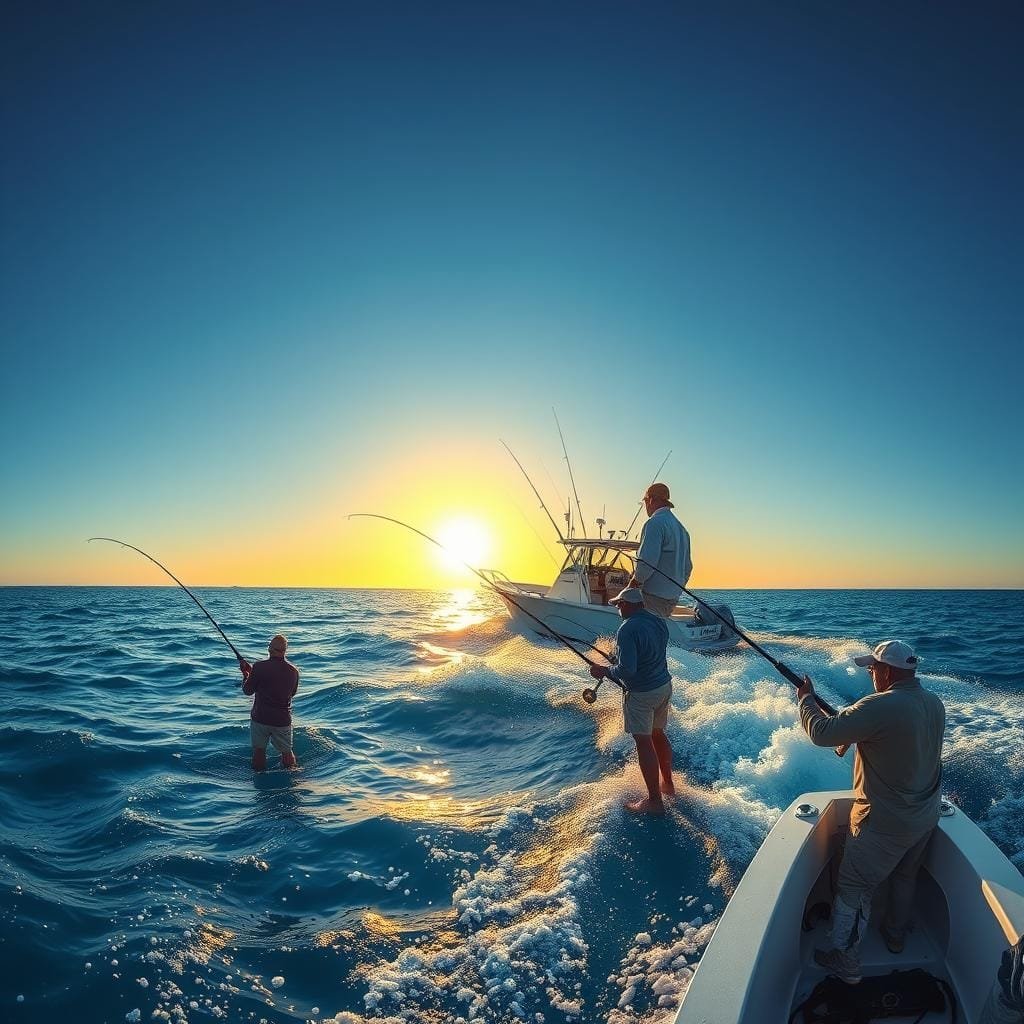
Start by reading the screen. Use sonar wreck fishing to map the high points. Look for thick arches stacked just off the metal or coral. This cluster sets your strike zone.
Stage the boat up-current and plan a controlled drop. This helps you catch more fish.
Pinpointing the strike zone around wrecks and reefs
For amberjack bottom fishing, send a lively bait on a slip sinker to the marks. Then, crank 10–20 turns to hover above the junk. AJs patrol there.
If the screen shows fish riding higher, repeat the drop. Count the turns to lock in the level. When current stiffens, swap sinker styles and shorten leader to keep control.
A quick primer on bottom fishing basics helps tune rig choices without guesswork.
Speed and rhythm for jigs from bottom to midwater
Drop to the floor, touch, and rise with a vertical jig cadence. Match the mood. On fired-up fish, use sharp twitches and fast bursts.
If they sulk, slow-pitch with measured lifts and pauses. Watch the graph and adjust cadence the instant arches slide higher or lower.
Chum strategies to pull AJs to the surface
On clear, calm days, chumming amberjack with live baits can lift fish from 100-plus feet. Mix in cut pieces to seed a trail. Then, beat the surface with the rod tip to mimic fleeing prey.
When a hooked fish brings followers, fire a ready pitch bait into the lane. Keep it in gear to stay tight.
Trolling live bait or deep-divers to cover water
To work the perimeter or dodge barracuda, run downrigger trolling with live baits set below the ‘cuda layer. Pair that with trolling deep divers like the Rapala X-Rap Mag or Yo-Zuri Deep Diver.
Adjust speed so plugs track right through the marked band. Make wide laps around the wreck edge. Bump the rigger up or down as the sonar wreck fishing picture shifts.
When the bite scatters, rotate between amberjack bottom fishing, a refined vertical jig cadence, and a fast pass with trolling deep divers. The switch keeps pressure on active fish while presenting clean options to the rest of the school.
Reading conditions: current, sonar marks, and bait presence
Start by reading sonar for amberjack with intent. Look for clean arches above wreck marks and reef edges. Don’t get buried in steel or rock. Note the exact band where the lines stack.
Plan depth management so your bait or jig passes right through that zone.
Match fishing current to your presentation. In heavy flow, use slimmer metal and strong-swimming live baits. This cuts drag and holds the line angle.
In light current, slow-pitch profiles and bulkier baits can hover longer. They won’t spiral off target.
Track bait schools on structure. Clouds of runners, threadfin, or squid show up as tight wisps. Predators push above or alongside.
When the screen lights up over wreck marks, set passes to intersect the feeding layer. Maintain contact on the drop.
Dial depth management with practical cues. Count the fall, watch the scope, and adjust sinker weight. Keep the rig vertical in 60–250 feet.
If barracuda or sharks crash the column, shift deeper. Use a downrigger or slide to bypass the toothy layer.
Stay alert to water conditions. Clean edges, temp breaks, and a steady ripple often hold life longer. For a deeper dive into mapping subtle ledges and using electronics, see this guide to reefs and wrecks. Refine your read before the next drop.
Fight smart: hookset, pressure, and keeping AJs out of the junk
Drive the hook hard and lean back right away. This is how you start fighting an amberjack. Keep the rod bent deep and move the fish fast. This is key to keeping them out of structure in the first 10 seconds.
Don’t let up: constant pressure and short, measured pumps
Keep constant pressure and make short pumps to get line. Use a harness or cushioned gimbal to keep your rod tight. Only give in if you must, then go back to short pumps to control the fish.
Free-spool for the follow-up bite after a miss
When a bait gets slapped or the jig gets bumped, use a quick free-spool tactic. Thumb the spool or tap the lever to feed line, then re-engage and sweep. Their tough mouths usually hold a hook well if you’re smooth.
Capitalize on schools: keep a pitch bait ready
Amberjack often come in groups, so be ready for doubles. Pitch a second bait when one rises. Keep a leadered rod with a circle hook and live bait ready. Pitch and crank fast to keep fish out of structure.
- Hookset: firm sweep while the boat is in gear to load the rod fast.
- Pressure plan: constant pressure with short pumps to win early.
- Backup move: brief free-spool tactic after a miss, then re-engage.
- Team play: pitch bait readiness for quick doubles when a school appears.
| Tactic | Goal | When to Use | Pro Tip |
|---|---|---|---|
| Constant pressure | Keeping fish out of structure | First run and near wreck edges | Angle the rod to the open side of the wreck to steer the fish |
| Short pumps | Gain inches without gassing out | Any pause after a surge | Lift 12–18 inches, reel down fast, repeat with steady rhythm |
| Free-spool tactic | Trigger an instant re-bite | After a missed hit or bait slap | Feed 2–4 feet of line, then engage and sweep smoothly |
| Pitch bait readiness | Hook followers from a school | When a hooked fish brings up packmates | Keep a pre-rigged live bait rod in a holder, drag set and leader checked |
Stay calm, stay tight, and keep working the plan. This amberjack fight technique blends constant pressure, short pumps, and a sharp free-spool tactic with true pitch bait readiness. It helps you win when the wreck lights up.
Regional notes: Gulf of Mexico seasons, Florida wrecks, and travel hotspots
The Gulf of Mexico amberjack season is a big deal from Texas to Florida. It usually happens from May to October. The best time is late spring to early summer.
Make sure to check NOAA and state updates before you go. Look for wrecks, reefs, and rigs in 60–250 feet. Keep baits close to the structure. And be ready for fast drops when the sonar lights up.
Florida wreck fishing is amazing from the Panhandle to the Keys. The Dry Tortugas are a favorite spot for jig fans. Live pinfish and blue runners are great, and 4–8 ounce vertical jigs catch suspended fish well.
Charter guides in Destin, Tampa Bay, Miami, and Key West know these spots well. They plan trips around tides and moon phases to find active schools.
Travelers can find bigger fish where it’s less crowded. Panama amberjack near Mariato love runners and squid on reefs and seamounts. Kona amberjack in Hawaii’s ledges do well with low traffic and clean currents.
Worldwide, look for strong reef systems, oil rigs, or offshore springs. Adjust to local bait like threadfin, runners, and squid. And use strong leaders for the first run.