Want fast bites and fewer misses offshore? Start with the best bait for tuna. Match what they’re hunting right now. Tuna bait that copies sand eels, pilchards, sardines, or ballyhoo draws strikes from yellowfin, bluefin, and blackfin.
The right tuna fishing lures and live bait for tuna shine in clean water. They work best with moving current and steady boat control.
This guide breaks down yellowfin bait, bluefin bait, and blackfin bait. It shows clear picks and simple tactics. You’ll see how jig-and-pop tuna strategies compare to trolling lures for tuna.
We’ll name proven brands and models. Then, we’ll show how to rig them for a natural swim.
From live-chumming to metal jigs and hard baits, we focus on what works. Expect real-world gear from Shimano, Daiwa, Penn, Avet, and Nomad. Plus, spread ideas that cover water fast.
Short, direct tips help you choose smart. Fish confident and stay tight when the reel screams.
Why Bait Choice Matters for Yellowfin, Bluefin, and Blackfin
Choosing the right bait at the right time is key. Tuna forage changes with the season and weather. Watch birds and sea creatures to find the best spot.
Matching local forage: sand eels, pilchards, sardines, ballyhoo
Sand eels are common in some areas. Use slim lures to mimic them. In other places, like Florida, use live bait like pilchards.
Yellowfin like small bait. Use lures that look like schools. For deeper water, use spreader bars.
Reading conditions: water color, temps, and current edges
Water color tells you a lot. Yellowfin like clear blue water. Bluefin can be found in colder, murkier water.
Look for temperature breaks and current edges. These areas have a lot of bait. If you see life, it’s a good spot.
Adjusting to species behavior and size class
Bluefin have different preferences. Big bait attracts big fish. Smaller lures work for school fish.
Yellowfin like fast lures. Blackfin prefer slower ones. Match your lure to the fish you see.
Keep your tackle simple. Use different lures for different situations. Find the right spot and stay there.
Live Bait That Consistently Produces Offshore
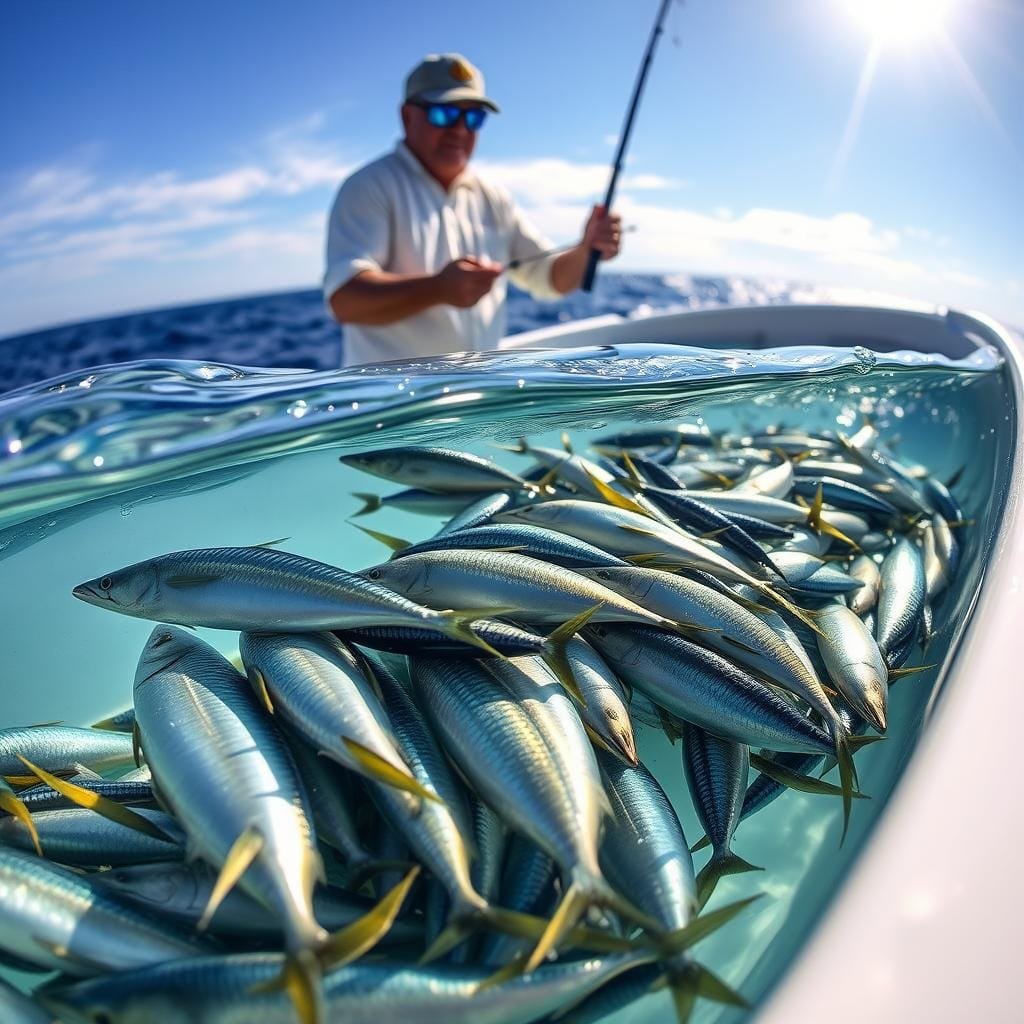
When tuna jump up, keep it simple. Use live bait that looks like what you see. This way, fish focus on the bait, not the metal.
Pilchards, threadfin herring, and sardines for live-chumming
In the Florida Keys and Gulf, live-chumming works well. Toss small pilchard chum to attract blackfin and yellowfin. Free-line a bait with little weight and let it swim.
Threadfin herring and sardines are great too. Mix them to keep the tuna interested. Stagger baits at different depths and slow down your boat.
Ballyhoo and mackerel rigs for slow-trolling and drifting
For tuna along edges, use live ballyhoo rigs. Troll slowly at 3–5 knots. Use one short and one long bait to cover all areas.
Mackerel rigs work well for bigger tuna. Troll near rips and color changes. Keep a pitch rod ready for surprises.
Leader choices and hook sizes to avoid spooking tuna
For clear water, use stealth. A 30–50 lb fluorocarbon leader works for blackfin. Use 60–80 lb for big yellowfin or bluefin.
Choose the right hook size. Use 3/0–5/0 hooks. Circle hooks are best for free-lined baits. Use small, strong swivels and knots.
| Live Bait | Best Use | Rig Style | Leader (Fluoro) | Hook Type | Typical Hook Size | Notes |
|---|---|---|---|---|---|---|
| Pilchards | Live-chumming | Free-line with minimal hardware | 30–40 lb fluorocarbon leader tuna | Circle hooks tuna | 3/0–4/0 hook size tuna | Use steady pilchard chum to keep fish high and aggressive. |
| Threadfin Herring | Live-chumming, slow drift | Nose- or shoulder-hooked | 40–50 lb fluorocarbon leader tuna | Circle or light J | 3/0–5/0 hook size tuna | Stagger depths; swap baits often to stay lively. |
| Sardines | Live-chumming, pitching to foamers | Free-line, small swivel | 30–40 lb fluorocarbon leader tuna | Circle | 3/0–4/0 hook size tuna | Perfect when sardines tuna are the dominant forage. |
| Ballyhoo | Slow-trolling edges | Ballyhoo rigs with chin weight | 50–80 lb fluorocarbon leader tuna | Circle or short-shank J | 4/0–5/0 hook size tuna | Run one short, one long; keep a pitch bait ready. |
| Mackerel | Drifting or bump-trolling | Mackerel rigs with bridle | 60–80 lb fluorocarbon leader tuna | Circle, add stinger if needed | 4/0–5/0 hook size tuna | Add a small stinger when sharks or kingfish slash baits. |
Dead Bait Rigs and How to Run Them
When the ocean gets bumpy, dead bait for tuna is key. A clean ballyhoo rig swims straight and covers a lot of ground. Keep things simple, keep baits cold, and make sure each rig runs straight.
Pre-rigged ballyhoo for spread flexibility
Pre-rigged ballyhoo makes changing positions easy. Use them on flat lines, short and long riggers, and even way back. Mix with cedar plugs and Green Machine daisy chains to mimic a school.
Ballyhoo Rigs by Offshore Tackle work well with spreader bars. They stay balanced at 5–7 knots. This lets you fish in different spots without getting tangled. Start with good bait care: thaw slow, keep on ice, and replace any worn-out bait.
Stinger rigs when sharks and kingfish are around
Short strikes waste time and bait. A stinger rig adds a small hook to catch nippers. Use No. 5–7 wire to the stinger and a fluoro lead to the nose hook.
Set the stinger just past the anal vent on larger baits. Keep it light to avoid killing the roll. Rotate stinger baits to corners where toothy fish hide, and keep singles outboard.
When to brine and how to keep bait crisp
Cold, brined bait runs straighter and lasts longer. A simple brine mix—sea salt, crushed ice, and baking soda—keeps scales tight. Brined bait should feel firm but not frozen.
Keep brined ballyhoo in a slush, away from sun and spray. Swap any side-tracking pieces at the first sign of trouble. With 6–7 rods out, quick changes keep the spread sharp.
- Run two cedar plugs on the corners near the prop wash for commotion.
- Place pre-rigged ballyhoo on short and long riggers for clean lanes.
- Send a single shotgun far back to pick off wary fish.
- Use bars or chains outboard to simulate a fleeing pod without overlap.
| Rig/Bait | Best Position | Target Speed (knots) | Why It Works | Pro Tip |
|---|---|---|---|---|
| Pre-rigged ballyhoo | Short/Long Riggers | 5–7 | Natural skip and swim that matches small forage | Pinch the beak and break it clean to reduce spin |
| Ballyhoo trolling rig + directional bar | Outboard, clear water | 6–7 | Wider footprint draws fish from depth and distance | Stagger bar lengths to prevent crossovers in turns |
| Cedar plug | Corners near wash | 6–8 | Erratic darting triggers reaction bites | Run darker colors tight when the sun is high |
| Stinger rig tuna (wire stinger) | Corners or center flat | 5–6.5 | Catches short strikers like king mackerel and sharks | Use small treble or single stinger to match bait size |
| Brined bait (ballyhoo) | Any lane | 5–7 | Firmer body holds up to turns and chop | Refresh slush with ice and salt every few hours |
Proven Artificial Lures That Imitate Top Forage
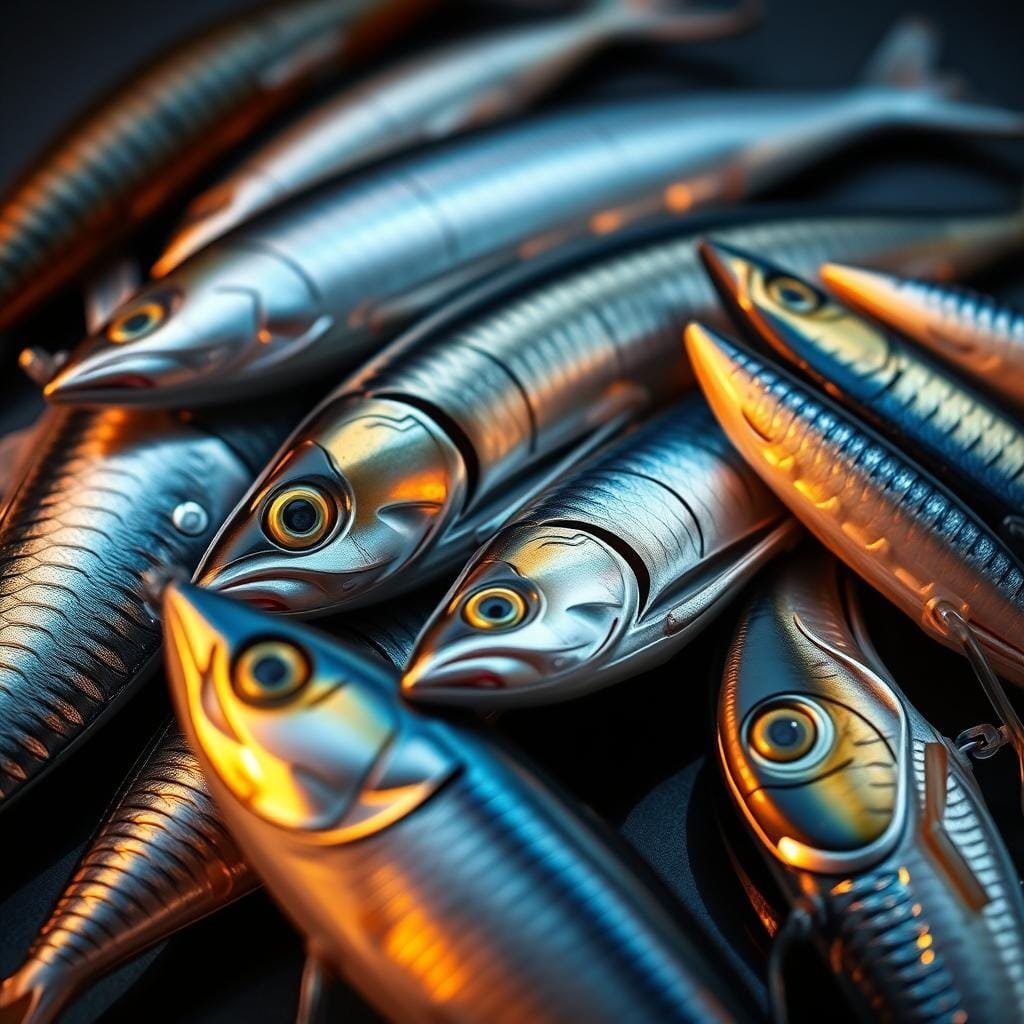
Artificial lures help you cover a lot of water fast. They look like real food. When bait piles up, picking the right lure can turn marks into bites. For more on bait signals, check out this guide to tuna food indicators.
Vertical jigs for the thermocline bite
Drop tuna jigs right where fish are holding. Shimano Butterfly Jigs and Daiwa Saltiga metals work well. Use Williamson Gomoku, Calissa Fast Fall, and Nomad Streaker in 80–200 g.
Work them with fast bursts and short pauses. This will trigger reaction strikes at the right depth.
Use Bright PinkGlo or 3D chrome for low light. Natural colors work best in clear water. Keep hooks sharp and split rings strong to stay connected.
Poppers and stickbaits for surface feeds
When birds dive and tuna chase bait, poppers are key. Nomad Chug Norris and Yo-Zuri Mag Popper cast far and splash high. Add Madd Mantis Cherry Pop for a loud knock that draws bites.
Stickbaits mimic injured baitfish. Madscad sinking looks like a wounded sardine. Pause, then speed up to get the fish chasing.
Cedar plugs, feathers, and divers for covering water
For searching, use a spread that covers a lot of ground. A 6-inch cedar plug tuna on the corners near the wash is great. Add trolling feathers and Green Machine chains to mimic skipping bait.
For deeper marks, use diving minnows tuna can’t ignore. Pair them with a cedar plug and a feather to check three lanes at once. This helps you find promising current lines.
| Lure Type | Best Use | Notable Models | Presentation Tips | Target Zone |
|---|---|---|---|---|
| Tuna jigs | Thermocline or marked bait stacks | Shimano Butterfly, Daiwa Saltiga, Williamson Gomoku, Calissa Fast Fall, Nomad Streaker | Fast lift-drop cadence, brief pauses, color match to light | 60–300 ft |
| Tuna poppers | Surface feeds with birds and spray | Nomad Chug Norris, Yo-Zuri Mag Popper, Madd Mantis Cherry Pop | Big splash, straight pull, then walk pauses on the edge | Top 0–10 ft |
| Stickbaits tuna | Finicky fish under foamers | Madscad sinking | Sweep-sweep-pause, keep tension through the glide | Subsurface 3–20 ft |
| Cedar plug tuna | Covering water near the prop wash | Natural 6-inch, rigged 100–150 lb mono | 6–8 knots, corners tight to the wake | Mid-depth lane behind boat |
| Trolling feathers | Skipping bait imitation on search passes | Green Machine daisy chains, assorted feathers | Mix colors, staggers at varied distances | Surface and upper 10 ft |
| Diving minnows tuna | Reaching sonar-marked depth bands | Nomad DTX Minnow | Match troll speed to rating, track on the deep rod | 15–50 ft |
Jigging Essentials: Depth, Presentation, and Strikes
Use electronics to find bait and marks. Drop your jig straight down to the layer you want. Then, use a steady vertical jigging rhythm to climb up.
Blend short bursts with pauses. This tuna jigging trick turns followers into biters during the flutter.
Working the column: drop, reel-jig cadence, and pauses
Start at the bottom or your target band. Move up 20 to 40 feet at a time. Pop the rod, crank two to four turns, pause, then repeat.
This rhythm works well with thermocline jigging when fish suspend. If marks move higher, use speed jigging tuna. This keeps the jig in the right spot.
Strikes often happen on the fall. Let fast-fall jigs flutter on a semi-slack line. But stay ready. Keep contact, then go back to a crisp vertical jigging rhythm.
This will trigger the chase and the eat.
Shimano Butterfly, Daiwa Saltiga, Williamson Gomoku, and fast-fall jigs
Shimano Butterfly Jigs are great for flutter bites. Daiwa Saltiga metal and Super Deep styles work well in heavy current and deeper edges. Williamson Gomoku Vertical Jigs drop fast and respond to subtle lifts.
For night or fickle drift, try a Nomad Streaker in PinkGlo or a Calissa Fast Fall. They keep you in play.
Match your reel and line to the load. Use 60–100 lb braid on a Daiwa Saltiga or Shimano Stella. Pair it with a 80–100 lb fluoro leader, then a 200-lb Spro swivel and split ring. For more on jig and bait pairings, see this midshore tuna tactics guide.
Strike setting: three hard lifts to stay tight
When you feel a bite, commit to hookset tuna jigging. Do three firm, high lifts to bury the assist hooks. Keep the rod low after the set and drive pressure through the reel.
Short pumps prevent slack and stop head-shakes from opening holes.
If the fish misses, drop back two cranks and rip the jig. This quick reset keeps speed jigging tuna honest and often draws the second hit.
| Jig Model | Use Case | Weight Range | Cadence Tip | Notes |
|---|---|---|---|---|
| Shimano Butterfly | Flutter strikes around bait pods | 120–250 g | Lift-lift-pause to mimic a wounded sand eel | Excels for thermocline jigging with marked suspenders |
| Daiwa Saltiga (Metal/Super Deep) | Deep edges and hard current | 150–300 g | Two fast cranks, short pop, brief stall | 3D finishes pair well with a bright sun or clear water |
| Williamson Gomoku Vertical | Quick drop to moving marks | 100–200 g | Tight, snappy vertical jigging cadence | Versatile for mixed-size tuna and variable drift |
| Nomad Streaker (PinkGlo) | Low light, calm seas, or scattered fish | 80–200 g | Fast-fall jigs with controlled flutter and brief pauses | Strong for night bites and clean water clarity |
| Calissa Fast Fall | Covering water and night drifts | 100–200 g | Quick reel bursts with micro-pause | Value pick that delivers authoritative drops |
| Rigging & Hookset | Lock in on impact | N/A | Three hard lifts, then steady grind | Balances pressure for reliable hookset tuna jigging |
Topwater Thrills: Poppers That Trigger Explosive Eats
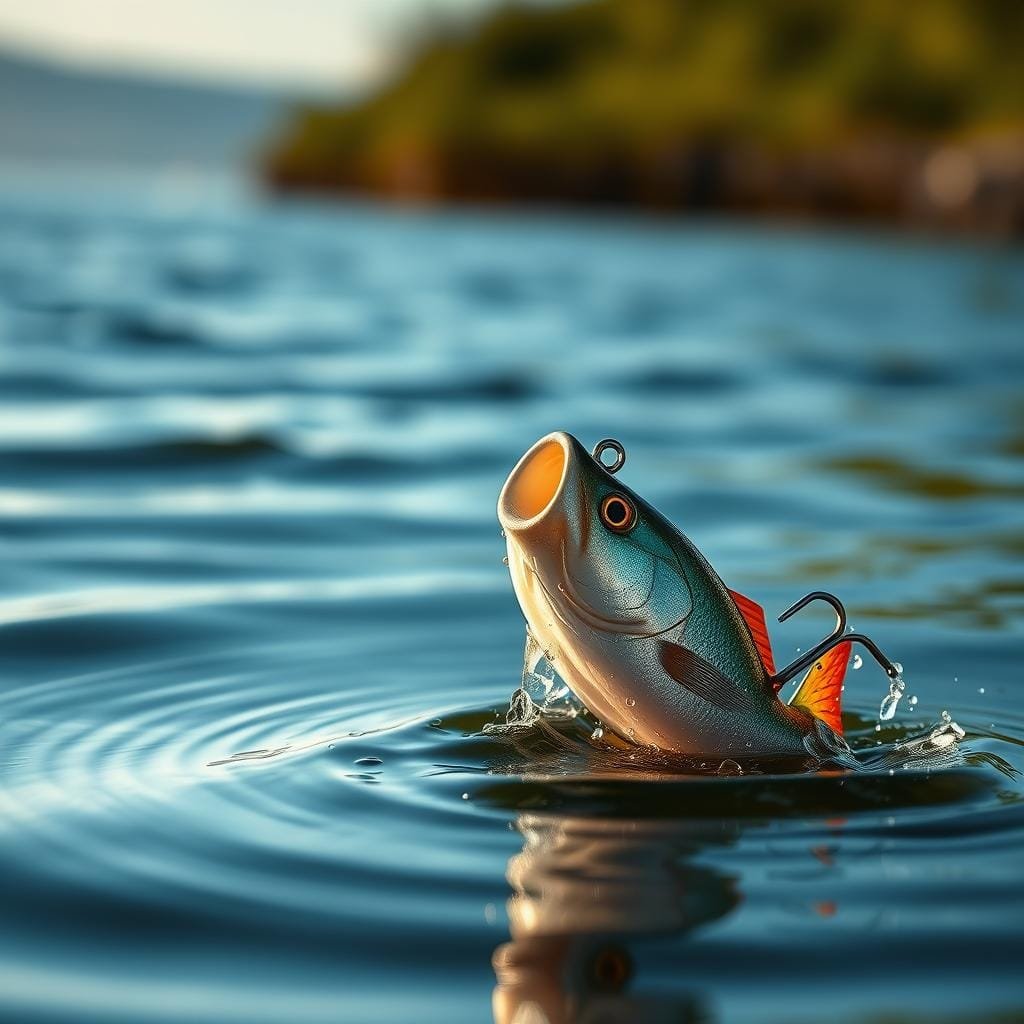
When tuna see bait, a sharp cast and rod work make water chaotic. A good tuna poppers technique keeps the plug in the right spot. This makes every splash count.
Nomad Chug Norris and Yo-Zuri Mag Popper for big splash and reach
The Nomad Chug Norris is big and floats well in choppy water. It has strong hardware for long runs. The Yo-Zuri Mag Popper has a special face and system for throwing far and straight.
These poppers are great for wide schools. They need distance and a loud splash to call fish up.
Sound, cadence, and walk-the-dog to mimic fleeing bait
Start with two hard chugs, then pause. Switch to a slow walk-the-dog rhythm. This imitates a wounded baitfish, not a bass plug.
In calm water, slow down. In windy water, use sharp rod sweeps. This keeps you connected.
Color selection to match seasonal prey
Choose popper colors that match the bait in the water. Use olive for sand eels, chrome-blue for sardines, and bone or green for ballyhoo. In dim or dirty water, bright colors help the lure stand out.
Keep a few colors ready: a natural one, a bright one, and a dark silhouette. If fish aren’t biting, try a different color. Small changes can make a big difference.
Adjust these details for the Nomad Chug Norris and Yo-Zuri Mag Popper. They work well in a tuna poppers technique that keeps schools interested and hungry.
Dialed Trolling Spreads for Tuna
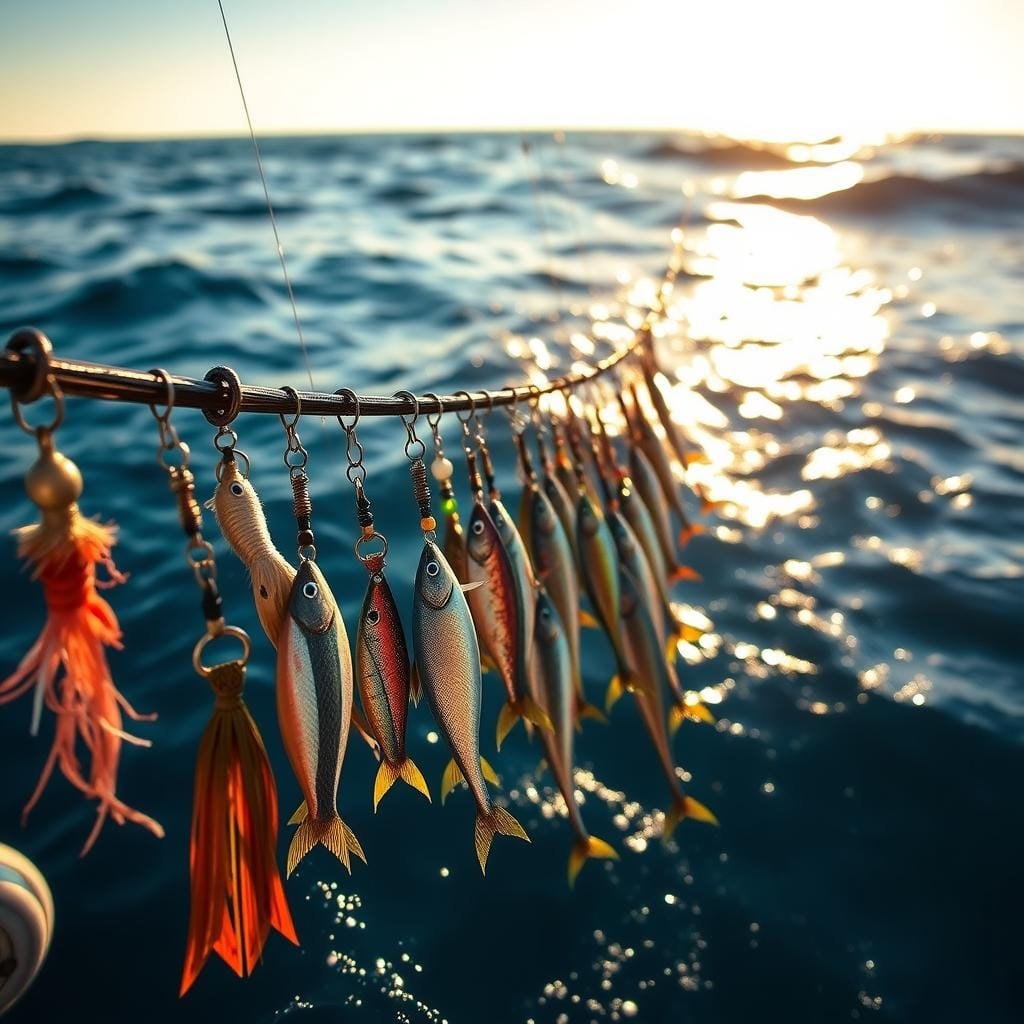
Make a tuna trolling spread that covers high, mid, and deep lanes. Use different baits to avoid them getting in each other’s way. Keep turns smooth and let each lure do its job. Most teams use six to seven rods to cover a wide area but keep it easy to manage.
Cedar plugs on the corners close to the wash
Begin with cedar plugs placed smartly. Use one short on each corner, right by the prop wash. This makes them move fast and catch tuna’s attention.
Use both natural and blue/white finishes to match the light and bait size. Add a pre-rigged ballyhoo on an inside rigger. This adds a subtle kick that fills the gap between the corners and long positions.
Green Machine daisy chains and directional spreader bars
A Green Machine daisy chain in the middle looks like a bait train. It attracts tuna bites. Use spreader bars from Black Bart, Sterling Tackle, or Chatter Lures to cover more ground and bring fish behind the wake.
For small boats or wide tournament areas, use directional tracker bars. Try Sterling Side Tracker or Chatter Lures models. They work 30 feet off the wake without outriggers and up to 60 feet with them. This pushes lures into clean water and reduces tangles.
Hard-bait divers and DTX-style minnows to hit marked depths
When the sounder shows fish below the surface, switch to diving lures tuna can see. A Nomad DTX Minnow stays at speed and dives to the right depth. Change lead lengths to adjust the depth.
Balance hard-bait divers on the sides with one deeper track in the middle. Adjust speed and drop-back to keep the spread fresh. Then, change colors as the light changes to keep the spread natural.
best bait for tuna
The best bait for tuna depends on what fish are chasing in your area. Use pilchards, threadfin herring, sardines, ballyhoo, and slim mackerel when fish are active. In clear water, use small, clean artificial baits.
Live bait is great for blackfin tuna on humps. Ballyhoo and mackerel work well for yellowfin tuna. Artificial baits are good when bait is scattered or deep.
For trolling, use ballyhoo, cedar plugs, and Green Machine daisy chains. Add a Nomad DTX Minnow to check depths. Change colors to match the bait in the water.
Popper bait tuna is perfect when fish are hitting bait on top. Use a Nomad Chug Norris or Yo-Zuri Mag Popper. On calm days, try stickbaits like the Nomad Madscad.
For deep marks, use jigging bait tuna. Try Shimano Butterfly, Daiwa Saltiga, and Williamson Gomoku. Use a quick cadence to get bites.
- Live staples: pilchards, threadfin herring, sardines, ballyhoo, mackerel
- Dead classics: pre-rigged ballyhoo for flexible spreads
- Hard-bait workhorses: cedar plugs, Green Machine chains, directional spreader bars, Nomad DTX Minnow
- Topwater keys: popper bait tuna with Chug Norris or Mag Popper; add stickbaits when fish get picky
- Vertical tools: fast-fall jigs that match local forage size
| Scenario | Choice | Why It Works | Rigging Notes |
|---|---|---|---|
| Clear water, skittish fish | Small live sardines | Natural flash with subtle kick | 60–80 lb braid, fluorocarbon leader, PR or Slim Beauty, 200-lb swivel |
| Scattered birds, long search | tuna trolling bait: cedar plugs and spreader bars | Covers water fast and calls fish up | Staggered lengths, clean drop-back, inspect split rings |
| Deep marks at thermocline | jigging bait tuna: Butterfly or Streaker-style jigs | Fast fall to target zone; erratic flutter triggers bites | Assist hooks, short-shank, three hard lifts to stay tight |
| Foamers on top | popper bait tuna: Nomad Chug Norris, Yo-Zuri Mag Popper | Loud splash and profile match fleeing bait | Long casts, cadence changes, brief pauses near boils |
| Sharky zones, mixed fish | Pre-rigged ballyhoo with stingers | Dead bait stays straight; improves hookup on short strikes | Light chin weight, straight track, check wash for spin |
Keep your tuna bait list flexible. Let water color and life in the water guide you. Adjust your bait and tackle as needed.
Light-Tackle Jig-and-Pop Setup That Wins Fights
Modern tuna spinning reels make big fish easy to handle. A balanced jig-and-pop setup puts pressure on the fish. It also saves your back. Keep it simple, durable, and ready to go fast when the school pops up.
Spinning reels with stout drags: Daiwa Saltiga, Shimano Stella
The Daiwa Saltiga tuna and Shimano Stella tuna reels have smooth drags. They stay cool even during long runs. Choose sizes that fit your target fish and the water you fish in.
These reels start smoothly and pick up line fast. This helps control a fish that’s running fast near the boat.
Short, soft jigging rods and long popping rods with backbone
For jigging, use short, soft-tip rods that are 5′ to 5’6″ long. They keep your rhythm going and don’t tire you out. Their tips are forgiving but can drive hooks well.
For popping, use long rods that are 7’6″ to 8’4″ long. They can cast 2–4 oz plugs far. They also bend deep to turn heavy fish.
Braid classes (60–100 lb), fluorocarbon leaders, and terminal hardware
Choose braid that matches your reel and fishing style. Use 60 lb for 10K–14K, 80 lb for 18K, and 100 lb for 20K. A fluorocarbon leader that matches your main line is good for avoiding chafe and staying quiet around bait.
Use PR or Slim Beauty knots for a slim profile. This lets your line pass through guides easily. Finish with a 200 lb swivel and a heavy split ring for quick lure swaps.
| Component | Jigging Setup | Popping Setup | Why It Works |
|---|---|---|---|
| Reel | Daiwa Saltiga tuna (10K–14K) | Shimano Stella tuna (18K–20K) | High drag and rapid retrieve control bursts and keep tension steady. |
| Rod | 5’–5’6″ jigging rods tuna, soft tip, stout mid | 7’6″–8’4″ popping rods tuna, fast action, strong butt | Short rods speed the cadence; longer rods cast far and absorb runs. |
| Main Line | 60–80 lb braid for tuna | 80–100 lb braid for tuna | Diameter and capacity balance sensitivity, casting, and lift. |
| Leader | 60–80 lb fluorocarbon leader tuna | 80–100 lb fluorocarbon leader tuna | Clear, abrasion-resistant link that handles teeth and tail scuffs. |
| Connections | PR or Slim Beauty to 200 lb swivel | PR or Slim Beauty to 200 lb swivel | Low-profile knots cast clean and hold under peak drag. |
| Hardware | 200 lb split ring; speed-jig capable terminal tackle tuna | 200 lb split ring; popper-ready terminal tackle tuna | Quick changes keep you on-feed when size and color shift. |
Finding Life: Birds, Mammals, Sand Eels, and Water Quality
Start scanning at the 20-fathom curve and push outward. Keep your eyes up and screens on. The best clue for finding tuna is motion on the surface.
Watch mixed flocks of storm petrels, shearwaters, terns, and gulls riding rips. When those birds tighten and dip, it often means a sand eel bite is underway. Pair what you see with your sounder, but remember that fast surface feeds don’t always mark cleanly.
Nothing beats birds and whales tuna teams working over sand eels. Fin and humpback whales pin bait, then tuna slash the edges and pick off stragglers. Slide in upwind, kill the noise, and cast poppers or drop jigs along the bubble trails.
Keep an eye out for dolphin pods tuna pushing bait; their erratic speed shifts and sharp turns are classic tuna signs offshore.
Track water color tuna and temp bands as you run. A cobalt or clean blue lane often favors yellowfin when the temperature for tuna hovers near the low 70s. Bluefin handle greener water and cooler pushes, yet they’ll ride warm edges too.
Temperature breaks hold life, but bait shifts across those lines, so work both sides and the seam.
Sand eels drive so many feeds that smart anglers match them. Learn the Bounce Off Bottom, Aggressive Darting, Stop & Go, and Slow & Low cadences with metal or soft plastics. For more on dialing the sand eel bite and proven imitations like Nomad Streaker Jigs and NLBN Straight Tail, see this guide on best sand eels tactics, and remember that small teasers can spark reaction strikes.
Use binoculars to glass distant bird piles, debris lines, and nervous bait. Mark humps, rips, and subtle breaks on GPS, then work those edges in patient loops. Skip crowded trolling lanes so you can freely jig and pop around the life you find.
Small details—flight height of birds, whale lunges, and quick color changes—link together as reliable tuna signs offshore.
Regional Edge: Blackfin Tactics in Florida and the Gulf
Blackfin tuna can be found in the Florida Keys and the Panhandle. They like humps, reef drop-offs, and current edges. Spring to fall is the best time to catch them, with South Florida being the top spot most months.
Smart tactics include using live chum, trolling at 6–8 knots, and deep jigging when it’s hot.
Live-chumming over humps and edges
In the Florida Keys, set up your gear up-current of structures like the Marathon Hump. Use pilchards or sardines to attract schools quickly. Then, free-line baits on 20–30 lb fluorocarbon for clean bites.
Look for reef edges and temperature breaks, where blue meets green. Use a small egg sinker for Gulf blackfin that hide in mid-column when it’s sunny.
Trolling feathers and cedar plugs at 6–8 knots
To find fish, troll with feathers, jet heads, and small skirted ballyhoo. Trolling at 6–8 knots keeps your spread tight. This lets you cover rips and bird activity.
As it gets warmer, add planers or a downrigger to reach cooler layers. Use a diving hard bait to hit sonar marks while the rest of the spread keeps searching.
Vertical jigging deeper in summer heat
When the bite goes deep, switch to vertical jigging with 100–200 gram metals. Drop to marks and jig erratically. Adjust your weight to match the drift.
In the Florida Straits and over Gulf wrecks, pause mid-column where bait is. If fish come up, switch to live baits without moving to keep the action going.
| Zone | Prime Move | Key Gear | Why It Works |
|---|---|---|---|
| Marathon Hump | Marathon Hump live chum and free-line | Fluorocarbon 20–30 lb, circle hooks 2/0–3/0 | Draws Florida Keys blackfin off structure and keeps bites clean |
| Reef Drop-Offs | 6–8 knot troll with cedar plugs and feathers | Outriggers, planers, small ballyhoo | Covers edges fast; trolling feathers tuna excels on scattered bait |
| Gulf Wrecks | Vertical jig blackfin at marked layers | 100–200 g metals, high-speed spinning, braid 50–65 lb | Reaches cool water where Gulf blackfin stack during heat |
Safety, Regulations, and Offshore Readiness
Big water rewards those who plan well. Use heavy-duty reels and strong drag systems. Choose gear like Penn International and Daiwa BG MQ for tough fishing.
Use braid and fluorocarbon to avoid line breaks. Keep your deck clean and your rigs ready. Don’t forget to have ice on hand.
Before you go, check tuna rules from NOAA. Bluefin fishing rules change often. Know the bag limits and sizes for your area.
Review the rules the night before and again in the morning. Make sure you have fish tags, measuring tape, and release tools.
Choose a good weather window for your trip. Watch the wind, swell, and current closely. Carry an ACR ResQLink PLB and keep your electronics ready.
Have a ditch bag, flares, and spare batteries. Use VHF without blocking others. Keep your gear organized and your plan clear.
When you catch fish, handle them carefully. Bleed them at the rail and ice them well. If you must release, do it quickly and gently.
A good plan means smart and safe fishing. Know your gear, follow NOAA rules, and pick the right weather. This way, your fishing trip will be successful and enjoyable.
FAQ
What’s the best bait for tuna when sand eels are the main forage?
Use vertical metal jigs and slim soft baits to match the hatch. Shimano Butterfly Jigs and Daiwa Saltiga metal jigs work well. Williamson Gomoku, Calissa Fast Fall, and Nomad Streaker (80–200 g) mimic sand eels. Slow-fished RonZ soft baits also attract tuna when whales and birds are around.
How do water color and temperature affect yellowfin and bluefin bites?
Yellowfin prefer blue, clear water around 70°F. Bluefin can bite in colder, brown water down to mid-40s. Look for birds, whales, and dolphins, and bait along temperature breaks and current edges. Bait is more important than the break itself.
How should I adjust lure and bait size to the tuna I’m seeing?
Use smaller jigs and baits for school fish. Step up to heavier jigs and larger baits for bigger fish. Match local forage like pilchards and sardines.
What live baits consistently produce offshore for blackfin and yellowfin?
Pilchards, threadfin herring, sardines, and ballyhoo are top choices. Live-chumming with pilchards or sardines can attract surface feeds. Use free-line baits with minimal hardware and fluorocarbon leaders for stealth.
When should I slow-troll live ballyhoo or mackerel instead of chumming?
Slow-troll or drift natural baits when fish are scattered or bait is deep. Live ballyhoo and mackerel work well around humps and when sonar marks tuna mid-column.
What leader and hook sizes help avoid spooking tuna?
Use 30–50 lb fluorocarbon for blackfin, heavier for bigger fish. Downsizing helps in clear water. Run 3/0–5/0 circle or J-hooks to match bait size; add stingers for sharks and king mackerel.
Why are pre-rigged ballyhoo so popular in tuna spreads?
Pre-rigged ballyhoo add natural scent and swim. They fit any position in a spread. Pair them with cedar plugs and spreader bars for a hybrid spread.
When should I add a stinger rig to dead baits?
Use stingers for short strikes or in areas with toothy bycatch. They save missed fish on ballyhoo and mackerel without changing your main presentation.
How do I keep dead baits fresh and running straight?
Brine ballyhoo to firm them and preserve scales. Keep them cold and out of the sun. Chilled, brined baits track straighter and last longer.
Which vertical jigs work best at the thermocline?
Shimano Butterfly, Daiwa Saltiga, Williamson Gomoku Vertical Jigs, Calissa Fast Fall, and Nomad Streaker are proven. Use colors like PinkGlo and 3D flashy finishes in low light or stained water.
What poppers and stickbaits draw tuna on the surface?
Nomad Chug Norris Popper and Yo-Zuri Mag Popper cast far and throw a big splash. Madd Mantis Cherry Pop is a standout with steady rod sweeps and short pauses. Use sinking stickbaits like Nomad Madscad for subsurface chasers.
How do cedar plugs, feathers, and divers help?
Cedar plugs are reliable bite-getters tight to the wash. Feathers and Green Machine chains mimic small bait schools. Diving hard baits like Nomad DTX Minnow reach marked depths and let you probe layers seen on sonar.
What’s the right jigging cadence to trigger tuna?
Drop to the target layer, then work a reel–jig cadence up through the column. Add pauses to mimic wounded bait; most hits come on the flutter fall. Vary speed based on drift, current, and fish response.
Which jig models are top producers for strikes on the fall?
Shimano Butterfly Jigs are famous for flutter strikes. Daiwa Saltiga metal jigs, Super Deep models, Williamson Gomoku, Calissa Fast Fall, and Nomad Streaker round out a proven lineup for varied depths and currents.
How should I set the hook when a tuna hits a jig?
Drive the assist hooks home with three hard lifts to stay tight and prevent shake-offs. Keep steady pressure and avoid pumping too high to maintain hook hold.
Which poppers excel for long casts and big commotion?
Nomad Chug Norris Popper and Yo-Zuri Mag Popper both cast long and move water. Their cupped faces and balanced bodies hold in chop, helping you reach breaking fish without crowding them.
What retrieve cadence works best for topwater tuna?
Use deliberate rod sweeps to push water, then pause. Mix in walk-the-dog when fish are picky. Avoid bass-speed burn-ins; tuna often eat after the pause or during a slower chug.
How do I pick popper colors for changing conditions?
Choose forage-matching tones—sand eel greens, sardine silvers, ballyhoo blues. In stained water or low light, go brighter or holographic for added flash and visibility.
Where should cedar plugs run in a tuna spread?
Fish 6-inch natural cedar plugs tight on the corners near the prop wash. The turbulence adds life and draws reaction bites from all tuna species.
How do Green Machine chains and directional spreader bars help?
Green Machine daisy chains imitate bait trains and are legendary producers. Directional spreader bars from Black Bart, Chatter Lures, and Sterling plane lures 30–60 feet off the wake into clean water, widening coverage and reducing tangles.
When should I deploy hard-bait divers like the Nomad DTX Minnow?
Use divers to hit specific depth strata you’re marking on sonar. Vary lead lengths, positions, and speeds to track along bait layers and current edges without outriggers.
What’s the best bait for tuna, bottom line?
Use what they’re eating. Live pilchards, threadfin herring, sardines, ballyhoo, and mackerel produce for blackfin and yellowfin. Pre-rigged ballyhoo anchor trolling spreads. When forage is sandeels, metals and slow-sink soft baits shine. Blend tactics based on water color, temperature, birds, mammals, and marks.
What spinning reels are ideal for jig-and-pop tuna?
Daiwa Saltiga and Shimano Stella deliver stout drags and durability. They pair well with heavy braid and handle long fights on 60–100 lb classes without drama.
What rods work for speed jigging and long-range popping?
Use short, soft-tip jigging rods (5’–5’6″) like Centaur for efficient cadence and lift. For popping, 7’6″–8’4″ rods with strong mid and butt sections launch 2–4 oz plugs and turn 200-plus-pound fish.
What braid, leader, and terminal tackle should I run?
Spool 60–100 lb braid based on reel size. Match fluorocarbon leaders. Connect with PR or slim beauty knots, then a 200-lb Spro swivel and a 200-lb split ring for fast jig swaps and clean rigging.
How do I find tuna using birds, mammals, and water quality?
Start around the 20-fathom curve and scan outward. Look for storm petrels, shearwaters, terns, and gulls, plus fin and humpback whales and dolphins working sand eels. Blue, clean water is great, but bait presence is the true tell.
What are top blackfin tactics in Florida and the Gulf?
Live-chum over offshore humps and reef edges with pilchards or sardines. Troll feathers, small skirted ballyhoo, and cedar plugs at 6–8 knots to find fish. In summer heat, drop metal jigs deeper to the thermocline.
How should I set up a diversified trolling spread for tuna?
Run 6–7 rods. Keep cedar plugs on the corners near the wash. Place Green Machine chains and spreader bars out wide. Add a Nomad DTX Minnow or other diver to cover marked depths. Mix in pre-rigged ballyhoo for natural appeal.
What safety gear and rules should I consider before heading offshore?
Check NOAA regulations and seasons, including for bluefin. Carry a PLB like the ACR ResQLink, monitor weather, and keep VHF, GPS, sonar, and radar in working order. Ice and bleed tuna quickly for quality, and handle releases with care.
Which conventional reels and setups are reliable for trolling and chunking?
Penn International, Avet 2-Speed, Shimano Trinidad, Penn HD Spinning, and Daiwa BG MQ are proven workhorses. Match with robust lines, fluorocarbon leaders, 200-lb Spro swivels, and clean knots like PR or slim beauty.